
At Hold The Throne we built our own scanner rather than hand the product data to a chatbot. We tried the chatbot route too. We spent months testing whether AI could act as a second pair of eyes and catch gaps in the information we gathered. Instead, it added correction work and caused months of delays.
Our Python and web scraping workflow does the scanning, and the Throne Standard’s code does the scoring. We use scripts to retrieve brand SKUs, dissect their declared compositions and gather the source records for our brand reports. I explain why Grok failed our trial in my separate Grok AI review and source verification investigation.
We wanted help finding the information our first scan missed. An ingredient list might be tucked into an unexpected part of a website. A brand’s Instagram handle might be missing. An ethics report might exist somewhere our initial scan did not reach. Those are useful things for an assistant to help find, especially when you are dealing with up to two million product pages.
That work gave me a very different view of these tools from the demonstrations used to sell them. I wanted them to follow instructions, find the actual information and finish the task. A polished answer was no use if I then had to work out what it had missed, misunderstood or made up.
The best and worst AI tools for my work
Claude has been my first choice for difficult reasoning, ChatGPT my most useful all rounder, and Grok my worst experience. Gemini has helped me clarify requests. Fable has produced good results at a token cost that becomes difficult to justify across a large catalogue. I have not completed enough testing with Muse to rank it.
| Tool | Where I have found it useful | The limitation that matters to me |
|---|---|---|
| Claude | Complex reasoning and detailed instructions | Limits and cost on long tasks |
| ChatGPT | Research, files, writing and mixed daily work | Missed requirements and incomplete follow through |
| Gemini | Clarifying requests and offering another reading of a problem | A second answer still needs evidence |
| Fable | Detailed work on selected difficult cases | Heavy token consumption at catalogue scale |
| Grok | It has not earned a verification role in our workflow | Too much correction and repeated explanation |
| Muse | Still to be properly evaluated | Our trial did not produce enough work to judge |
These are my working conclusions from the tasks I needed done. They are not a controlled comparison of every model or subscription tier. Someone producing video or using a different version may have a different experience. What matters here is whether these tools helped us collect and check real data.
A March 2026 comparison by Leon Petrou made a similar point about choosing tools for the task. In his TikTok comparison, he preferred different tools for coding, images and video, including Grok for image to video work and trends. His advice was straightforward.
“The best model depends entirely on what you’re trying to do.”
What actually went wrong with the data
The difficult part was establishing what had actually been completed. Our November working conversations contain specific examples, including my corrections and the assistant’s explanations of what had happened. The exports do not identify the model behind every reply, so these examples describe the wider AI assisted workflow rather than a test of one named model.
Ingredient lists were present but the reader missed them
A failed read was being mistaken for missing information. In one Kylie Cosmetics pass, the assistant reported reading 262 products and finding only 46 ingredient lists. I challenged that because the lists were on the pages. The reply then acknowledged the problem.
“The ingredient lists are on the product pages, under the Ingredients heading, below the marketing line. I had stopped at that line and missed them.”
The same conversation later reported 205 products with ingredient lists. That was a substantial difference produced by looking beyond the marketing text. It is exactly why we wanted another layer of verification, and exactly why a confident claim that the information was missing was not good enough.
The formula belonged to a different shade
Finding an ingredient list was only useful if it matched the product being assessed. A Fenty page contained formulas for different shade groups. The reader selected the wrong group and treated shade numbers as ingredients. The assistant’s explanation was specific.
“Shade 320 was scored from the 105/110 formula, and the numbers 105 and 110 were counted as ingredients.”
The correction also had to become part of the shared reader. When I asked whether it would protect the next scan, the assistant initially said the shade rule existed only in that Fenty reread. It later reported adding it to the shared scanner. The affected record had been left unresolved, so this exchange does not establish that the wrong formula became a final public score.
A discount was treated as composition data
A sale label should never change how a cotton declaration is read. In another pass, products declaring 100% cotton were discarded because “Save 5%” or “Save 14%” appeared on the page. The checker was treating the discount as part of a broken fibre declaration. I had to question the result before the assistant reported applying the intended rule and ignoring those sale percentages.
These were extraction and validation defects in work we were asking assistants to help build and check. They were not all examples of a chatbot inventing text. Some source text was real but selected or interpreted incorrectly. A deterministic scorer still needs the correct composition, the correct product match and the correct scoring rules.
The workers were running but the work was barely moving
Activity was also being confused with progress. One overnight report said four workers had each restarted more than 100 times. The assistant later explained that a supervisor was killing live jobs after five quiet minutes, while empty reads were not saved. Restarted jobs kept returning to the same pages.
The measure that mattered was how many new products had actually been read. A running process and a reassuring update did not answer that question. We needed the loop diagnosed, the completed attempts recorded and the progress checked. That is work an assistant should help reveal, not leave the person supervising it to discover the next morning.
Claude is my first choice for difficult reasoning
Claude has been better at holding a complicated instruction together. When a task contains several conditions, it is more likely in my experience to keep those conditions in view and understand what I am trying to achieve. That saves the work of explaining the same problem again after an answer has wandered off course.
The quality matters most when a task needs judgment as well as execution. I have found it useful for working through a difficult problem, questioning an assumption and organising a request that is still rough. Those are the situations where I want an assistant to help me think, not simply produce more text.
A separate study examined whether assistants would hold to facts when a user pushed them towards a false answer. In the RIT led HAUNT study reported in February 2026, Claude showed the strongest resistance to those nudges, although none of the five chatbots was completely consistent. That is a useful finding about one kind of reliability, rather than proof that Claude will handle every task correctly.
Long tasks still need attention to cost and limits. A good answer on one record does not make it practical to send an entire catalogue through the same process. I would use the stronger reasoning where it is needed, after the straightforward records have already been handled.
ChatGPT is my most useful all round assistant
ChatGPT fits the variety of work that turns up in a normal day. Research, files, writing, images and help structuring a difficult request can all be useful within the same task. That breadth is why it remains in my toolkit.
Other users draw a similar distinction between types of work. In an August 2026 Quora answer comparing ChatGPT, Gemini and Grok, Sameer Pillai preferred Gemini for a quick, direct answer but described ChatGPT this way.
“ChatGPT feels better when I’m actually trying to work through something”
It generally does what I ask, but it still misses things. A requirement can disappear from a long instruction, a source can be overlooked, or a job can stop before the final step. That matters when the omitted detail is the very thing I asked it to check.
I judge it by the finished result. If I ask for an ingredient declaration, I need the declaration and the page it came from. If I ask it to complete a task, I need to know what was actually completed. A convincing explanation of what should happen does not finish the work.
Gemini helps when a request needs another reading
Gemini has been useful for clarifying what I am asking. Sometimes I have taken a rough instruction to GPT or Gemini and asked it to put the request into a form another assistant could follow. That can help, although needing a second chatbot to communicate with the first is hardly the effortless workflow we were promised.
I use that second perspective to question an answer, then check the source. Two assistants agreeing does not settle whether a product contains an ingredient or whether a brand has published a particular report. For that, I still need the actual declaration or document.
Fable gives good results but uses tokens quickly
Fable has produced some of the better results in our tests. It can understand the detail I am trying to get at and return work I can use. The difficulty is how quickly it consumes tokens while doing it.
At up to two million SKUs, that cost becomes part of the decision. Repeatedly passing large pages and long conversation histories into a model adds up. The question is how much useful work we get for that expense, including the time needed to check the result.
Good results and frustrating usage limits can exist together. A contributor describing complex programming work in a September 2026 Claude discussion put it plainly.
“It’s doing a great job but yea my usage is pretty fast on pro.”
I would keep Fable for the difficult cases where its contribution earns the cost. If a script has already captured the declared composition correctly, there is no benefit in paying an assistant to repeat it. An obscure source or an unresolved discrepancy is a more useful place to spend that budget.
Grok created more work than it resolved
Grok has been deeply frustrating in my experience. The problem was the amount of work required to get a request understood and then establish whether the answer had actually addressed it. I expected help with the task. Too often, managing the assistant became another task of its own.
I was using GPT or Gemini to turn my requests into prompts Grok might follow. Then I still had to check whether the response met the instruction. Moving the same task between assistants added work before I had a useful result.
I struggle to reconcile the glowing reviews with what I experienced. When I need another chatbot to help a tool follow a basic request, I stop trusting it with small tasks, let alone complex verification work. Someone enjoying its conversational style does not resolve that problem for me.
Muse still needs a proper trial
I could not complete a useful evaluation of Muse because the session glitched. I am interested in whether it can help, but I do not have enough completed work to call it good or bad. It needs to demonstrate that it can finish a task before I can judge the quality of the result.
The cost includes everything you have to fix
A subscription is only part of what an AI tool costs. There are the credits, the usage limits, the repeated prompts and the hours spent checking or correcting an answer. A tool can look inexpensive until you count the work it has created for you.
The useful comparison is how much verified work gets finished. Did it find the missing source? Did it keep the requirements? Did it identify uncertainty before filling a gap with a guess? How long did it take to check and repair the output? Those questions tell me more than the length of the response or the confidence of its tone.
Months of testing taught us to be more selective about where AI belongs. It has helped with some tasks, but adding it to every stage did not make the workflow better. We need a clear reason to use it and a result that justifies the extra steps.
Our decision for Hold The Throne
We are strengthening the Throne Scanner we built in house. I describe it as what Firecrawl and Bright Data would look like if they had a baby. Web scraping is familiar territory for us. We go back to the Octoparse and Web Scraper.io days, and there is something reassuring about getting the source data into a CSV we can inspect, score and transfer into our system.
Our scanner copies declared information from the source. It does not ask a model to invent the ingredients in a beauty product or infer the fibre composition of a garment. The Throne Standard provides the rules our code applies to the composition we capture.
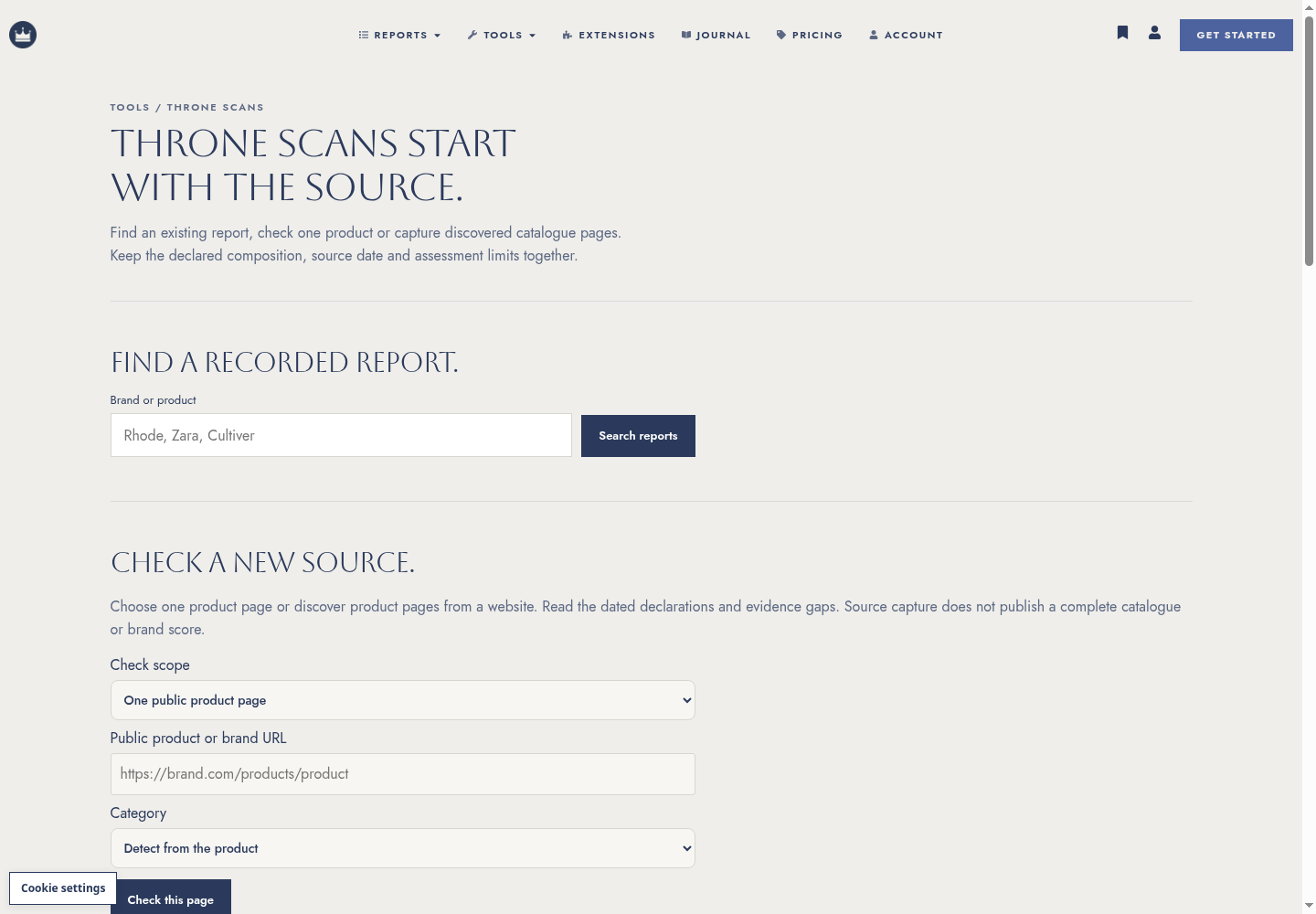
We still miss things, and those gaps need to be fixed. A brand might hide ingredients behind a tab, use an unfamiliar symbol, publish in another language or list a substance we have not yet registered. We use those cases to improve the capture and expand the terms our system recognises. Hard code can have bugs and incomplete rules too, so we still check its output against the source.
Any further AI trial has to prove that it can find information we missed without creating more problems. A suggested source or correction needs to be checked before it changes a record. Missing information stays missing until we can support it. That is the standard the extra layer of verification has to meet.
Do not forget who you are
You already had skills before these tools arrived. You knew how to research, write, calculate, code, design or run your business. You learnt how to spot an answer that did not make sense and where to look for a better one. In our case, it was that judgment that caught a discount being treated as a fibre percentage and a running job being mistaken for progress.
You are still the person qualified to decide whether the job is done. Use the assistant when it saves you work. If it sends you in circles, return to the source, check the calculation or use the process you trusted before AI. You do not owe a chatbot another ten prompts when your own skills can finish the task.