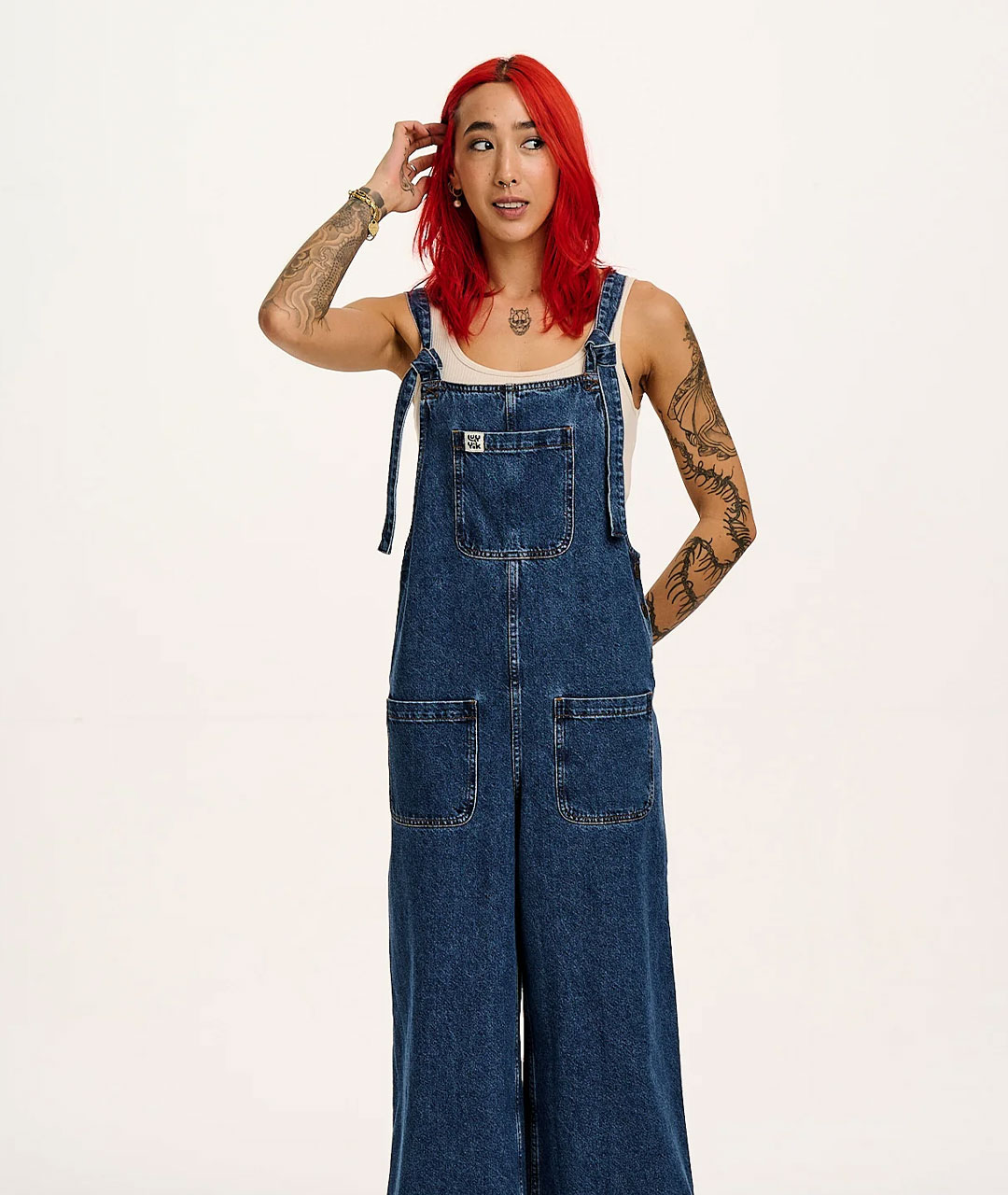
Lucy And Yak Review: Sustainable and Ethically Sourced Chemical Free Demin

Lucy And Yak

Lucy And Yak fibre breakdown, read to the Throne Standard:

These figures come from the 87.5% of Lucy And Yak’s 883-product catalogue that has been read. The remaining 110 products (12.5%) publish no fibre composition anywhere we can read, so they are counted in the catalogue total but sit outside the percentages above, and are listed in full below.

Fibre Styles %
100% plant (organic/regenerative cotton, linen, hemp) 146 70.9%
plant + synthetic blend 27 13.1%
plant + semi-synthetic blend 17 8.3%
100% semi-synthetic 1 0.5%
100% synthetic 15 7.3%
3/5 · Part natural · 70.6% plant fibre · 804 styles scanned
804 styles%
100% plant fibre70.6%
Synthetic25.9%
Semi-synthetic3.5%

804 Styles Scanned

2026-08-04

The full style-by-style breakdown for Lucy And Yak is being added.

About Lucy And Yak

Documented facts (from Lucy And Yak’s own disclosures corroborated by third parties): GOTS/OCS/GRS certifications and OEKO-TEX dyes; Fair Labor Association membership (2023) and Fair Wear membership (2026); Sedex membership and ETI Base Code across suppliers; six-monthly supplier factory assessments; above-minimum-wage pay reported at the Rajasthan factory; and public factory transparency (garment
Lucy And Yak garments are made primarily in India, at a family-run, GOTS-certified, solar-powered factory in Rajasthan run by a supplier (named publicly as Ismail) that makes exclusively for Lucy And Yak; the brand publicly reports this factory pays workers well above the state minimum wage. Secondary production is in Turkey, and there is a small “Made in UK” line sewn in Barnsley. The brand also references China in its early sourcing history. Note: Lucy And Yak’s own current “Our Fabrics” and “Our Suppliers” pages emphasise materials and standards more than naming exact factory countries, but the India/Turkey/UK breakdown is documented in press coverage and independent assessments.
Lucy And Yak is an independent British clothing brand founded in July 2017 in Barnsley, South Yorkshire, by Lucy Greenwood (creative director) and Christopher Renwick (CEO), initially as a direct-to-consumer e-commerce brand selling dungarees. It is not owned by a larger fashion group. In 2025 the founders began transitioning the business to an Employee Ownership Trust: the transition was announced on 13 August 2025, “LUCY & YAK EOT LIMITED” (company #16917729) was incorporated on 17 December 2025, and the move to employee ownership completed in early 2026. The trading company, LUCY AND YAK LTD (Companies House #10850530, incorporated 5 July 2017), remains the operating entity. Lucy Greenwood resigned as a director in July 2025 as part of the succession/employee-ownership plan.
Lucy And Yak is a real, currently-trading, legitimate business. Companies House lists LUCY AND YAK LTD (#10850530) as “Active”, a private limited company incorporated 5 July 2017, registered at Unit 3 Newton Road, Hoyland, Barnsley, S74 0FP, with accounts filed to 31 July 2025 and a confirmation statement dated April 2026. It operates a live e-commerce site plus roughly ten UK physical stores (Brighton, Bristol, Manchester, Edinburgh, Cardiff and others). This is the clothing/dungarees brand, distinct from any same-name entities in other industries.
Lucy And Yak is not conventional fast fashion; it operates as a mid-scale, values-led independent brand closer to the slow-fashion end. It began with 30 pairs of dungarees, produces from a limited number of dedicated supplier factories, uses lower-impact materials (organic cotton, Lenzing EcoVero, linen, deadstock/recycled fabrics), and runs repair and resale programmes to extend garment life. It is a fast-growing brand with frequent new prints and drops, so it is higher-volume than a true small-batch maker, but its sourcing model, certifications and repair/resale schemes distinguish it from fast-fashion mass retailers.
Certifications: Lucy And Yak holds material- and product-level certifications rather than a whole-company certification. Verified: GOTS (Global Organic Textile Standard) for organic cotton, re-certified in 2023; OCS (Organic Content Standard) on some products; GRS (Global Recycled Standard) for its recycled polyester; and it uses OEKO-TEX certified dyes on its organic cotton (meeting REACH chemical limits). On labour standards, Lucy And Yak joined the Fair Labor Association in July 2023 and became a Fair Wear member in January 2026; all suppliers are stated to be Sedex members following the ETI Base Code. NOT held / not documented: B Corp certification, Fairtrade certification, and European Flax certification are not publicly documented for Lucy And Yak..
Lucy And Yak holds the following certifications: Lucy And Yak holds material- and product-level certifications rather than a whole-company certification. Beyond any paper certification, our scan of 206 Lucy And Yak styles found 70.9% is 100% plant fibre, which is the measurable material fact behind Lucy And Yak’s claims.
The most common fibres in the Lucy And Yak styles we read were cotton and bamboo. That composition is the measurable fact behind what Lucy And Yak is made of, so check the specific Lucy And Yak label for any individual piece.
How we scan. Every figure on this page comes from the Throne Standard scan: we read the fibre composition off each live product on the brand’s own site, style by style, and count only single-fibre plant cloth (cotton, linen, hemp) as natural. Animal fibres such as wool, silk and cashmere and plastic-based synthetics such as polyester, nylon and elastane sit outside the plant-fibre figure, and regenerated fibres such as viscose, bamboo, modal and Tencel are counted as semi-synthetic. Percentages are calculated over the styles that state a composition; anything unlabelled is shown separately.

Share this page: Lucy And Yak

Facebook
X
LinkedIn
Reddit
Threads
Email
WhatsApp