Inside the Oliver Messel Houses of Mustique
Seven nights on a private island where the villas run to $43,000 a week, filming inside Flomarine with the butler and the chef, in a house drawn by the theatre designer who built for Princess Margaret and whose fifty year old villas still cool themselves
The first thing Alex tells me about Flomarine is not the price, or the plunge pools, or the five themed bedrooms. It is a love story. “Flomarine originated from the previous owner,” he says, before we have even left the entrance. “His two daughters, Flo and Marina.” The house is named after two little girls, and the softest fact of the day has arrived in the first five minutes.
Alex is the butler and head of staff, and Flomarine is his island’s version of a particular kind of house, one of a small, closed set of villas on Mustique drawn in the Sixties and Seventies, or built in their tradition, by a man who never trained as an architect.
Oliver Messel initially designed for the theatre, not for the home.
He dressed Margot Fonteyn’s Sleeping Beauty at Sadler’s Wells, painted the sets for The Thief of Baghdad, and made worlds that only had to last a season. Then, in his sixties, he moved to the Caribbean and did the same thing to houses that he had done to opera, and quietly solved a problem the rest of luxury travel is only now naming.
I came to Mustique for a week to answer a blunt question, is a billionaire island actually sustainable, and I left facinated over a queer icon and set designer.
Hold The Throne reviews eco luxury stays all over the world, the Four Seasons private island at Desroches, the over water villas at Anantara Kihavah, and few of them are designed with the intelligence of a Messel house.
The Oliver Messel Houses That Invented Mustique
Oliver Messel was the most celebrated British stage designer of his generation, and by the 1960s the most out of fashion.
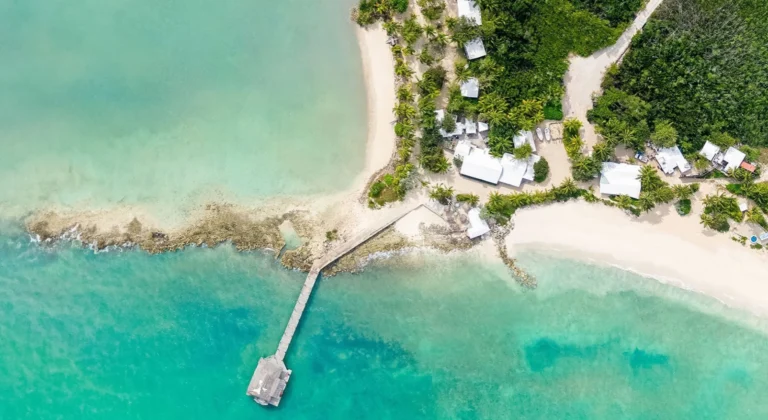
Taste had turned to realism, and his romantic, escapist worlds no longer belonged on the stage. So he took them to the Caribbean instead. He had already transformed houses in Barbados when the developer Colin Tennant asked him to invent a look for a scrubby, near empty island called Mustique.
What he built was, in Tennant’s words, an invention, like Treasure Island.
Between 1960 and 1978 Messel drew around thirty house plans, of which over eighteen were built, a small and deliberate body of work that will never grow, because there will never be more Messel houses.
Oliver’s first Mustique commission was the Cotton House hotel in 1970. The house that set the island’s whole visual language, though, was Les Jolies Eaux, the villa Tennant built as a wedding gift for Princess Margaret, completed in 1972 and drawn by Messel, who happened to be Lord Snowdon’s uncle. Coral stone balustrades, plantation shutters, lily pools, a theatrical neo Georgian style that fused eighteenth century Europe with the tropics. Everything that came after, Clonsilla, Blue Waters, Sea Star, Point Lookout, and the villas built in the school like Flomarine, speaks that language.
Inside the Oliver Messel Style, More Windows Than Walls and Messel Green
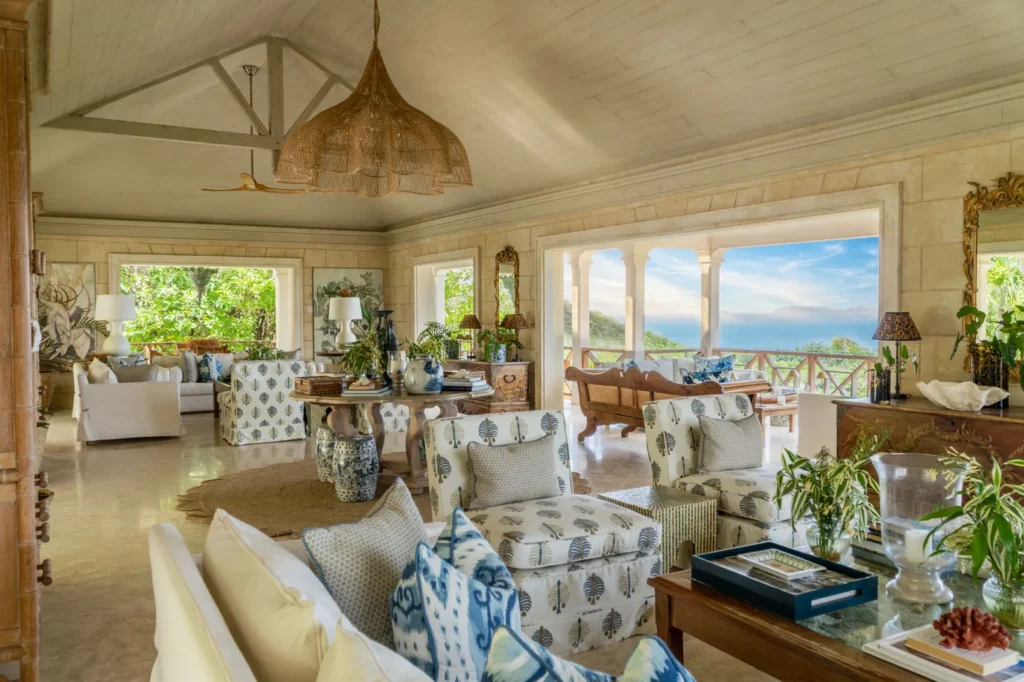
There is a line people use to describe a Messel house in one breath, that there are more windows than there are walls, and it is almost literally true.
He wanted a room to feel bigger, brighter and more magical than its walls allowed, and he had a lifetime of theatrical trickery to do it with. Slender Greek columns and flattened Georgian arches.
Plaster mouldings and gingerbread fretwork, the wooden latticework that reads like lace. A front door positioned to look straight through the house to the sea beyond, so you walk in and the view is framed like a painting. White on white to make a space feel endless, and painted concrete floors passed off as marble.
Messel Green Bedroom Interior Design
His colour was green, a soft minty sage the whole Caribbean now calls Messel Green, though on Mustique he reached for vivid tropical yellows too, chosen so the houses melted into the foliage rather than sat on top of it. He had Rousseau style jungle grown right up to the windows. His favourite trick, one designer remembered, was to suggest there might be an even grander house round the corner. There never was. That was the theatre.


You see all of Oliver Messels style Flomarine once you know to look.
The slender columns and flattened arches, the jalousied shutters that move air but keep the sun out, the terraces off every bedroom, a skylight over the master, walls that stop being walls. Every room I filmed was flooded with light, so much that I kept asking Alex to adjust the lamps because the daylight was outshining my camera. We love light, we live in light, and this house was drawn by someone who felt the same.
How an Oliver Messel House Cools Itself, No Doors, Just Breeze
We were standing in the main living room when I noticed there was nothing to close. No doors, just openings.
“Just open concept,” Alex said. I asked if there was a benefit. “Yeah. Get the cool breeze.”
That is the whole answer, and it is the engineering hiding inside the beauty. Messel merged inside and outside on purpose, doorways and windows placed to pull the trade winds straight through the house, deep eaves and shutters to keep the sun off. He came to it as illusion, a stage set for the performance of social life, and told an interviewer he “attempted every device to make as much magic as possible.” But a house drawn to catch the breeze is a house that barely needs air conditioning, and Messel was doing passive climate design decades before the phrase existed, for entirely theatrical reasons. On an island still fighting to run on less diesel, that fifty year old trick of light and breeze is the greenest thing standing.
The house even keeps its own past. In the boot room Alex showed me the original plan, framed and kept through every renovation. “Oliver built a lot of these houses,” he said. “But this is just the original plan that was kept.” Beside it, the previous owner’s original decorative work, also kept. Repair and keep, rather than gut and replace, which is its own quiet sustainability.
The Garden of an Oliver Messel Villa, Everything From the Next Island Over
The plants were the first thing I checked, the way I check the landscaping at every stay we review, because imported ornamentals shipped in for the look are one of the quiet tells of a place that only performs sustainability. Alex walked me through the beds by the entrance.
“These are some local plants that we source from Saint Vincent,” he said. “We tend to support local here at Flomarine.” Saint Vincent is the main island of the country Mustique belongs to, two hours away by boat, and the garden is stocked from there, not from a nursery in Florida. He named them one by one. “We have some red foxtail, as we like to call them.” A dry looking shrub I would have walked straight past, “these are very dry season resistant, it’s a ficus.” A plant with white flowers called lady of the night, because “at night, these white flowers, they give off a sweet aroma, like a perfume.”
And then the neem trees. “Sometimes, if you’re feeling toxic, you can take a few leaves, dry them, boil them and drink them,” Alex said, a folk cleanse locals use, not the guests. I am reporting it as what he told me, not as medical advice. But a villa where the butler can tell you which tree on the lawn makes the bitter tea is exactly the detail we look for and rarely find at a stay this expensive. Alex’s line about the ficus is the real tell: on a naturally dry island of scrub and cactus, the homeowners plant for the climate they actually have, not the one on the postcard.
Inside an Oliver Messel Eco Luxury Villa, the Chef and the Local Market
Chef Loretta has cooked on this island for over twenty years and fed parties of a hundred, and she buys almost everything off the same boat as the garden. “It is all grown locally,” she told me while she seasoned the vegetables. “Most of our fruits and vegetables come from Saint Vincent. They come to the market here, and then we buy them.”
The meal she made while we filmed was built from exactly that, the rocket, the beetroot she pureed, the carrots, red onions and peppers she grilled beside the lamb, market produce carried over the water rather than flown in from Miami. Local goat, local beef, fish from these waters, lobster only in season, conch if you ask. She started in the hotel system and prefers a private villa. “Here you can explore, create new things to give the guests new things every day.”
When she made her arugula salad I asked for a version without the parmesan so I could eat it, and she plated two without a pause. Plant based guests are not an inconvenience here, they are Tuesday. Her signature is rack of lamb in herb breadcrumbs with beetroot puree, and when I asked why lamb, she said, “it’s just very beautiful when it’s on the plate.” The detail that undid me, though, was the ice cream. Past the four ovens, Alex pointed at the machine. “We can also make local ice cream for you. Guava, soursop, banana, papaya, whatever you like.” Local fruit, churned in the house. A shorter supply chain than my ice cream has in London.
Is Mustique Sustainable, the Conservation Island Behind the Messel Houses
I did not know, while I was filming, that the whole of Mustique is a legal conservation zone, covering the entire island and 1,000 yards of sea as a no take reserve.
I found out while i was walking around Lagoon beach, after snorkling and noticed the signs about conservation, bird watching and mangroves.
This confirms that what I had seen at Flomarine was a one off. It is not.
Since 2015 the island has out planted over 10,000 coral fragments from underwater nurseries, it monitors Hawksbill and Leatherback turtle nests through the season, composts its organic waste, crushes glass on island for aggregate, folds washed up sargassum into the compost, and stopped handing out plastic and paper bags at the shops entirely.
Now the fine print, because I always read it. The island still runs mostly on diesel, only about 15% renewable today, with a published plan to reach 70% solar that has not landed yet. Fifteen percent is a start, not a medal, and you do not get gold medals for saying please and thank you. So no, Mustique is not the Throne Standard on energy. It is something rarer, an island of extreme wealth that has quietly made conservation the rule rather than the marketing, and a set of houses that were accidentally sustainable half a century before anyone was selling it.
What It Costs to Stay in an Oliver Messel Villa on Mustique


Flomarine runs from around $31,000 per week for the whole villa, sleeping ten across five en suite bedrooms with a staff of four including Alex and Loretta, rising toward $43,000 in high season before taxes (current rates on the Mustique website).
Split ten ways in low season that is roughly $440 per person a night, staffed and fed, the price of a good city hotel suite, in a Messel school villa on a conservation island. It is the top of the market and I will not pretend otherwise.
If your budget lives elsewhere, Frangipani Eco Lodge in Barbuda is the off grid, solar powered opposite pole of the same Caribbean, and our verified eco stays cover everything in between across the Caribbean.
Why the Oliver Messel Houses Still Matter
We were wrapping up by the dining area when I stopped mid sentence. “Oh. One sec. There’s a turtle. Go go go.”
And we ran, camera swinging, after a tortoise crossing the garden at dusk, off to tuck itself in for the night. It felt like the island summing itself up. I came to film a luxury villa and ended the day chasing a reptile across the lawn with the butler, in a house a theatre designer drew to breathe on its own.
The tortoises are everywhere on Mustique once you start looking, ambling along the road edges like they hold shares in the place. I did not spot a single famous face all week.
I lost count of the tortoises. There will never be more than eighteen or so of these Messel houses, and Flomarine carries their whole idea, that the smartest luxury is the kind that works with the climate instead of against it. See one while they stand.