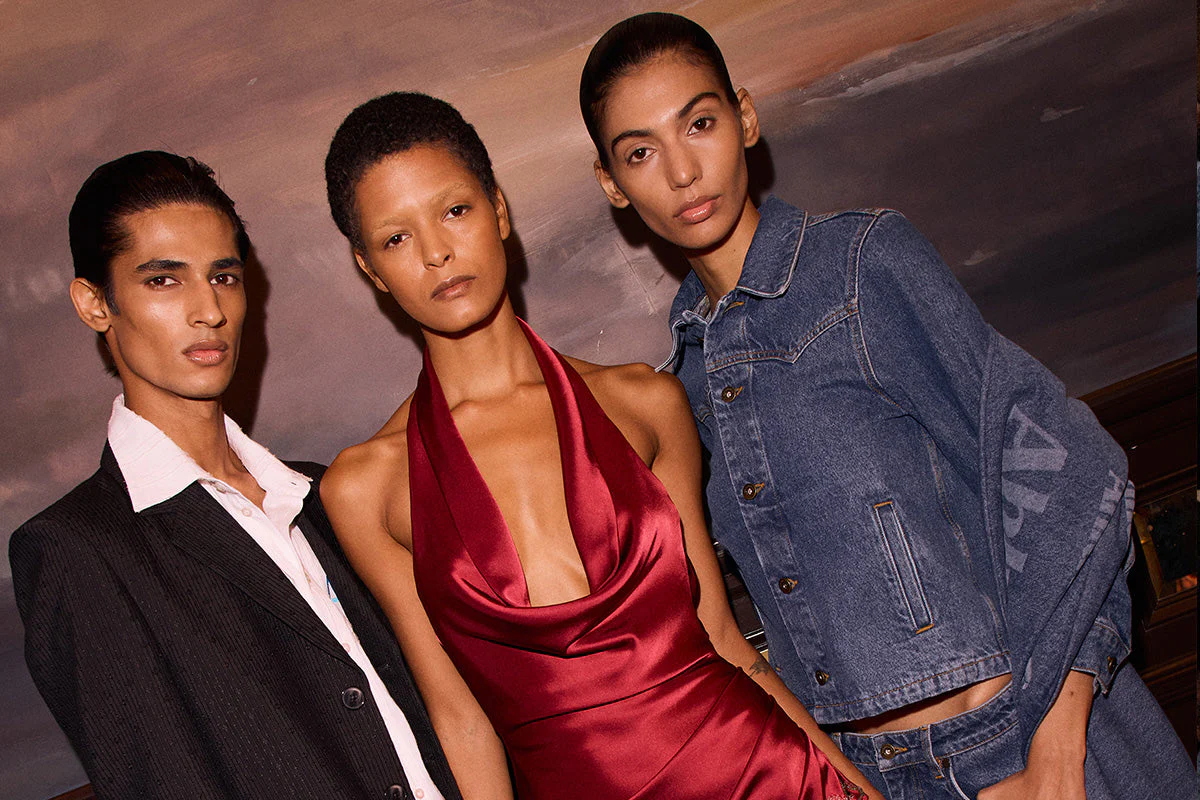
Ahluwalia

Ahluwalia sells clothes with 37.5% natural plant fibre material across 40 scanned styles. The rest breaks down as 2.5% animal fibre, 35.0% synthetic, 20.0% semi-synthetic and 5.0% with no stated composition.

2026-07-14

The full style-by-style breakdown for Ahluwalia is being added.

About Ahluwalia

Ahluwalia is not clearly sustainable on materials: our scan of 40 styles found 37.5% plant fibre (35.0% synthetic). Documented facts (verifiable): Ahluwalia’s business is built on upcycling deadstock, vintage, surplus and post-consumer materials, a positioning consistently reflected in independent press, its runway shows and awards (H&M Design Award, LVMH Prize finalist, QEII Award for British Design, BFC/GQ Menswear Fund). It publishes a Modern Slavery Statement disclosing an eight-country sourcing footprint a
Ahluwalia does not publicly state a single “made in” country for its garments. In its own Modern Slavery Statement the brand says it “sources goods and services from the United Kingdom, Italy, Turkey, China, India, Tunisia, Ukraine and The Netherlands,” and its Values page states garments “are made at female-owned factories” using surplus, post-consumer, recycled and organic materials. The specific country or factory of final garment assembly is not publicly documented, so it should be treated as a self-reported sourcing footprint rather than a confirmed single manufacturing location.
Ahluwalia is an independent, designer-owned London fashion label founded in 2018 by British designer Priya Ahluwalia (born December 1992), who created it immediately after completing her MA in Menswear at the University of Westminster. It is not owned by any parent group or conglomerate; Priya Ahluwalia is the founder and creative director and is the named director of the UK operating companies behind the brand, including AHLUWALIA STUDIO LIMITED (company no. 11509855, incorporated 9 August 2018, SIC 46420 “wholesale of clothing and footwear”), AHLUWALIA LIMITED (13503836) and AHLUWALIA WORLD LIMITED (14947253), all currently listed as Active at UK Companies House. The brand draws on Priya Ahluwalia’s dual Indian-Nigerian heritage and London roots.
Ahluwalia is a real, currently trading, legitimate business. It is an established London-based fashion house that showed its Spring/Summer 2026 collection “Affinity” at London Fashion Week in September 2025 (covered by WWD, Hypebeast and others) and released a PUMA collaboration in late 2025. Its UK operating companies are registered and Active at Companies House, and founder Priya Ahluwalia has won documented industry honours including the H&M Design Award (2019), LVMH Prize finalist (2020), the Queen Elizabeth II Award for British Design (2021) and the BFC/GQ Designer Menswear Fund (2021). Not defunct or dormant as a brand.
Ahluwalia is a slow-fashion, small-batch designer label, not fast fashion. It operates on a seasonal runway/ready-to-wear model built around upcycling: the brand is documented as working with deadstock fabrics, vintage and surplus textiles, patchwork and one-of-a-kind pieces, with research trips to garment-recycling hubs such as Panipat, India and Lagos, Nigeria. It produces limited designer collections rather than high-volume, rapid-turnover fast-fashion ranges.
Ahluwalia is a mixed bag for non-toxicity: 37.5% of its range is plant fibre that breathes and biodegrades, with 35.0% plastic-based synthetics that can shed microplastics. Certifications: Ahluwalia holds no verifiable third-party sustainability certifications. No GOTS, OEKO-TEX, Fair Trade, B Corp or European Flax certification for Ahluwalia could be confirmed from the brand’s own site (Values, About, Modern Slavery and Sustainability statements) or any reliable independent source. The brand’s Modern Slavery Statement notes it has been “introduced to” the Sedex responsible-sourcing platform and is “looking at adopting” it, but that is a monitoring tool and stated as not-yet-adopted, not a certification. Press coverage of the SS26 “Affinity” collection references “certified viscose and wools,” but no specific certifying body (e.g. FSC, LENZING, RWS) is named, so this cannot be verified. Verifiable certifications: Not publicly documented / none confirmed..
Ahluwalia holds the following certifications: Ahluwalia holds no verifiable third-party sustainability certifications. Beyond any paper certification, our scan of 40 Ahluwalia styles found 37.5% is 100% plant fibre, which is the measurable material fact behind Ahluwalia’s claims.
Our scan of 40 Ahluwalia styles found 37.5% is 100% plant fibre, 2.5% animal fibre, 20.0% semi-synthetic (such as bamboo viscose), 35.0% synthetic, 5.0% with no stated composition. The most common fibres in the Ahluwalia styles we read were cotton and bamboo. That composition is the measurable fact behind what Ahluwalia is made of, so check the specific Ahluwalia label for any individual piece.
How we scan. Every figure on this page comes from the Throne Standard scan: we read the fibre composition off each live product on the brand’s own site, style by style, and count only single-fibre plant cloth (cotton, linen, hemp) as natural. Animal fibres such as wool, silk and cashmere and plastic-based synthetics such as polyester, nylon and elastane sit outside the plant-fibre figure, and regenerated fibres such as viscose, bamboo, modal and Tencel are counted as semi-synthetic. Percentages are calculated over the styles that state a composition; anything unlabelled is shown separately.

Share this page: Ahluwalia

Facebook
X
LinkedIn
Reddit
Threads
Email
WhatsApp