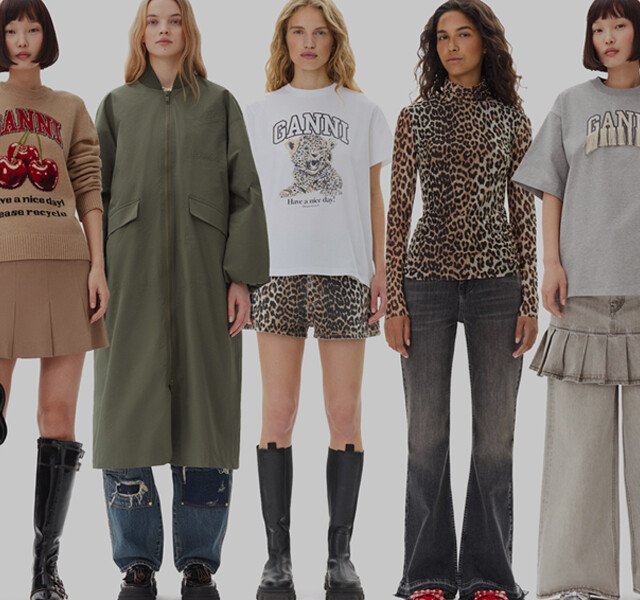
Ganni

Ganni sells clothes with 42.5% natural plant fibre material across 40 scanned styles. The rest breaks down as 17.5% animal fibre, 35.0% synthetic, 2.5% semi-synthetic and 2.5% with no stated composition.

2026-07-14

The full style-by-style breakdown for Ganni is being added.

About Ganni

Ganni is partly sustainable on materials: our scan of 40 styles found 42.5% plant fibre (35.0% synthetic). DOCUMENTED FACTS: B Corp certification (2022, score 90.6, recertified 105.3) is a verifiable third-party assessment listed on B Lab. Multi-country outsourced manufacturing (eight countries) and denim traceability work (partnership with Provenance for supply-chain tracing) are documented. Ganni publishes annual Responsibility Reports and a supplier list. MARKETING CLAIMS / CAVEATS TO TREAT WITH CAR
Ganni does not own factories; it outsources production to third-party manufacturing partners across at least eight countries: Bulgaria, China, Greece, India, Italy, Portugal, Spain and Turkey. Reporting indicates the bulk of garment production is concentrated in China, Turkey and India, with some EU production in Portugal, Spain and Italy. Ganni’s denim specifically is made and sourced in Turkey. Ganni publishes a supplier/facility list on its corporate website as part of its transparency reporting.
Ganni is a Danish fashion brand founded in 2000 in Copenhagen by gallerist Frans Truelsen as a cashmere apparel line; it was taken over in 2009 by Nicolaj Reffstrup (CEO) and his wife Ditte Reffstrup (creative director), who reshaped it into the contemporary designer label it is today. Ganni is NOT independent: US private-equity firm L Catterton (a partnership involving Catterton, LVMH and Groupe Arnault) acquired a majority 51% stake in December 2017, with the Reffstrups retaining a minority holding. Laura du Rusquec (former Balenciaga deputy CEO) was appointed CEO in 2024. As of 2025, L Catterton was reported to be preparing to sell its majority stake (valuation figures of up to roughly 700m USD / DKK 2bn cited), so ownership may change. The legal entity is Ganni A/S, headquartered in Copenhagen, Denmark.
Yes. Ganni is a real, currently-trading, legitimate business. It is actively operating in 2025: it runs 70+ stores worldwide, opened new stores in 2025 (Amsterdam, Chicago, Manila), presented its Autumn/Winter 2025 collection at Paris Fashion Week, made new senior executive appointments, and continues to sell via ganni.com (cited around 38m USD e-commerce revenue in 2025). 2024 revenue was reported at DKK 1,331m (+10% YoY). This is unambiguously the Danish clothing/fashion brand, not a same-name business in another industry.

Ganni occupies a contested “grey area” rather than being clearly slow or clearly fast fashion. It positions itself as a contemporary / “affordable luxury” Scandinavian label and produces some capsule and classic pieces, and notably does NOT market itself as a “sustainable” brand (it uses the framing “more responsible” and “progress over perfection”). However, it draws fast-fashion-adjacent criticism because it releases roughly 8 to 10 collections/trend-driven drops per year, a rapid, trend-responsive production cycle that critics argue encourages overconsumption regardless of material choices. It is not a traditional ultra-cheap fast-fashion retailer (higher price point, outsourced but partly EU/traceable production), but it is more accurately “high-volume contemporary” than slow or small-batch.
Ganni is a mixed bag for non-toxicity: 42.5% of its range is plant fibre that breathes and biodegrades, with 35.0% plastic-based synthetics that can shed microplastics. Certifications: Ganni’s headline verified certification is B Corp: the company (Ganni A/S) became a Certified B Corporation on 17 August 2022 with an initial B Impact score of 90.6, and later recertified with a higher score of 105.3 out of 200 (Environment 51.3, Governance 16.6, Workers 16.1, Community 16.5, Customers 4.7). At initial certification it was cited as the highest-scoring contemporary fashion brand. At the product/material level, secondary sources (Panaprium) report Ganni uses fibres/inputs certified to GOTS (organic textiles), GRS (Global Recycled Standard), RWS (Responsible Wool Standard) and FSC; these are material certifications rather than facts confirmed on Ganni’s own certification landing page, so treat that specific list as product-input claims. No Fair Trade or European Flax certification is documented. OEKO-TEX is not confirmed for Ganni specifically..
Ganni holds the following certifications: Ganni’s headline verified certification is B Corp: the company (Ganni A/S) became a Certified B Corporation on 17 August 2022 with an initial B Impact score of 90. Beyond any paper certification, our scan of 40 Ganni styles found 42.5% is 100% plant fibre, which is the measurable material fact behind Ganni’s claims.
Our scan of 40 Ganni styles found 42.5% is 100% plant fibre, 17.5% animal fibre, 2.5% semi-synthetic (such as bamboo viscose), 35.0% synthetic, 2.5% with no stated composition. The most common fibres in the Ganni styles we read were cotton and wool. That composition is the measurable fact behind what Ganni is made of, so check the specific Ganni label for any individual piece.
How we scan. Every figure on this page comes from the Throne Standard scan: we read the fibre composition off each live product on the brand’s own site, style by style, and count only single-fibre plant cloth (cotton, linen, hemp) as natural. Animal fibres such as wool, silk and cashmere and plastic-based synthetics such as polyester, nylon and elastane sit outside the plant-fibre figure, and regenerated fibres such as viscose, bamboo, modal and Tencel are counted as semi-synthetic. Percentages are calculated over the styles that state a composition; anything unlabelled is shown separately.

Share this page: Ganni

Facebook
X
LinkedIn
Reddit
Threads
Email
WhatsApp