Mate The Label

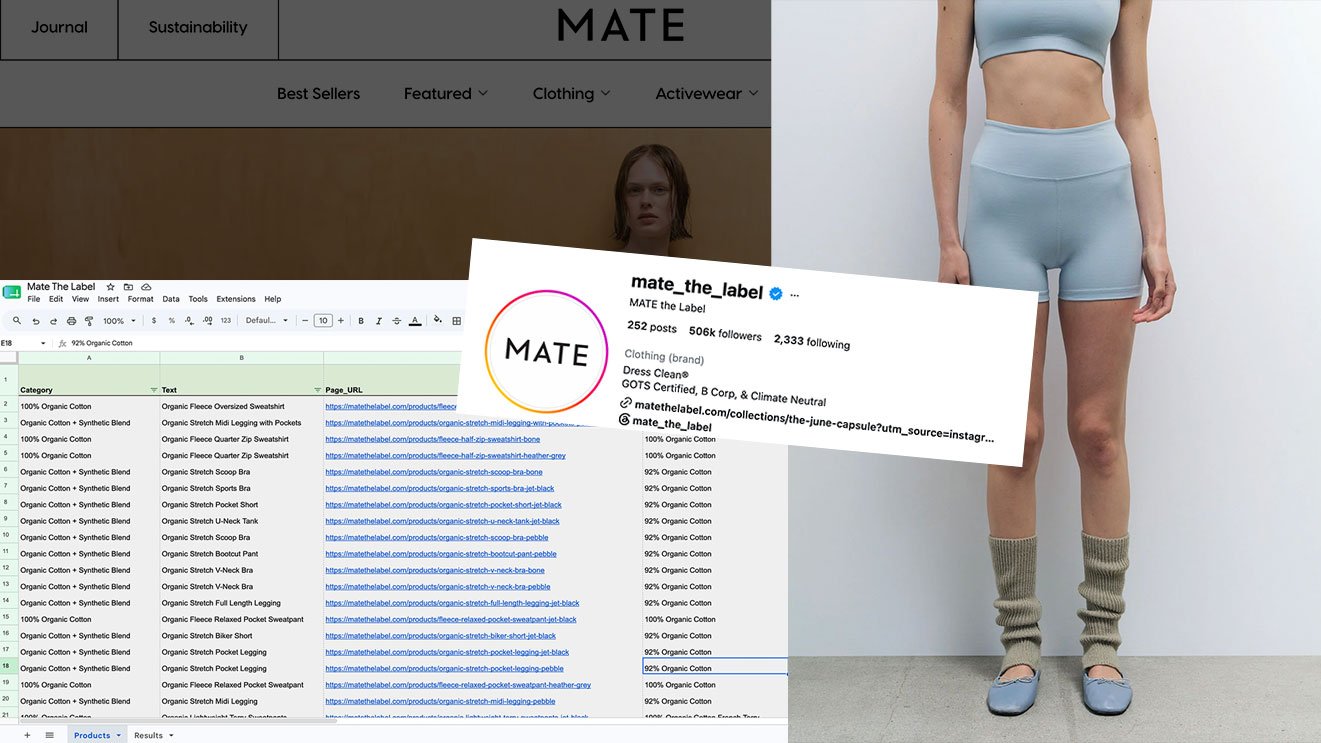
MATE the Label sells clothes with 58.4% natural plant fibre material across 106 scanned styles. The rest breaks down as 0.0% animal fibre, 33.0% synthetic, 1.9% semi-synthetic and 16.0% with no stated composition.

2026-06-14

The full style-by-style breakdown for Mate The Label is being added.

About MATE the Label

MATE the Label is partly sustainable on materials: our scan of 106 styles found 58.4% plant fibre (33.0% synthetic). Documented facts (independently verifiable): B Corp certification via B Lab (score 84.4, April 2023); Climate Neutral/Climate Label certification; GOTS-certified organic cotton and GOTS-approved dyes; local LA manufacturing with named factory partners; use of TENCEL and organic/plant-based fibers; plastic-free/recycled packaging. Documented gaps and criticisms (from Ecolife’s assessment): MATE lac
MATE the Label garments are cut, sewn, and dyed in Los Angeles, California, USA, with the brand stating manufacturing occurs within roughly a 15-mile radius of its LA headquarters. Independent reporting (Ecolife brand report) names LA production partners including Mola, Inc., Ghlee Apparel, Inc., and Thienes Apparel, Inc., with some organic knit production via Grupo ITV in Peru. Raw materials are sourced internationally: organic cotton from India (Maharashtra), linen, and TENCEL lyocell from Austria.
MATE the Label is an independent, founder-owned Los Angeles apparel company founded in 2013 by Kayti O’Connell Carr (also styled Kayti Carr), who remains Founder/CEO. It grew out of her earlier vintage clothing line, MATE Vintage. It is privately held and operates as an independent brand, not a subsidiary of any parent company or fashion conglomerate. (Note: it is unrelated to same-name entities in other industries; this is the LA sustainable clothing brand at matethelabel.com.)
MATE the Label is a real, currently-trading, legitimate business. Its website (matethelabel.com) is live and selling as of July 2026, it maintains an active LA/Culver City physical shop presence, an active LinkedIn company page, and a current B Lab Certified B Corporation listing. There is no indication of closure, bankruptcy, or dormancy.
MATE the Label is slow / small-batch fashion, not fast fashion. It operates a limited “clean essentials” range built on a deliberately narrow fiber portfolio (organic cotton, linen, TENCEL), localized LA manufacturing, and circularity programs (repair, resale, and a textile take-back/recycling scheme it calls reMate). It does not follow the high-volume, rapid-drop, low-cost model characteristic of fast fashion.
MATE the Label is a mixed bag for non-toxicity: 58.4% of its range is plant fibre that breathes and biodegrades, with 33.0% plastic-based synthetics that can shed microplastics. Certifications: MATE the Label is a Certified B Corporation (certified April 2023, reported B Impact Score of 84.4) and is Climate Neutral / Climate Label certified. It uses GOTS-certified organic cotton and GOTS-approved organic dyes. A supplier (Grupo ITV, Peru) reportedly carries Fair Trade certification for some organic knit production. It does NOT appear to hold OEKO-TEX STANDARD 100, ZDHC/bluesign wastewater certifications, or European Flax certification (its linen sourcing is not European Flax certified per available reporting). “Not publicly documented” for any OEKO-TEX or European Flax certification at the brand level..
MATE the Label holds the following certifications: MATE the Label is a Certified B Corporation (certified April 2023, reported B Impact Score of 84. Beyond any paper certification, our scan of 106 MATE the Label styles found 58.4% is 100% plant fibre, which is the measurable material fact behind MATE the Label’s claims.
Our scan of 106 MATE the Label styles found 58.4% is 100% plant fibre, 1.9% semi-synthetic (such as bamboo viscose), 33.0% synthetic, 16.0% with no stated composition. The most common fibres in the MATE the Label styles we read were cotton and linen. That composition is the measurable fact behind what MATE the Label is made of, so check the specific MATE the Label label for any individual piece.
How we scan. Every figure on this page comes from the Throne Standard scan: we read the fibre composition off each live product on the brand’s own site, style by style, and count only single-fibre plant cloth (cotton, linen, hemp) as natural. Animal fibres such as wool, silk and cashmere and plastic-based synthetics such as polyester, nylon and elastane sit outside the plant-fibre figure, and regenerated fibres such as viscose, bamboo, modal and Tencel are counted as semi-synthetic. Percentages are calculated over the styles that state a composition; anything unlabelled is shown separately.

Share this page: Mate The Label

Facebook
X
LinkedIn
Reddit
Threads
Email
WhatsApp