Best Eco Stays in Dominica

Where to stay in Dominica by area, with the best sustainable hotel in each region and honest, practical advice on getting around, safety and when to go. Plan your trip.

Where to stay in Dominica

The best areas to stay in Dominica range from an off grid cliffside lodge perched above the sea, to a beachfront eco resort and spa, and a secluded oceanfront estate hidden among the rainforest. Options are spread from Soufriere, Rosalie to Portsmouth. Every stay we recommend below is genuinely sustainable and chosen so your money stays on the island.

Where to stay in Dominica by area, at a glance

Area
Best for
The vibe
Our sustainable pick
AreaSoufriere
Best forcouples and divers wanting calm Caribbean water and hot springs
The vibesleepy southwest fishing bay with warm volcanic waters
Our sustainable pickCoulibri Ridge
AreaRosalie
Best fornature lovers and walkers chasing the wild, untamed side
The viberugged Atlantic east coast, rivers, rainforest and pounding surf
Our sustainable pickRosalie Bay Eco Resort & Spa
AreaPortsmouth
Best forfirst-time visitors wanting a lively northern base and easy day trips
The vibethe relaxed second town, river trips and the north’s natural sights
Our sustainable pickSecret Bay

Soufriere is best for couples, divers, snorkellers and slow travellers wanting calm Caribbean water and volcanic hot springs

Soufriere sits on the sheltered southwest coast of Dominica, roughly a 1 hour 45 minute to 2 hour drive from the main Douglas-Charles airport (DOM) or about 20 to 30 minutes from the smaller Canefield airstrip and the capital Roseau. Taxis are the usual way to arrive and a hire car is best for exploring at your own pace. It is a quiet fishing village wrapped around a bay famed for its bubbling underwater hot springs, world class diving and the Scotts Head peninsula, suiting couples, divers, snorkellers and anyone after a slow, local rhythm rather than resort buzz.

The difference between Soufriere and other popular Dominica bases like Roseau and Portsmouth is that Soufriere stays small and village quiet, with the marine reserve and geothermal springs on its doorstep, whereas Roseau gives you the bustle of the capital and its restaurants and Portsmouth leans on the Indian River and Cabrits in the north, so Soufriere is the pick when you want water, warmth and calm over town life.

Where to stay in Soufriere: Top Pick

Coulibri Ridge is the best place to stay in Soufriere, Dominica

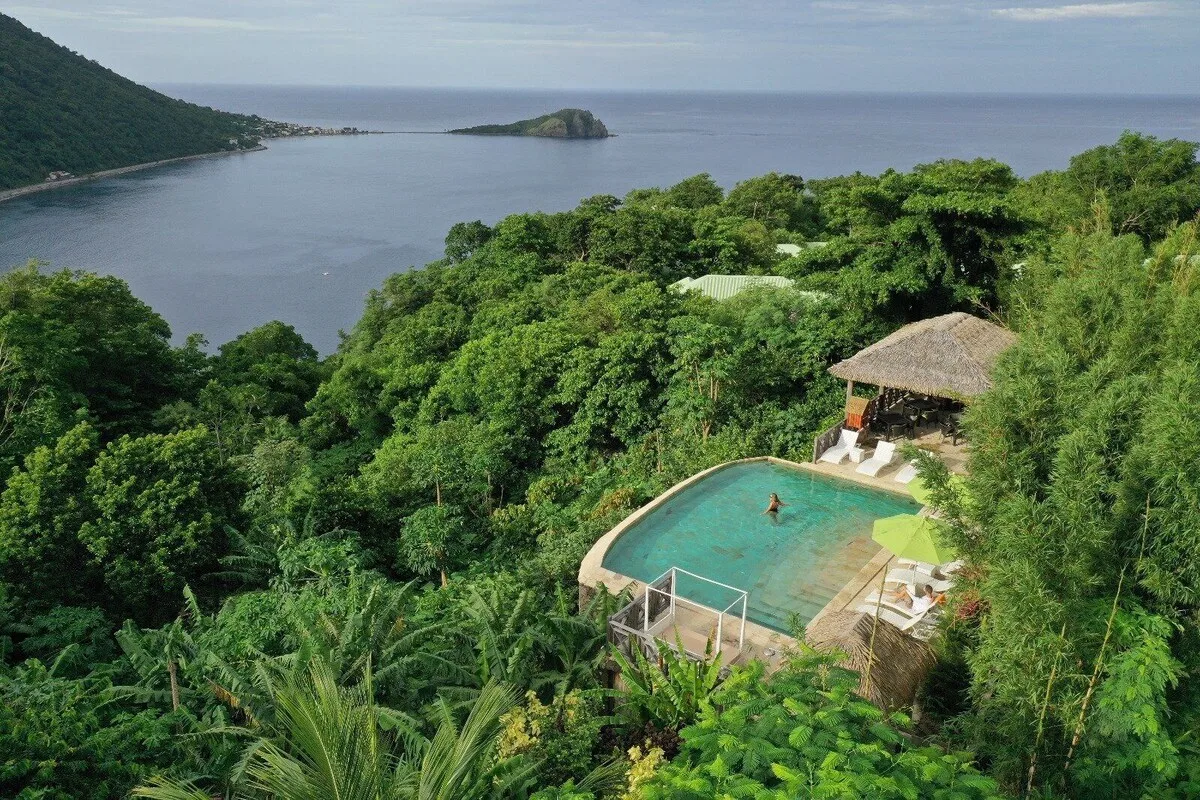
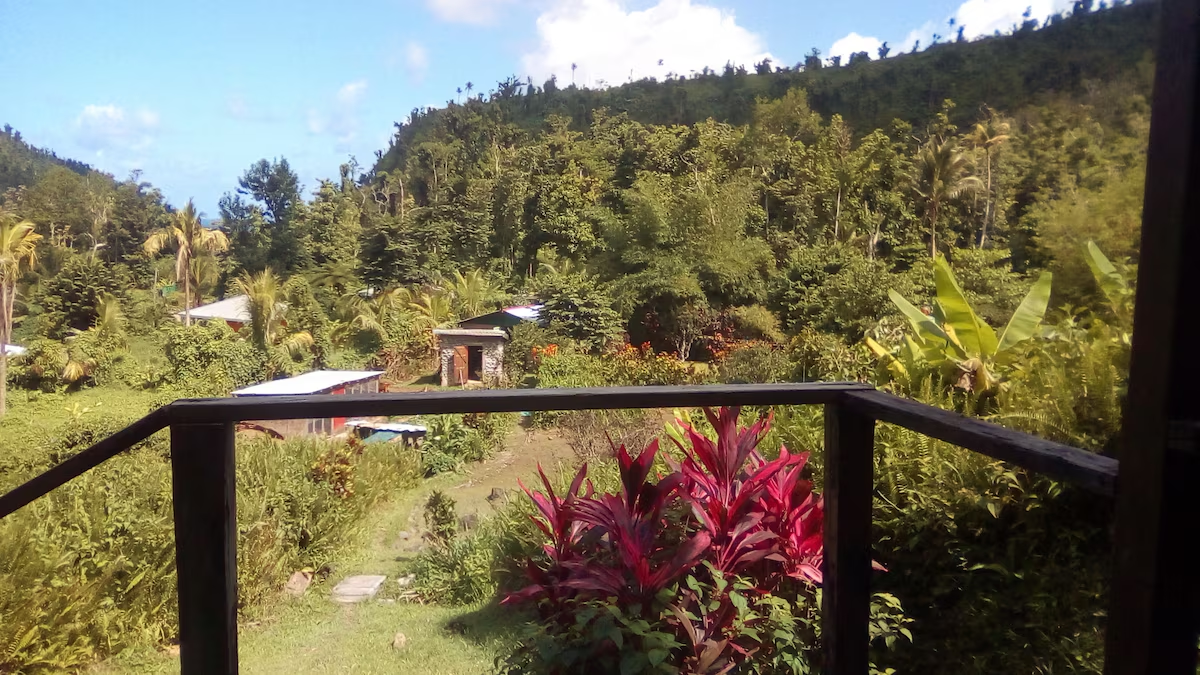
Coulibri Ridge sits high on a ridge above Soufriere as a fully off grid eco resort, a 14 suite property woven into tropical wilderness, mature gardens and the romantic ruins of an eighteenth century estate. Built from recycled timber and locally quarried stone, the buildings feel as though they have grown out of the hillside rather than been dropped onto it, with sweeping views across the sea and the surrounding peaks and open air spaces that catch the trade winds. The setting is the real luxury here, a place designed to slow you down rather than fill every hour.

Who owns Coulibri Ridge?

Coulibri Ridge is independently owned and operated, the result of a long term private vision to build a genuinely self sufficient property on a wild stretch of Dominica’s southwest coast. That independence shows in the detail of the place, from the salvaged materials to the closed loop power and water systems. It is reflected too in the resort holding the distinction of being the first Caribbean member of Beyond Green, the global collection of properties chosen for their sustainability leadership.

About the rooms in Coulibri Ridge

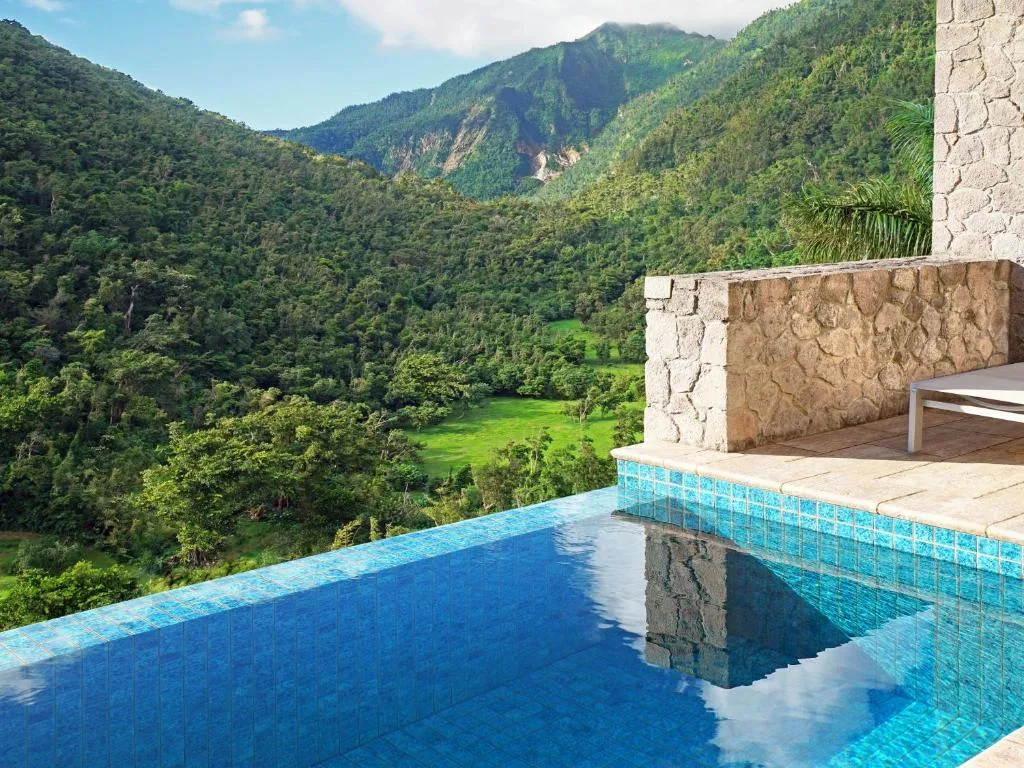
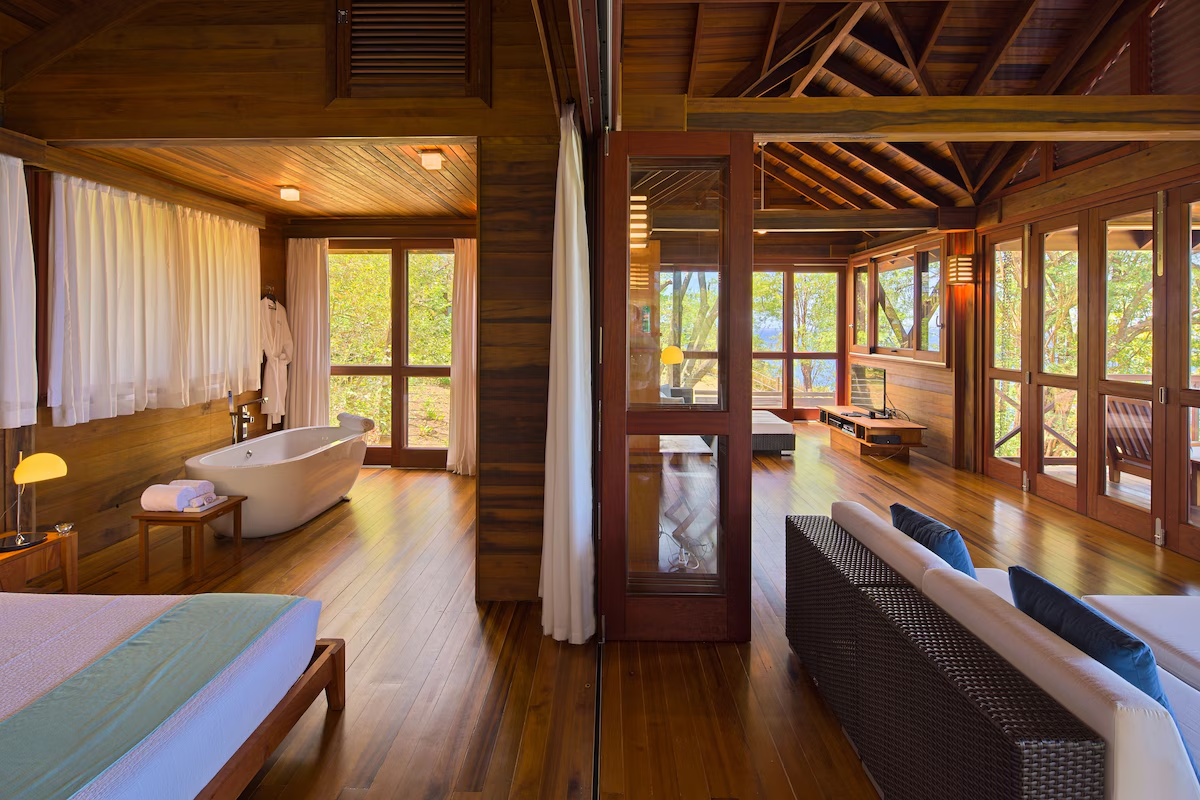
There are just 14 air conditioned suites at Coulibri Ridge, including studios and two storey duplexes set along the ridge, running from a generous 930 square feet to 1,550 square feet (86 to 144 square metres), so even the smallest unit is larger than most Caribbean hotel rooms. The categories are the Seaview Studio, which faces south with a large terrace and looks across the water to Martinique, the Morne Fou Loft with valley views from the bedroom, and the duplex Sky Penthouses, the largest suites on the property at around 1,000 square feet. The penthouses face north over the Sulphur Spring Valley, and of the seven duplex suites four have an outdoor rain shower while three come with a private infinity pool.

The layout is built mainly for couples, with the private pool penthouses the most family friendly option. Chlorine free pools, copper and UV purified rainwater and battery and solar power carry right through the suites. Because this is a remote, off grid ridge top property reached by steep mountain road, it suits adults and couples seeking seclusion rather than families wanting a beachfront base.

What food is available at Coulibri Ridge?

The dining room leans on the island around it, drawing on local produce and Dominica’s deep Creole traditions for menus that change with what is fresh and in season. Dishes celebrate the volcanic soil and the surrounding farms and waters, so you eat with the island rather than against it. The daily rhythm of meals folds naturally into days that drift between the pools, the gardens and the views.

Sustainability features of Coulibri Ridge

The resort runs on more than 250 solar panels feeding batteries banked on site, supplemented by two vertical axis wind turbines designed to spare local birds and bats. Every drop of water is rainwater, collected on site and purified by ultraviolet light and copper ionisation before it reaches the suites and the chlorine free pools, with runoff from the terraces and walkways put back to work watering the gardens. It is a genuinely closed loop way of living lightly on a wild coast, with the eco credentials forming the engine of the resort rather than an afterthought.

Who is Coulibri Ridge for?

This is a place for couples and conscientious travellers who want barefoot luxury, sweeping island views and a clear conscience, all in one place. It suits honeymooners, slow travellers and nature lovers above all, with active families with older children also finding plenty to fill the days. The quiet, romantic mood means it leans away from those wanting nightlife or a busy resort scene.

How to get to Coulibri Ridge from the airport

The closest airport to Coulibri Ridge is Douglas-Charles Airport (DOM) on the northeast coast of Dominica, a scenic drive of roughly two hours and around 60 kilometres down to the southwest and the Soufriere area, winding through rainforest and mountain villages along the way. The smaller Canefield Airport (DCF) near Roseau is closer at around an hour, though it handles only limited regional flights.

Private transfer or taxi to Coulibri Ridge

A pre arranged private transfer is the easiest option to get to Coulibri Ridge, and most guests use the resort’s own transfer service, which is offered to and from Douglas-Charles Airport. The final climb up to the ridge top is steep and best left to a local driver who knows the road, so the property coordinates this for you and you are met on arrival. Standard island taxis also run from both airports, though for the last stretch a transfer arranged through the resort is the smoothest option.

Public transport to Coulibri Ridge

Public transport to Coulibri Ridge is possible with multiple changes. Dominica’s network runs on shared minibuses, known locally as transport and marked with an H on the number plate, which leave from the bus stands in Roseau and connect the capital with villages including Soufriere for a modest fare. Services are infrequent, stop in the evenings and do not climb the private ridge road, so you would ride to Soufriere village and then take a short taxi up to the property. For most arrivals a resort transfer, a taxi or a hire car is the practical way to reach Coulibri Ridge, with the minibuses better suited to day trips into Soufriere village or Roseau once you have settled in.

Things to do while staying at Coulibri Ridge

Things to do around Coulibri Ridge range from soaking in the warm geothermal waters of the nearby Soufriere sulphur springs, a gentle way to feel the island’s volcanic heart, to far more energetic days out on the water and in the forest. Within easy reach you have the Scotts Head peninsula, where the Caribbean Sea meets the Atlantic and the snorkelling over the Soufriere Scotts Head Marine Reserve is some of the best on the island, with the famous bubbling underwater hot springs of Champagne Reef close by.

Beyond the bay, the trails and waterfalls of Morne Trois Pitons National Park reward a day’s exploring, the bubbling Boiling Lake hike tests serious walkers, and the laid back fishing village of Soufriere itself offers a taste of local life, Creole cooking and village markets. The dive sites along this coast are a draw in their own right, while back at the resort the chlorine free pools, the gardens and the long ridge top views fill the quieter hours.

Nature lovers and solo travellers will be in their element among the dive sites and forest paths, culture seekers will enjoy the village markets and Creole cooking, and couples will find the romantic, slow pace exactly what they came for, while active families with older children will have plenty to fill the days between hikes, snorkelling and springs.

Rosalie is best for nature lovers, hikers, turtle watchers and slow travellers chasing the wild, untamed side of Dominica

Rosalie lies on the wild east coast facing the Atlantic, around a 45 minute to one hour drive from Douglas-Charles airport (DOM) on winding mountain roads, where a hire car or pre-arranged transfer is more or less essential as taxis are scarce. This is rugged, rainforested Dominica at its most dramatic, with black sand, river mouths, sea turtle nesting and trails into the interior. It suits nature lovers, hikers and slow, conscious travellers who want quiet and raw scenery over swimming beaches, since the Atlantic surf here is rough and better admired than swum.

The difference between Rosalie and other popular Dominica bases like Roseau and Portsmouth is that those towns put you near ferries, restaurants, shops and a busier mix of visitors, whereas Rosalie keeps you on the remote Atlantic shore with little more than rainforest, river and ocean for company. Where Roseau works as a convenient hub for the Boiling Lake trailheads and Portsmouth opens up the calmer north and Cabrits, Rosalie trades that bustle for genuine seclusion, dark skies and a turtle nesting beach right on the doorstep.

Where to stay in Rosalie: Top Pick

Rosalie Bay Eco Resort & Spa is the best place to stay in Rosalie, Dominica

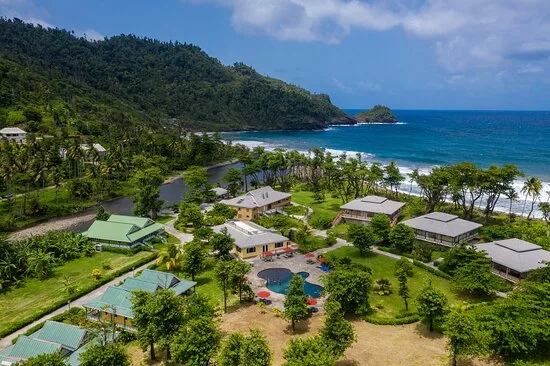
Rosalie Bay Eco Resort & Spa sits where rainforest, river and ocean meet, a 22 acre sanctuary on a black sand beach that has long been a nesting ground for sea turtles. The setting is the headline act: tropical gardens, the murmur of the Rosalie River meeting the Atlantic, and cottages built in warm Caribbean colours with verandas angled towards the sea. It is intimate rather than sprawling, with an onsite spa, yoga pavilion and riverside pool that give the whole property an unhurried, restorative rhythm.

Who owns Rosalie Bay Eco Resort & Spa?

Rosalie Bay Eco Resort & Spa was founded by Beverly Deikel, who built the property on the black sand beach where she felt a deep personal connection to the land and its nesting turtles. Her vision shaped both the look of the place and its conservation mission. The staff are largely drawn from the surrounding villages, giving the resort a warmth that reflects its founder’s roots in the local community.

About the rooms in Rosalie Bay Eco Resort & Spa

There are 28 air-conditioned rooms and suites at Rosalie Bay Eco Resort & Spa, including the budget and standard Queen rooms, the Deluxe and King rooms, the larger Junior, Premier and River suites, and the Oceanfront Suite at the top as the biggest unit and the one closest to the Atlantic. The 28 rooms are spread across nine low-rise cottages set into a riverside garden on the black sand bay, so the whole place feels more like a hamlet than a hotel. Couples tend to take the suites, while the Family Suites are the ones set up for travelling with children.

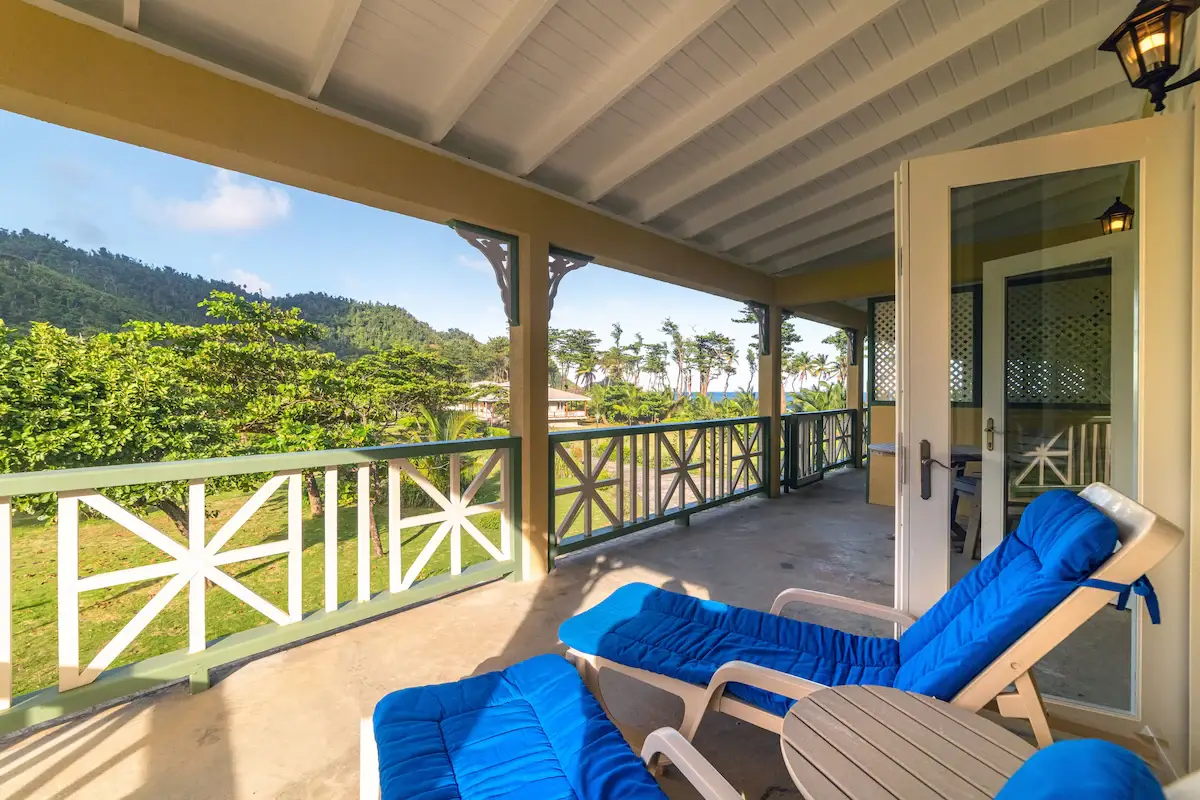
The rooms share a consistent, hand-built character: hand-carved four-poster or wooden beds, soundproofed walls, granite-topped bathrooms (the Oceanfront Suite adds a whirlpool tub), local Batik artwork and a private porch, veranda or balcony on every room. What changes between categories is mostly the outlook, with views sorted into garden, Rosalie River and Atlantic Ocean aspects, plus a handful that look over the pool. Every unit is air-conditioned, which is worth noting on an island where many eco-lodges are fan-only.

What food is available at Rosalie Bay Eco Resort & Spa?

An onsite restaurant leans into Dominica’s reputation as the Nature Island, with menus built around island grown produce, fresh fish and herbs and fruit from the resort’s own gardens. Menu items carry a genuine farm to table character, with local Caribbean flavours at the heart of every plate. Dining is relaxed and generous, often taken to the sound of the river and the surf.

Sustainability features of Rosalie Bay Eco Resort & Spa

Rosalie Bay Eco Resort & Spa runs on renewable power, with more than 200 solar panels and a 225 kW wind turbine, the first turbine of its kind on the island. Its sea turtle conservation programme, established with WIDECAST, has helped grow nesting from just seven recorded nests in 2003 to nearly seventy. That blend of renewable energy and hands on conservation makes the resort a real model for low impact luxury in the Caribbean.

Who is Rosalie Bay Eco Resort & Spa for?

Rosalie Bay Eco Resort & Spa is perfect for nature lovers and conscious travellers who want comfort and quiet purpose in equal measure, close to the wildest beauty Dominica has to offer. Couples after a romantic, restorative escape, families curious about the turtle programme and independent adventurers drawn to the rainforest trails will all feel at home, provided they value seclusion and wild scenery over nightlife and swimming beaches.

How to get to Rosalie Bay Eco Resort & Spa from the airport

The closest airport to Rosalie Bay Eco Resort & Spa is Douglas-Charles Airport (DOM) on the northeast coast of Dominica, roughly an hour to an hour and fifteen minutes by road from Rosalie on the island’s wild southeastern shore, a drive of around 30 to 40 kilometres through rainforest and over river valleys.

Private transfer or taxi to Rosalie Bay Eco Resort & Spa

A pre arranged private transfer is the easiest option to get to Rosalie Bay Eco Resort & Spa, since drivers know the route and the winding mountain roads are best taken at an unhurried pace after a long flight. Booking a transfer in advance through the resort means you are met on arrival and driven straight to the beach. A taxi from Douglas-Charles Airport is the alternative, and local drivers will happily run the route, though agreeing the fare before you set off is wise as journeys are not metered. If you prefer your own wheels, a hire car is available at the airport and gives you the freedom to explore the interior at your own pace.

Public transport to Rosalie Bay Eco Resort & Spa

Public transport to Rosalie Bay Eco Resort & Spa is possible with multiple changes. Dominica has no national coach company, so travel relies on the island’s privately run minibuses, locally called transports, which radiate mostly from Roseau and run on informal schedules. You would take an east coast transport heading towards Castle Bruce or the Kalinago Territory, then change for a route taxi running down the southeast coast towards Rosalie, finishing with a short taxi for the final approach to the beach. These minibuses thin out considerably on this remote stretch, so the journey is slow, unreliable and impractical with luggage. For a smooth arrival, a pre booked transfer or a hire car is genuinely the best way to reach the resort.

Things to do while staying at Rosalie Bay Eco Resort & Spa

Things to do around Rosalie Bay Eco Resort & Spa range from walking the black sand beach at dawn to watch for nesting leatherback, green and hawksbill turtles, a quietly moving experience that nature lovers and curious families will remember for years, to cooling off in the freshwater pools and cascades along the Rosalie River right beside the property.

Nearby you can hike a stretch of the Waitukubuli National Trail, the long distance footpath that runs the length of Dominica, and venture inland towards the geothermal wonders of Morne Trois Pitons National Park, a UNESCO World Heritage site with its famous Boiling Lake and Emerald Pool. Sea kayaking and birdwatching fill the quieter hours, while a visit to the Kalinago Territory just up the coast offers genuine cultural depth for anyone who wants to understand the island’s Indigenous heritage.

Between the turtle programme, the river swims and the rainforest trails, the area works equally well for families, couples and independent adventurers. Solo travellers and nature lovers will relish the birdwatching and the quiet, culturally curious visitors have the Kalinago Territory within easy reach, and families gain a rare, hands on connection to conservation that turns a holiday into something their children will remember.

Portsmouth is best for first-time visitors, nature lovers and northern day-trippers wanting a lively, sociable base

Portsmouth, the island’s second town, sits on Prince Rupert Bay in the north, roughly an hour from Douglas-Charles airport (DOM), with taxis on hand and a hire car handy for reaching nearby trails and beaches. It is a friendly, low key hub near Cabrits National Park, the Indian River boat trips and some of Dominica’s better swimming spots, making it a practical and sociable base for first-time visitors and those exploring the north. Travellers who want easy access to rainforest, calm coves and a working Caribbean town all in one place tend to settle here happily.

The difference between Portsmouth and other popular Dominican bases like Roseau and Calibishie is that Portsmouth pairs a genuine town atmosphere with quick reach to the wilder north, where Roseau is busier and more administrative and Calibishie is a quieter, scattered seaside village. You get the markets, boat trips and national park on your doorstep without the bustle of the capital, which makes it an easy, well rounded first introduction to the island.

Where to stay in Portsmouth: Top Pick

Secret Bay is the best place to stay in Portsmouth, Dominica

Secret Bay sits on a forested clifftop above two hidden coves near Portsmouth, a quietly luxurious hideaway carved gently into the hillside. Timber villas are dotted through the canopy with deep privacy between them, each with its own plunge pool, open air living spaces and uninterrupted views over the Caribbean, so the whole place feels less like a hotel than a private retreat among the rainforest.

Who owns Secret Bay?

The resort was founded by Dominican entrepreneur Gregor Nassief, whose vision was a property that treads lightly on the island it celebrates. That founding philosophy, putting the landscape and local environment first, runs through every part of the place, from how the villas were built to the farms and gardens that feed guests.

About the rooms in Secret Bay

There are 27 rooms at Secret Bay, including six named tiers of private, freestanding villa and no standard hotel rooms at all. Each one is a treehouse-style residence built from sustainably sourced Guyanese hardwood and raised on the forested clifftops above Tibay Beach. The intimate one-bedroom Mapou (around 1,220 sq ft) and the petal-shaped one-bedroom Ylang Ylang (around 2,030 sq ft) suit couples, while the two-to-three-storey Ti-Fey and Friends and Family villas (1.5 to 2.5 bedrooms) and the larger Zabuco villas work for families and small groups. At the top sit the Multi-Villa Estates, interconnected compounds running from 2 up to 3.5 bedrooms and as much as 6,109 sq ft, alongside a curated Honeymoon collection for couples. Every villa is a self-contained home rather than a bedroom, with its own private plunge pool, a full open-plan kitchen, open-air living areas and a covered terrace, and floor-to-ceiling glass walls framing either ocean or jungle-to-sea views. Because these are open-air, breeze-cooled structures threaded between mature trees the resort was built without heavy machinery to spare, the living spaces are naturally ventilated rather than fully sealed and air-conditioned in the conventional sense. Each one also comes with a dedicated villa host and farm to table dining from the organic farm that feeds the Zing Zing kitchen.

What food is available at Secret Bay?

The onsite farm to table kitchen, Zing Zing, draws on an organic farm and gardens planted at each villa to bring just picked produce to the table. Dining can be as private as the villas themselves, whether that is a chef preparing a meal in your own kitchen or a quiet supper looking out over the water. Meals here are ingredient led and Creole influenced, tying every plate back to the land around you.

Sustainability features of Secret Bay

This is a resort that runs on a genuine environmental ethic rather than an afterthought, and it is one of the island’s leading Green Globe certified properties, a standard very few resorts in the region reach. The villas were built without heavy machinery so that mature trees could be spared, using sustainably sourced Guyanese hardwood, and that respect for the landscape carries through to the organic farm and villa gardens that supply the kitchen.

Who is Secret Bay for?

It is perfect for couples and discerning nature lovers who want barefoot luxury and real environmental conscience in equal measure. Honeymooners and those after a romantic, deeply private escape will feel most at home, as will travellers who want to be immersed in rainforest and ocean without sacrificing comfort or sustainability.

How to get to Secret Bay from the airport

The closest airport to Secret Bay is Douglas-Charles Airport (DOM) on the northeast coast of Dominica, roughly an hour and a half by road to the property near Portsmouth on the northwest coast, a drive of around 40 to 50 kilometres that winds through rainforest and along the coast.

Private transfer or taxi to Secret Bay

A pre arranged private transfer is the easiest option to get to Secret Bay, and the resort can organise this so a driver meets you on arrival and handles the long final leg. A taxi works too, with drivers waiting at the airport, though many visitors prefer to be driven so they can take in the scenery without negotiating the narrow, winding roads themselves. Booking the transfer in advance is wise, as the journey is long and partly through remote terrain.

Public transport to Secret Bay

Public transport to Secret Bay is possible with multiple changes. Dominica’s shared minibuses, known locally as transport vans and marked with an H on the number plate, run on set routes between Roseau, Portsmouth and the main towns, so you would travel by van as far as Portsmouth and then take a short taxi out to the resort. The vans do not serve the clifftop property directly, timings are informal and luggage space is tight, so for this trip a private transfer or hire car is strongly recommended over public buses.

Things to do while staying at Secret Bay

Things to do around Secret Bay range from snorkelling and kayaking straight off the resort’s two secluded beaches, where the calm Caribbean water is ideal for spotting fish along the volcanic shoreline, to gentle days spent simply enjoying the privacy of your villa and plunge pool.

Nearby you can hike into Cabrits National Park with its restored Fort Shirley, take a guided trip up the Indian River by rowing boat, or explore the markets and colonial streets of Portsmouth. Venture further and you can reach the famous Boiling Lake and the waterfalls of Morne Trois Pitons National Park, along with hot springs, river pools and rainforest trails that make Dominica such a remarkable nature destination.

Nature lovers and solo travellers will be in their element among the trails and wildlife, couples come for the seclusion and romance, and culture seekers can dig into the island’s Kalinago heritage and Creole towns. It is less suited to families wanting busy resort entertainment and more a place that rewards the curious, the active and the romantic in equal measure.

When is the best time to visit Dominica?

The reliably driest, sunniest window runs roughly December to April, which is also peak season for prices and visitor numbers. The wetter months span June to November, overlapping the Atlantic hurricane season (1 June to 30 November), when downpours are heavier and the small risk of a major storm is real, though Dominica stays green and waterfalls run full. Late April to early June and late November offer good value with generally settled weather between the two extremes.

Is Dominica safe, and how do you get around?

Dominica has a relatively low crime rate and is one of the calmer Caribbean islands, but apply normal care: avoid isolated areas and beaches after dark, watch your belongings at large gatherings and do not leave valuables in hire cars. Driving is on the LEFT in right-hand-drive vehicles and a hire car is genuinely useful given mountainous, often narrow and potholed roads with few signs, though taxis and pre-booked transfers work well if you would rather not drive; a UK licence is accepted but you typically buy a local visitor’s permit. The currency is the Eastern Caribbean dollar (EC$), pegged at around EC$2.70 to the US dollar; US dollars are widely taken, cards are accepted at hotels and larger venues but carry cash for villages, and tipping is modest with around 10 percent in restaurants if no service charge is added and a few dollars for guides and drivers.

Why we only list sustainable stays in Dominica

Every hotel in this guide was hand picked and checked for how it actually runs, and most are locally rooted so your money stays in local hands rather than leaving with an all inclusive chain. For the full breakdown with photos and booking links see our guide to the best sustainable hotels in Dominica, or zoom out to the best sustainable hotels across the Caribbean.

More Caribbean Sustainable Stays
Book Your Next Stay Consciously

Travel is a wonderful opportunity to connect with Mother Earth.

However, it is also frequently undermined by reckless development and disrespectful tourism practices.

This directory is a curated, verified list of hotels, lodges, and resorts that honour our planet and are led by visionary stewards of the environment.

From farm-to-table culinary experiences to dedicated ocean conservation efforts, such as marine protection and coral restoration, these establishments are redefining hospitality.

12% Off Sustainable Swimwear

Freedom Ecowear is offering our readers 12% off their eco-friendly swimwear, perfect for your next eco getaway. Use the link and your discount is added automatically.

Sustainable Travel Destinations, Eco-Stays and Eco-Tour Guides

The best eco friendly stays in Bahamas, hand picked from certified retreats to off grid hideaways.
The best eco friendly stays in Sint Maarten, hand picked from certified retreats to off grid hideaways.
The best eco friendly stays in Haiti, hand picked from solar powered resorts near Cap Haitien to mountain guesthouses built from recycled materials and surf lodges grown from ecotourism. Find and book your sustainable stay.
The best eco friendly stays in Cuba, hand picked from off grid solar casas in Vinales to family eco farms beside the Humboldt rainforest and hotels built around living trees. Find and book your sustainable stay.
The best eco friendly stays in Barbuda, hand picked from off grid solar lodges and Barbudan owned cottages to timber built beach hotels on empty pink sand. Find and book your sustainable stay.
The best eco friendly stays in Antigua, hand picked from certified Green Globe stays where you can harvest your own fruit, to off grid hideaways. Find and book your sustainable stay.

More Great Articles From Hold The Throne

The Good Trade names ten sustainable underwear brands, but eight of them sell synthetics. Hold The Throne read every fabric label and found that brands like Pact, Quince and Organic Basics blend elastane, micromodal, TENCEL or recycled nylon into the underwear, while only KENT and Oddobody pass as 100% non toxic, natural materials. This is the honest sustainable underwear list: which of The Good Trade’s organic cotton and ethical lingerie picks are GOTS certified plant fibre, and which are plastic against the skin.
Vinted is being compared to the 2020 Wayfair child trafficking conspiracy after viral screenshots of overpriced toy listings described with ages, heights and coded language. Here is what France is investigating, why the upload timestamps matter, and the ultimatums Vinted now has to answer.
Ethical Consumer’s A to Z of ethical fashion brands gets the ethics right and the fibre wrong. Out of 29 picks, only Earthmonk and Where Does It Come From? are actually 100% plant fibre. The other 27 carry bamboo viscose, TENCEL, wool, elastane or mixed secondhand fibre.
I burned my whole swimwear business down to start again. At its peak doing five figures a month, Vivi Rufino and her partner David stopped producing entirely and spent seven years rebuilding Freedom Ecowear from polyester to natural fibres like hemp and organic cotton. Standing in the workshop the two of them built, Vivi explains why even recycled polyester failed, and why destruction was the only way forward.
Vogue’s 28 best sustainable clothing brands list is right about ethics and wrong about fibre. Of 28 brands, 26 fail a plant-fibre-only test because they lean on TENCEL, viscose, wool, silk and recycled polyester. Here is the proof, composition by composition.
5 certified eco hotels in Singapore near the Marina Bay Street Circuit for F1 Singapore Grand Prix, each verified green, from LEED and Green Key stays to carbon neutral operations, all close to the action.

Latest Data Reports

Share this page: Where to Stay in Dominica: Best Areas and Sustainable Hotels

Facebook
X
LinkedIn
Reddit
Threads
Email
WhatsApp