Destinations › Europe · The Destination Index · universal template · every figure sourced
Montenegro.
Southeastern Europe, between the Adriatic Sea and Serbia. 13,812 sq km and 623,129 people, 294 km of coastline, Mediterranean climate, hot dry summers and autumns and relatively cold winters with heavy snowfalls inland.
Region · EuropePopulation · ~623,129Languages · Montenegrin (official), Serbian, Bosnian, Albanian, RomaniEco Index · 62/100 · Passable
The Eco Index across 12 pillars · scored 0 to 5 · World Bank, OWID, WHO/UNICEF JMP, FiBL, Protected Planet, IUCN, UNESCO (2023-24)
Conservation
Wildlife
Water
Food & farming
Organic & clean
Climate & energy
Waste
Health
Heritage
Ownership
Governance
Future
The History of Montenegro.
Montenegro sustains a strong living folk heritage shaped by highland clan culture and the Adriatic coast. The oro, a circle dance performed at weddings and gatherings, remains widely alive, as does gusle playing, the single-string fiddle that accompanies sung epic poetry.
Where the name comes from
Crna Gora in Montenegrin, 'black mountain'. Montenegro is the Venetian translation of the same. Source: UK Permanent Committee on Geographical Names toponymic factfile.
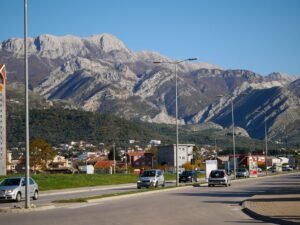
The land itself: a deeply indented coast with a narrow plain, backed by rugged limestone mountains and plateaus. Its high point is Zla Kolata, 2,534 m. Source: UK Permanent Committee on Geographical Names toponymic factfile.
Where it starts
Twenty metres of continuous record
The Red Rock shelter at Crvena Stijena holds one of the longest and best-preserved Middle Palaeolithic sequences in southeastern Europe: a stratified deposit over twenty metres deep across 31 levels. Its dated layers reach back 85,000 to 71,000 years, older artefacts lie in deeper layers that have not yet been dated, and the same shelter was still in use through the Neolithic and into the Bronze Age. Very few sites anywhere record so long a stretch of human life in one spot.
How it got here
Duklja to referendum
Illyrian peoples held the coast and mountains before the region became Roman, with the city of Doclea founded near modern Podgorica. A Slavic principality, Duklja, formed from the tenth century and was recognised as a kingdom in 1077. The mountain interior resisted full Ottoman control while the coast passed to Venice. Montenegro was recognised as an independent state in 1878, was part of successive Yugoslav states from 1918, and restored its independence by referendum in 2006.
The timeline
c. 180,000 years ago
Crvena Stijena.
The oldest dated layer at the Red Rock shelter is around 78,000 years old, with older stone tools in deeper layers that remain undated, in a sequence over twenty metres deep. ↗
c. 85,000 to 71,000 years ago
Neanderthal layers.
Dated layers at Crvena Stijena hold one of the longest continuous records of Neanderthal occupation in southeastern Europe. ↗
c. 6000 BC onward
Farming and the Bronze Age.
The same shelter is used through the Neolithic and into the Bronze Age, a sequence of tens of thousands of years in one place. ↗
c. 1000 BC to AD 400s
Illyrians and Rome.
Illyrian peoples hold the coast and mountains before the region becomes Roman, with the city of Doclea founded near modern Podgorica. ↗
c. 900s to 1100s
Duklja.
A Slavic principality forms and is recognised as a kingdom in 1077. ↗
1400s to 1700s
Mountain independence.
The mountain interior resists full Ottoman control while the coast passes to Venice. ↗
1878
Recognition.
The Congress of Berlin recognises Montenegro as an independent state in 1878. ↗
1918 to 2006
Yugoslavia and after.
Montenegro is part of successive Yugoslav states and then of a union with Serbia. ↗
2006
Independence, by 0.5%.
The referendum of 21 May 2006 passes with 55.5% for independence against a threshold of 55%. Half a percentage point separated the result from failure, and Montenegro left the union with Serbia. ↗
Around 22.2% of the land is protected across five national parks, Durmitor, Biogradska Gora, Lovcen, Skadar Lake and Prokletije (World Bank, 2025). Marine protection covers about 5.3% of Montenegro's marine and coastal area (Protected Planet, September 2026), and the first marine parks declared in 2021 have been criticised as protected largely on paper.
Is wild Montenegro protected? 22.2% of the land is, against a 30% target for 2030
How protected is nature in Montenegro?
Forest cover61.5%
Terrestrial protected area22.2%
Marine protected area5.3%
78 (mammals, birds, fish & plants) listed as threatened.
Critically Endangered, the last IUCN category before Extinct in the Wild, and still recorded in Montenegro. GBIF holds 3 verified occurrence records.
Galeorhinus galeus
Critically Endangered, the last IUCN category before Extinct in the Wild, and still recorded in Montenegro. GBIF holds 3 verified occurrence records.
Anguilla anguilla
Critically Endangered, the last IUCN category before Extinct in the Wild, and still recorded in Montenegro. GBIF holds 55 verified occurrence records.
Species named here are drawn from GBIF occurrence records for Montenegro filtered to the IUCN Red List threatened categories. Species are listed where GBIF holds occurrence records for them in this country. Record counts are not published here because the figure cannot be reproduced from a public GBIF query.
Nature reserve in Tivat Municipality, mapped and named in the open record for Montenegro. OpenStreetMap.
Water and Ocean in Montenegro.
Montenegro is water-rich, drained by the Tara, Moraca, Piva and Zeta rivers and holding Lake Skadar, the largest lake in the Balkans, alongside abundant karst springs. About 85.1% of the population uses safely managed drinking water (World Bank, 2022) and tap water is generally safe in towns, with rural systems accounting for most of the shortfall. Supply security is high thanks to the mountain rivers and karst aquifers.
85.5% of people here have safely managed drinking water at home (2024, WHO/UNICEF JMP). Most homes have a safe supply, but coverage is not universal, so check locally before drinking from the tap.
Cleanest water: The Tara River and the upper Piva.
What are the rules on Montenegro beaches?
·Tap water: Varies.
✓Plastic rules: Ban on the sale of lightweight plastic bags from 20 October 2024..
✓Solo travel: rated easy on the record for this destination.
✕Marine protection: 0.07% of the sea is protected. The 30x30 pledge for 2030 is not met yet.
Named on the open map: Baosici Beach, Kumbor Beach, Ljuta Beach, Otrant Beach, Kuc beach. That is 5 named beaches in the public record for Montenegro, each one a place you can look up before you go. OpenStreetMap.
Where does the sewage go?
50.9%
of people have safely managed sanitation
50.9% of people here use a safely managed sanitation service, meaning waste is contained, emptied and treated rather than reaching the ground or the sea untreated (2024, World Bank / WHO-UNICEF JMP, SDG 6.2.1). The rest is what the rivers and the coast receive.
How is the sea around Montenegro doing?
One cross-section, every answer measured.
Surface
What the coast carries
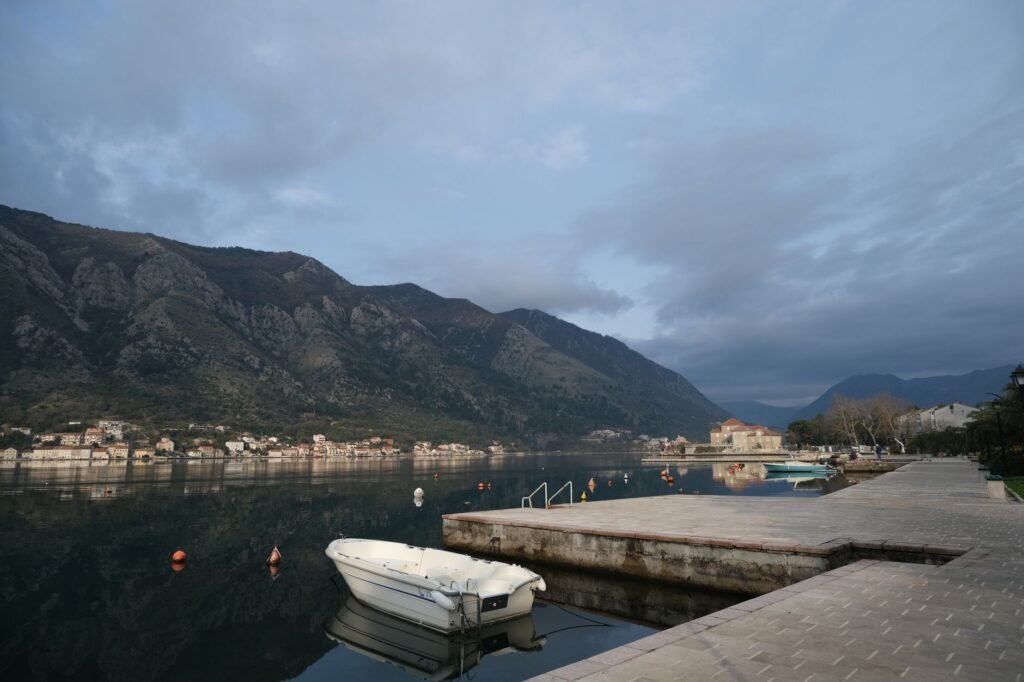
Mediterranean coast, alpine north; the Bay of Kotor is prone to summer heat.
Nearshore
Protected water
5.3% of territorial waters are protected, against the 30% pledged for 2030 under the Global Biodiversity Framework.
Cleanest
Where the water is cleanest
The Tara River and the upper Piva..
The record
Measured
Montenegro is water-rich, drained by the Tara, Moraca, Piva and Zeta rivers and holding Lake Skadar, the largest lake in the Balkans, alongside abundant karst springs. About 85.1% of the population uses safely managed drinking water (World Bank, 2022) and tap water is generally safe in towns, with rural systems accounting for most of the shortfall.
Sea protected
0.07%
Against the 30% pledged for 2030 under the Global Biodiversity Framework.
Threatened species
78 (mammals, birds, fish & plants)
Mammals, birds, fish and higher plants on the IUCN list.
Cleanest water
here
The Tara River and the upper Piva..
Is the tap water safe in Montenegro?
85.5% of people have safely managed drinking water at home (2024, WHO/UNICEF JMP).
When is the best time to visit Montenegro? Tap your month.
Montenegro has real farming, from Plantaze vineyards and coastal olives to northern dairy and Adriatic fisheries, but it runs a large agricultural trade deficit and imports most of its food, with domestic exports covering only around a tenth of food imports (FreshPlaza, 2025).
Where does the food in Montenegro come from?
23.6% imported
about US$1,193m a year
On the plate: Bread, cornmeal kacamak, peppers, ajvar.
How often each food is on the plate
Share of people eating each one regularly. These overlap, so they do not add up to 100%.
Bread60%
Kajmak42%
Cornmeal kacamak33%
Peppers24%
Ajvar15%
2 of 10
bites are imported
The island buys in more food energy than it eats. About US$1,193m a year leaves the country to pay for it. The green slice is roughly what still grows here.
About 23.6% of everything Montenegro buys in from abroad is food, roughly 2 in every 10 imported items on the dock (2024, World Bank). Farming itself is 3.4% of the economy and 19.6% of the land is agricultural, of which 0.7% is arable. The green slice is roughly what still grows here.
What is killing people in Montenegro? The imported diet.
Cause of death, and the diet behind it.
Non-communicable diseases, all combined65.3%
Diabetes10.7%
Adults living with overweight or obesity. 50%.
Can Montenegro feed itself?
0.7%
Arable land
19.6%
Agricultural land
12,436
Farmers
22,363
Arable acres
3.4%
Agriculture, share of GDP
Harvest: Olives and grapes from late summer into autumn, coastal citrus around Bar in winter.
Feeding itself
Montenegro has real farming, from Plantaze vineyards and coastal olives to northern dairy and Adriatic fisheries, but it runs a large agricultural trade deficit and imports most of its food, with domestic exports covering only around a tenth of food imports (FreshPlaza, 2025).
Certification
Certified organic land is about 1.9% of farmland (FiBL, 2020), below the EU average, though many traditional low-input smallholdings farm organically in practice without certification.
Water for crops
Montenegro is water-rich, drained by the Tara, Moraca, Piva and Zeta rivers and holding Lake Skadar, the largest lake in the Balkans, alongside abundant karst springs. About 85.1% of the population uses safely managed drinking water (World Bank, 2022) and tap water is generally safe in towns, with rural systems accounting for most of the shortfall.
Why the organic number looks like that. Certified-organic farmland is not separately reported for Montenegro, and that is a certification gap rather than proof nothing is grown cleanly. What the official land record does show: 19.6% of the country is agricultural land and 0.7% is arable (2023, World Bank). Certification is paid for per farm per year by a foreign body, which prices out smallholders, so the organic number reads worse than the practice.
What actually grows here
PotatoesWatermelonsGrapesCabbagesOrangesFigs
The food that already fits
The plant-based kitchen here is not an import. By tonnage, the largest crops grown in Montenegro are watermelons, potatoes, grapes, plums and sloes and oranges (FAO, FAOSTAT crop production, 2024). That is what the land itself puts on a plate.
Montenegro draws a majority of its electricity from renewables, with hydropower supplying close to 47 per cent and wind and solar adding around 11 per cent in 2024, so low-carbon sources cover more than half of generation. The single coal-fired plant at Pljevlja still provides roughly 40 per cent and is the country's main source of emissions and air pollution. Emissions per person are relatively low at about 3.7 tonnes in 2024. As an EU accession candidate that declared itself an ecological state in its constitution, Montenegro has adopted carbon pricing and an updated climate pledge, though the future of Pljevlja remains contested. Low emissions and majority renewable power support a solid score, tempered by continued coal reliance.
What powers Montenegro?
Renewable 75.6%Fossil 24.4%
Climate pollution per person
The safe amount, what the planet can absorb
2 tonnes
One person here
3.7 tonnes
The world average, for comparison
4.7 tonnes
The grid
Montenegro draws a majority of its electricity from renewables, with hydropower supplying close to 47 per cent and wind and solar adding around 11 per cent in 2024, so low-carbon sources cover more than half of generation. The single coal-fired plant at Pljevlja still provides roughly 40 per cent and is the country's main source of emissions and air pollution.
Pollution
Montenegro introduced a ban on the sale of lightweight plastic bags from 20 October 2024, but winter air pollution is severe in the coal town of Pljevlja and the national mean PM2.5 is about 16.5 micrograms per cubic metre (IQAir, 2025), well above the WHO guideline.
Water stress
Montenegro is water-rich, drained by the Tara, Moraca, Piva and Zeta rivers and holding Lake Skadar, the largest lake in the Balkans, alongside abundant karst springs. About 85.1% of the population uses safely managed drinking water (World Bank, 2022) and tap water is generally safe in towns, with rural systems accounting for most of the shortfall.
What pollutes most here
1The gridThe share of electricity still generated from fossil fuel.42%
2IndustryThe Pljevlja coal power plant and the KAP aluminium legacy near Podgorica..named
3AirModelled annual mean against a WHO guideline of 5 µg/m³.16.5
4On the recordMontenegro introduced a ban on the sale of lightweight plastic bags from 20 October 2024, but winter air pollution is severe in the coal town of Pljevlja and the national mean PM2.5 is about 16.5 micrograms per cubic metre (IQAir, 2025), well above the WHO guideline.
What has Montenegro promised on climate?
Net zero, whole economy2050
Electricity renewable today61.8% (2021)
Land protected, against a 30% target22.2% by 2025
Sea protected, against a 30% target5.3% by 2025
The net-zero target year on file with Climate Watch is 2050, status: in political pledge. Measured against it, 61.8% of electricity is already renewable (2021, World Bank), so 38.2% of the grid is still to be converted. The pledge on file is measured here against what has actually been delivered, not taken on its own (UNFCCC NDC Registry, CBD Kunming-Montreal Target 3).
The biggest line item
One return flight against a whole year of living.
A resident's entire year3.7 t CO2e
Safe-climate budget, per year2 t CO2e
Sydney return, economy2.84 t CO2e
Los Angeles return, economy1.89 t CO2e
Singapore return, economy1.71 t CO2e
Johannesburg return, economy1.38 t CO2e
New York return, economy1.32 t CO2e
How much CO2 does flying to Montenegro emit?
Tap where you would fly from. One return flight, economy.
Every prompt runs on a machine in a building on somebody’s grid. What that costs the planet depends less on the prompt than on what is burning to power it. Here is what would power one in Montenegro.
Data centres
0
Registered colocation and interconnection facilities, PeeringDB, 2026
Grid renewable
75.6 %
What a machine here runs on.
What powers a data centre in Montenegro?
A machine here runs mostly on renewables, but not entirely.
Renewable 75.6%Fossil 24.4%
Cooling water. Every one of those halls runs on the national grid, which is 61.8% renewable today (World Bank). A data centre is only as clean as the electricity behind it, so the same figure that decides this country's climate score also decides the footprint of the AI running inside it. Cooling water use is not separately published by facility, and no operator here reports it.
The rules. Montenegro has 0 colocation and interconnection facilities on the public PeeringDB register, alongside 1 internet exchange (MIXP.me).
20% residents to 80% visitors across a year. 2,510,000 international arrivals in 2019 against 623,129 people who live here (2025, World Bank / UN Tourism).
Where a visitor dollar goes in Montenegro
351k
Visitors a year
0.6
Visitors per resident
How deep in debt is Montenegro?· for every $100 Montenegro earns in a year, it owes…
Pay to the order of: the creditorsmemo · the 2020 peak
$ 108The worst year on the IMF record. Montenegro owed $108 for every $100 it earned.
IMF World Economic Outlook, 2020signed, the creditors
Pay to the order of: the creditorsmemo · today
$ 62What is owed now, for every $100 of national income (2026).
IMF World Economic Outlook, 2026signed, the creditors
Pay to the order of: the creditorsmemo · projected 2031
$ 66The IMF's own forecast has this rising to $66 by 2031.
IMF World Economic Outlook projection, 2031signed, the forecast
For every $100 Montenegro earns in a year, it owes $62 (2026, IMF World Economic Outlook). The interest on that is paid before schools, clinics or coastline get their turn.
Where does a tourist dollar actually go in Montenegro?
Play one tourist dollar around the board. Every square is a measured fact from this page.
START!
1
GO: a visitor lands
$100 goes on the table. 2,510,000 international arrivals in 2019 against 623,129 residents, 4.0 visitors for every resident (World Bank / UN Tourism).
$100 in play
2
The bed
Who owns the largest places to stay in Montenegro is not published in the records we can check, so this square is left open rather than guessed. Where a listing names its owner, it is shown in the ownership table below.
not published
3
The plate
Food is 23.6% of everything Montenegro imports (2024, World Bank), so a large part of every restaurant bill is paid to a supplier abroad. Eating what the land here actually grows, potatoes, watermelons, grapes, cabbages, oranges, figs, keeps that money with the grower.
sails in
4
The power
61.8% of the electricity is renewable (2021, World Bank), so the energy on the bill is mostly generated inside the country rather than shipped in.
made at home
5
What actually stays
On the parts that can be measured, the plate leaves and the power stays. It is genuinely a coin toss, decided by what you book.
split
6
Pay the bank first
Montenegro owes $62 for every $100 it earns (IMF World Economic Outlook, 2026 projection). The interest is paid before anything else on this board.
$62 per $100
7
No plan B
36.7% of everything Montenegro sells abroad is mineral fuels and oils (2023, UN Comtrade). One market moving takes the whole board with it.
36.7% one export
8
Community chest
Tourism earns 14.4% of everything Montenegro makes from exports (2020, World Bank / UN Tourism). That is how much of the economy depends on the game continuing.
14.4% of exports
9
Back to GO
The economy turns over about US$10 billion a year (IMF World Economic Outlook, 2026 projection). Every lap of this board is a choice about how much of it stays.
US$10bn
GDPUS$9.2bn
Agriculture, share of GDP3.4%
Visitors a year351,000
Visitors per resident0.6
Residents~623,129
Agriculture
Farming is 3.4% of the economy. Montenegro has real farming, from Plantaze vineyards and coastal olives to northern dairy and Adriatic fisheries, but it runs a large agricultural trade deficit and imports most of its food, with domestic exports covering only around a tenth of food imports (FreshPlaza, 2025).
Natural materials
Wool, felting, weaving and the making of Montenegrin national dress survive as living crafts, giving the country a modest but real natural-materials tradition.
Energy
Montenegro draws a majority of its electricity from renewables, with hydropower supplying close to 47 per cent and wind and solar adding around 11 per cent in 2024, so low-carbon sources cover more than half of generation. The single coal-fired plant at Pljevlja still provides roughly 40 per cent and is the country's main source of emissions and air pollution.
Who owns the biggest hotels in Montenegro?
By rooms · company records and press.
Prevalis Nature Cottage · ~3 roomsIndependentnot published
Visitors, over time
20151,560k
20161,662k
20171,877k
20182,077k
20192,510k
2020351k
International tourism receipts run at about US$0.18 billion in 2020 (World Bank / UN Tourism). That is 14.4% of everything the country earns from exports.
How much of your money actually stays here?
Tap the holiday you are planning.
All-inclusive resortForeign-owned hotel and tourist restaurantsLocally owned stay and local restaurantsGuesthouse, markets and public transport
Resort guest, villa renter, family, nomad or backpacker. The honest playbook for each, from the same sourced numbers.
Already booked a resort? · the rescue list
Five swaps that move your money back on-island
1. Eat where the country eats Choose kitchens cooking what the land here grows, potatoes, watermelons, grapes, cabbages, oranges and figs, over an imported menu. The checked list →
2. Book with a local operator Never the lobby desk. The margin on a tour is the part that stays. Eco tours →
3. Stay somewhere locally owned Ownership decides where the room rate books. Eco stays →
4. Use the transport residents use Buses link the towns and a car is best for the mountains, with the scenic Bar to Belgrade railway as an option.
5. Buy the craft, not the souvenir Natural-materials work made here pays the maker directly; imported gifts pay a shipping line.
swipe →
First time here
A compact Adriatic country where forested mountains, Europe's deepest river canyon and Lake Skadar's wetlands sit within a short drive of the coast.
Best time: Late spring and early autumn.
Getting around
Buses link the towns and a car is best for the mountains, with the scenic Bar to Belgrade railway as an option.
Transport is where the fare either stays or leaves.
Eating here
The everyday plate that actually grows here is potatoes, watermelons, grapes, cabbages, oranges and figs. Ordering those keeps the money with the grower and cuts the imported share of the meal.
Eating what the country grows is the cheapest way to cut the import bill.
Good to know
EUR; cards on the coast, cash in the north.
Rate my hotel. Tap yours for the honest verdict.
Ownership from company records and press.
Prevalis Nature Cottage
.
Who owns the place to stay
Prevalis Nature CottageIndependent · 3 rooms
The one property listed here does not publish who ultimately owns it, so no claim is made either way. Ownership is what decides how much of a room rate stays in the country, which is why we show it when a listing states it.
Society and Governance in Montenegro.
How well is Montenegro actually run?
Governance, measured · World Bank WGI
Four measured answers, none of them opinion. Averaged across corruption control, delivery and accountability, Montenegro scores 56 out of 100 (2024, World Bank Worldwide Governance Indicators). That matters here because every pledge on this page is only as good as the machinery meant to deliver it.
How well is Montenegro run? · each scored out of 100, higher is better
Clean government, scored 47 of 100
Control of corruption scores 46.7 out of 100 (2024, World Bank Worldwide Governance Indicators). That is below the halfway mark of governments measured.
47
Freedom and rights, scored 64 of 100
Voice and accountability, which measures free expression, free media and the ability to choose a government, scores 63.7 out of 100 (2024, World Bank WGI). Citizens have some room to question their government.
64
Government effectiveness, scored 59 of 100
Government effectiveness, which measures the quality of public services and how well policy is actually delivered, scores 58.5 out of 100 (2024, World Bank WGI). Delivery is rated above average.
59
Income equality, scored 34 of 100
The Gini index of income inequality reads 34.3 (2021, World Bank). Zero is perfect equality and 100 is one person holding everything. Below 40 is the level usually treated as manageable, and Montenegro sits inside it.
34
LGBTQ+ status: MixedSolo female travel: Easy98.5% adult literacyIndustry to avoid: The Pljevlja coal power plant and the KAP aluminium legacy near Podgorica.
What is daily life in Montenegro really like? Measured
Getting around, breathing, throwing away, learning. The honest checklist.
TransportAirWaterWastePower
✓How you get around Buses link the towns and a car is best for the mountains, with the scenic Bar to Belgrade railway as an option.
✓Air quality, measured Modelled annual mean 16.5. The WHO guideline is 5 µg/m³.
✓Where the air is cleanest Durmitor and the northern mountains.
✓Tap water Varies
✓What to drink Coastal tap is mostly drinkable; rural springs are bottled by default.
✓Plastic rules Ban on the sale of lightweight plastic bags from 20 October 2024.
✓Sockets and voltage Type C/F, 230V
98.5%
literacy. Secondary enrolment stands at 93.9% gross (UNESCO Institute for Statistics, 2023). UNESCO does not publish an education spending figure for Montenegro.
Made in Montenegro.
Wool, felting, weaving and the making of Montenegrin national dress survive as living crafts, giving the country a modest but real natural-materials tradition. Every step of processing done at home is value that stops leaving the country.
What Montenegro actually sells the world
The single biggest thing Montenegro sells the world is mineral fuels and oils, 36.7% of all exports in 2023 (about US$0.26 billion, UN Comtrade). The next four are aluminium at 11.7%, wood and wood articles at 7.4%, beverages, spirits and vinegar at 6.3%, pharmaceuticals at 6.2%.
Made now · natural materials
Wool
Worked in Montenegro from local material, and still a working craft rather than a museum piece.
Made now · natural materials
Felting
Worked in Montenegro from local material, and still a working craft rather than a museum piece.
Made now · natural materials
Weaving
Worked in Montenegro from local material, and still a working craft rather than a museum piece.
Made now · natural materials
Making of Montenegrin national dress survive as living crafts
Worked in Montenegro from local material, and still a working craft rather than a museum piece.
Made now · natural materials
Giving the country a modest but real natural-materials tradition
Worked in Montenegro from local material, and still a working craft rather than a museum piece.
Buys in · 8.8% of imports
Vehicles
Montenegro imported US$0.36 billion of vehicles in 2023, 8.8% of everything it bought abroad, and sells none of it back. Every point of that is a business that could be built at home rather than shipped in. UN Comtrade.
Buys in · 7.5% of imports
Machinery and mechanical appliances
Montenegro imported US$0.31 billion of machinery and mechanical appliances in 2023, 7.5% of everything it bought abroad, and sells none of it back. Every point of that is a business that could be built at home rather than shipped in. UN Comtrade.
Buys in · 6.3% of imports
Electrical machinery and electronics
Montenegro imported US$0.26 billion of electrical machinery and electronics in 2023, 6.3% of everything it bought abroad, and sells none of it back. Every point of that is a business that could be built at home rather than shipped in. UN Comtrade.
Buys in · 3.2% of imports
Furniture and bedding
Montenegro imported US$0.13 billion of furniture and bedding in 2023, 3.2% of everything it bought abroad, and sells none of it back. Every point of that is a business that could be built at home rather than shipped in. UN Comtrade.
The maths for an entrepreneur. Montenegro produces about US$9 billion a year, which is roughly US$14,817 per person (2025, World Bank). Farming is 3.4% of that, while food is 23.6% of everything the country imports. The country buys in more food than its own farms contribute to the economy, and every point of that gap is a business someone could build here rather than ship in.
A living tradition of Montenegro, still practised rather than archived.
Gusle epic singing
A living tradition of Montenegro, still practised rather than archived.
Bokeljska Mornarica ceremonial dance of Kotor
A living tradition of Montenegro, still practised rather than archived.
Orthodox slava patron feasts
A living tradition of Montenegro, still practised rather than archived.
Highland folk musicA living tradition of Montenegro, still practised rather than archived.
CostumeA living tradition of Montenegro, still practised rather than archived.
Does Montenegro protect its heritage by law?
Partly, and the gaps say as much as the protections.
What is kept alive. Montenegro sustains a strong living folk heritage shaped by highland clan culture and the Adriatic coast. The oro, a circle dance performed at weddings and gatherings, remains widely alive, as does gusle playing, the single-string fiddle that accompanies sung epic poetry. Orthodox Christian traditions, including the family slava patron feast, structure much of communal life.
Who it belongs to. Mountain villages keep transhumant herding alive in summer katun settlements, and agrotourism and family guesthouses are growing across the north. The coast is busier and more resort-driven, where tourism revenue is less community-rooted.
Only here. The Tara River Canyon, the deepest river canyon in Europe..
Three futures for Montenegro, every one run forward from measured data.
Where the making actually happens
Named cultural and craft sites on the open map: Government House, National Museum of Montenegro (Cetinje), Maritime Museum (Former place of Grgurina family 18th century) (Kotor), Museum square (Kotor), Natural History Museum of Montenegro (Podgorica), Cat's museum (Kotor). OpenStreetMap.
Every measured trend on one line
Run forward at the pace already recorded.
+11%
Forest cover
2006: 55.5 % → 2023: 61.5 %
-5%
Renewable electricity
2005: 65.2 % → 2021: 61.8 %
+158%
Tourist arrivals
2002: 136 k → 2020: 351 k
+52%
Protected land
2013: 14.6 % → 2025: 22.2 %
-59%
Farm workforce
1995: 10.3 % → 2025: 4.2 %
+1667%
Protected sea
2013: 0.3 % → 2025: 5.3 %
-49%
Agricultural land
2006: 38.3 % → 2023: 19.6 %
+24%
Urban population
1995: 52.8 % → 2025: 65.6 %
-36%
Air pollution
1995: 28.6 µg/m³ → 2023: 18.5 µg/m³
+24%
Adult overweight
1995: 40.4 % → 2022: 50 %
+0%
Electricity access
1995: 100 % → 2024: 100 %
+978%
GDP per person
1997: 1375 → 2025: 14817
+2%
Population
1995: 612 k → 2025: 623 k
-17%
Renewable energy use
2005: 47.6 % → 2021: 39.6 %
+4%
Energy per person
2005: 1663 kg → 2023: 1722 kg
+70%
Protected area, total
2013: 9.6 % → 2025: 16.3 %
+6%
Life expectancy
1995: 73.6 yrs → 2024: 77.9 yrs
+12%
Cereal yield
2006: 2971 ha → 2023: 3315 ha
+1244%
Fertiliser use
2006: 18.7 ha → 2023: 251.4 ha
-27%
Rural population
1995: 47.2 % → 2025: 34.4 %
-89%
Water productivity
2006: 20.4 $/m3 → 2022: 2.2 $/m3
+21%
Health spending
2011: 7.97 % → 2023: 9.65 %
+11%
Forest area
2006: 7466 km2 → 2023: 8270 km2
-28%
Electric power use
2005: 6315 kWh → 2023: 4564 kWh
-60%
Emissions: Agriculture
1990: 0.93 e → 2023: 0.37 e
+200%
Emissions: Industrial Processes
1990: 0.06 e → 2023: 0.18 e
World Bank open data, recorded series
How much forest is left?
Forest cover moved from 55.5% to 61.5% across 17 recorded years.
World Bank AG.LND.FRST.ZS
How clean is the grid?
Renewable electricity moved from 65.2% to 61.8% across 16 recorded years.
World Bank EG.ELC.RNEW.ZS
How many people visit?
Tourist arrivals moved from 136k to 351k across 18 recorded years.
World Bank ST.INT.ARVL
How much land is protected?
Protected land moved from 14.6% to 22.2% across 12 recorded years.
World Bank ER.LND.PTLD.ZS
How many people still farm?
Farm workforce moved from 10.3% to 4.2% across 30 recorded years.
World Bank SL.AGR.EMPL.ZS
How much sea is protected?
Protected sea moved from 0.3% to 5.3% across 12 recorded years.
World Bank ER.MRN.PTMR.ZS
How much land is farmed?
Agricultural land moved from 38.3% to 19.6% across 17 recorded years.
World Bank AG.LND.AGRI.ZS
How fast is it urbanising?
Urban population moved from 52.8% to 65.6% across 30 recorded years.
World Bank SP.URB.TOTL.IN.ZS
Is the air getting cleaner?
Air pollution moved from 28.6 µg/m³ to 18.5 µg/m³ across 28 recorded years.
World Bank EN.ATM.PM25.MC.M3
Is diet-related disease rising?
Adult overweight moved from 40.4% to 50.0% across 27 recorded years.
World Bank SH.STA.OWAD.ZS
Who has power?
Electricity access moved from 100.0% to 100.0% across 29 recorded years.
World Bank EG.ELC.ACCS.ZS
Is income rising?
GDP per person moved from 1375 to 14817 across 28 recorded years.
World Bank NY.GDP.PCAP.CD
How fast is it growing?
Population moved from 612k to 623k across 30 recorded years.
World Bank SP.POP.TOTL
What share of all energy is renewable?
Renewable energy use moved from 47.6% to 39.6% across 16 recorded years.
World Bank EG.FEC.RNEW.ZS
How much energy does one person use?
Energy per person moved from 1663 kg to 1722 kg across 18 recorded years.
World Bank EG.USE.PCAP.KG.OE
How much land and sea is protected together?
Protected area, total moved from 9.6% to 16.3% across 12 recorded years.
World Bank ER.PTD.TOTL.ZS
How long do people live?
Life expectancy moved from 73.56 yrs to 77.89 yrs across 29 recorded years.
World Bank SP.DYN.LE00.IN
How much does a hectare of cereal produce?
Cereal yield moved from 2971 kg/ha to 3315 kg/ha across 17 recorded years.
World Bank AG.YLD.CREL.KG
How much fertiliser goes on the land?
Fertiliser use moved from 18.7 kg/ha to 251.38 kg/ha across 17 recorded years.
World Bank AG.CON.FERT.ZS
How many people still live rurally?
Rural population moved from 47.17% to 34.39% across 30 recorded years.
World Bank SP.RUR.TOTL.ZS
How much value per cubic metre of water?
Water productivity moved from 20.42 $/m3 to 2.2 $/m3 across 16 recorded years.
World Bank ER.GDP.FWTL.M3.KD
How much goes on health?
Health spending moved from 7.97% to 9.65% across 12 recorded years.
World Bank SH.XPD.CHEX.GD.ZS
How much forest is there in total?
Forest area moved from 7466 km2 to 8270 km2 across 17 recorded years.
World Bank AG.LND.FRST.K2
How much electricity per person?
Electric power use moved from 6315 kWh to 4564 kWh across 18 recorded years.
World Bank EG.USE.ELEC.KH.PC
How have agriculture emissions moved?
Agriculture emissions moved from 0.93 to 0.37 MtCO2e across 33 recorded years.
Climate Watch (WRI), historical emissions
How have industrial processes emissions moved?
Industrial Processes emissions moved from 0.06 to 0.18 MtCO2e across 33 recorded years.
Climate Watch (WRI), historical emissions
Worst caseCurrent pathBest case
Worst case
Every measured decline continues at the pace already recorded. The weakest pillar, natural fibres at 2/5, is the one that gives way first.
Computed from: recorded series extended with no policy change
Current path
Every line above is a recorded World Bank series for this country. The current path is simply those series continuing at the pace already measured.
Computed from: recorded series, no policy change assumed
Best case
The pledges are met on their own stated timetables and the weakest pillars are lifted to match the strongest. Montenegro already shows it can do this: water scores 4/5.
Computed from: each published target delivered on its own date
What the best case actually asks for
Lift natural fibres
It scores 2 out of 5 today, among the weakest parts of Montenegro's record. Wool, felting, weaving and the making of Montenegrin national dress survive as living crafts, giving the country a modest but real natural-materials tradition. Lifting it toward the 4/5 the strongest pillars already reach is what the best case turns on.
measured each year
Costs: spending and enforcement, not new technology
Lift recycling
It scores 2 out of 5 today, among the weakest parts of Montenegro's record. Montenegro recycles under 20% of its municipal waste and sends most of it to landfill (European Environment Agency). Lifting it toward the 4/5 the strongest pillars already reach is what the best case turns on.
measured each year
Costs: spending and enforcement, not new technology
Lift conservation
It scores 3 out of 5 today, among the weakest parts of Montenegro's record. Around 22.2% of the land is protected across five national parks, Durmitor, Biogradska Gora, Lovcen, Skadar Lake and Prokletije (World Bank, 2025). Marine protection covers about 5.3% of Montenegro's marine and coastal area (Protected Planet, September 2026), and the first marine parks declared in 2021 have been criticised as protected largely on paper. Lifting it toward the 4/5 the strongest pillars already reach is what the best case turns on.
measured each year
Costs: spending and enforcement, not new technology
Government and Goals in Montenegro.
Who is in charge of Montenegro now · Office-holders from the UN Protocol and Liaison Service public list of Heads of State and Heads of Government, 8 September 2026. Legislature and election dates from IFES ElectionGuide. Constitution dates from the Constitute Project. Governance scores from the World Bank Worldwide Governance Indicators 2024.
Milojko Spajić
Prime Minister
Milojko Spajić is the head of government of Montenegro, in office since 31 October 2023. Every climate, protection and energy pledge on this page is delivered, or not, under this administration.
Public opinion, measured
Voice and accountability, the freedom to question government: 63.7 / 100. Above the halfway mark of governments measured. World Bank WGI 2024
Control of corruption: 46.7 / 100. Below the halfway mark of governments measured. World Bank WGI 2024
Political stability and absence of violence: 71.6 / 100. Above the halfway mark of governments measured. World Bank WGI 2024
Rule of law: 60.1 / 100. Above the halfway mark of governments measured. World Bank WGI 2024
Regulatory quality: 56.9 / 100. Above the halfway mark of governments measured. World Bank WGI 2024
Milojko SpajićPrime Minister
Parliament (Skupstina)Legislature, unicameral
Last election11 June 2023
Constitution2007, as revised to 2013
Government typeparliamentary republic
Montenegro national goals: climate commitments on record · as recorded by Climate Watch, World Resources Institute
2050
Net zero
In Political Pledge
Net-zero target as recorded by Climate Watch. Status: In Political Pledge (11/1/2021) ↗
The questions people actually type, answered in full sentences from the sourced data above.
swipe →
Is Montenegro sustainable?
Montenegro scores 63 out of 100 on the Throne Eco Index, across twelve equally weighted pillars. A compact Adriatic country where forested mountains, Europe's deepest river canyon and Lake Skadar's wetlands sit within a short drive of the coast.
Is the water in Montenegro safe and plentiful?
Montenegro is water-rich, drained by the Tara, Moraca, Piva and Zeta rivers and holding Lake Skadar, the largest lake in the Balkans, alongside abundant karst springs. About 85.1% of the population uses safely managed drinking water (World Bank, 2022) and tap water is generally safe in towns, with rural systems accounting for most of the shortfall. Supply security is high thanks to the mountain rivers and karst aquifers.
Can Montenegro feed itself?
Montenegro has real farming, from Plantaze vineyards and coastal olives to northern dairy and Adriatic fisheries, but it runs a large agricultural trade deficit and imports most of its food, with domestic exports covering only around a tenth of food imports (FreshPlaza, 2025).
Is it easy to eat plant-based in Montenegro?
Markets across the country sell fresh vegetables, peppers, beans, olives and bread, so unprocessed plant eating is easy and dishes like ajvar and grilled vegetables are everyday fare. Meat, cheese and kajmak remain central to the cuisine, however, and a dedicated vegetarian or vegan scene is modest outside the coast and Podgorica.
How much of Montenegro is actually protected?
Around 22.2% of the land is protected across five national parks, Durmitor, Biogradska Gora, Lovcen, Skadar Lake and Prokletije (World Bank, 2025). Marine protection covers about 5.3% of Montenegro's marine and coastal area (Protected Planet, September 2026), and the first marine parks declared in 2021 have been criticised as protected largely on paper.
What wildlife is left in Montenegro?
Lake Skadar holds one of the few remaining Dalmatian pelican breeding colonies in Europe, with about 140 breeding adults counted in 2026, while the mountains shelter brown bears, wolves and Balkan chamois, and the rivers and karst carry local endemics. Biodiversity is high for the country's size, spanning Mediterranean coast to alpine peaks.
Is Montenegro on clean energy?
Montenegro draws a majority of its electricity from renewables, with hydropower supplying close to 47 per cent and wind and solar adding around 11 per cent in 2024, so low-carbon sources cover more than half of generation. The single coal-fired plant at Pljevlja still provides roughly 40 per cent and is the country's main source of emissions and air pollution. Emissions per person are relatively low at about 3.7 tonnes in 2024.
How polluted is Montenegro?
Montenegro introduced a ban on the sale of lightweight plastic bags from 20 October 2024, but winter air pollution is severe in the coal town of Pljevlja and the national mean PM2.5 is about 16.5 micrograms per cubic metre (IQAir, 2025), well above the WHO guideline.
Does recycling work in Montenegro?
Montenegro recycles under 20% of its municipal waste and sends most of it to landfill (European Environment Agency).
Is the farming in Montenegro organic?
Certified organic land is about 1.9% of farmland (FiBL, 2020), below the EU average, though many traditional low-input smallholdings farm organically in practice without certification.
Are there natural materials and craft in Montenegro?
Wool, felting, weaving and the making of Montenegrin national dress survive as living crafts, giving the country a modest but real natural-materials tradition.
Is there living culture in Montenegro?
Mountain villages keep transhumant herding alive in summer katun settlements, and agrotourism and family guesthouses are growing across the north. The coast is busier and more resort-driven, where tourism revenue is less community-rooted.
What heritage does Montenegro keep alive?
Montenegro sustains a strong living folk heritage shaped by highland clan culture and the Adriatic coast. The oro, a circle dance performed at weddings and gatherings, remains widely alive, as does gusle playing, the single-string fiddle that accompanies sung epic poetry. Orthodox Christian traditions, including the family slava patron feast, structure much of communal life.
So is Montenegro actually green? The measured answer
What is working: renewable electricity at 61.8%.
What is not: sea protected at 5.3% against a 30% mark.
Montenegro sits 61 of 77 at 62/100. Every name links to its own destination page, built exactly like this one. The full ranking →
What is Montenegro particularly good at?
✓Culture, scored 4/5. Mountain villages keep transhumant herding alive in summer katun settlements, and agrotourism and family guesthouses are growing across the north. The coast is busier and more resort-driven, where tourism revenue is less community-rooted.
✓Energy, scored 4/5. Montenegro draws a majority of its electricity from renewables, with hydropower supplying close to 47 per cent and wind and solar adding around 11 per cent in 2024, so low-carbon sources cover more than half of generation. The single coal-fired plant at Pljevlja still provides roughly 40 per cent and is the country's main source of emissions and air pollution. Emissions per person are relatively low at about 3.7 tonnes in 2024. As an EU accession candidate that declared itself an ecological state in its constitution, Montenegro has adopted carbon pricing and an updated climate pledge, though the future of Pljevlja remains contested. Low emissions and majority renewable power support a solid score, tempered by continued coal reliance.
✓Heritage, scored 4/5. Montenegro sustains a strong living folk heritage shaped by highland clan culture and the Adriatic coast. The oro, a circle dance performed at weddings and gatherings, remains widely alive, as does gusle playing, the single-string fiddle that accompanies sung epic poetry. Orthodox Christian traditions, including the family slava patron feast, structure much of communal life. On the Bay of Kotor the centuries-old Bokeljska Mornarica maritime brotherhood still performs its ceremonial dance for Saint Tryphon. Several distinct traditions remain genuinely practised rather than staged.
Where does Montenegro score worst?
✕Wildlife, scored 3/5. Lake Skadar holds one of the few remaining Dalmatian pelican breeding colonies in Europe, with about 140 breeding adults counted in 2026, while the mountains shelter brown bears, wolves and Balkan chamois, and the rivers and karst carry local endemics. Biodiversity is high for the country's size, spanning Mediterranean coast to alpine peaks.
✕Natural fibres, scored 2/5. Wool, felting, weaving and the making of Montenegrin national dress survive as living crafts, giving the country a modest but real natural-materials tradition.
✕Recycling, scored 2/5. Montenegro recycles under 20% of its municipal waste and sends most of it to landfill (European Environment Agency).
Similar countries doing it better and worse
FranceScored on the same twelve pillars as Montenegro.78
SwitzerlandScored on the same twelve pillars as Montenegro.75
GermanyScored on the same twelve pillars as Montenegro.75
IcelandScored on the same twelve pillars as Montenegro.65
United KingdomScored on the same twelve pillars as Montenegro.65
SerbiaScored on the same twelve pillars as Montenegro.58
A note from the lens of mother natureswipe →
Energy, 4/5
Montenegro draws a majority of its electricity from renewables, with hydropower supplying close to 47 per cent and wind and solar adding around 11 per cent in 2024, so low-carbon sources cover more than half of generation. The single coal-fired plant at Pljevlja still provides roughly 40 per cent and is the country's main source of emissions and air pollution.
Food and farming, 3/5
Montenegro has real farming, from Plantaze vineyards and coastal olives to northern dairy and Adriatic fisheries, but it runs a large agricultural trade deficit and imports most of its food, with domestic exports covering only around a tenth of food imports (FreshPlaza, 2025).
Heritage, 4/5
Montenegro sustains a strong living folk heritage shaped by highland clan culture and the Adriatic coast. The oro, a circle dance performed at weddings and gatherings, remains widely alive, as does gusle playing, the single-string fiddle that accompanies sung epic poetry.
The Montenegro Directory.
Everything on Hold The Throne that sits in Montenegro, checked and listed.
World Bank Worldwide Governance Indicators, 2024. Percentile among all governments measured.
Government effectiveness
58.5 / 100
World Bank Worldwide Governance Indicators, 2024. Percentile among all governments measured.
Rule of law
60.1 / 100
World Bank Worldwide Governance Indicators, 2024. Percentile among all governments measured.
Political stability
71.6 / 100
World Bank Worldwide Governance Indicators, 2024. Percentile among all governments measured.
Voice and accountability
63.7 / 100
World Bank Worldwide Governance Indicators, 2024. Percentile among all governments measured.
Environmental Performance Index
47.7 / 100 · 74 of 180
Yale Environmental Performance Index 2024, ranked 74 of 180 countries assessed.
Ecosystem vitality
50.2 / 100 · 85 of 180
Yale Environmental Performance Index 2024, ranked 85 of 180 countries assessed.
Biodiversity and habitat
42.1 / 100 · 116 of 180
Yale Environmental Performance Index 2024, ranked 116 of 180 countries assessed.
Air pollution
87.3 / 100 · 38 of 180
Yale Environmental Performance Index 2024, ranked 38 of 180 countries assessed.
Terrestrial biomes protected
42.5 / 100 · 112 of 180
Yale Environmental Performance Index 2024, ranked 112 of 180 countries assessed.
Marine protected areas
75.1 / 100 · 61 of 131
Yale Environmental Performance Index 2024, ranked 61 of 131 countries assessed.
How Montenegro Is Scored. The Throne Standard.
Every destination on the index is scored the same way, so a 4 in Barbados means exactly what a 4 means in Iceland. No self-declared data and no brochure claims are accepted. Every figure on this page carries its named source and year, and the history on each page names what empire took as plainly as it scores the present.
The 12 pillars every destination is scored on, equally weighted
01
Conservation
Land and sea actually protected, not pledged
02
Wildlife
What survives, what is endemic, what is lost
03
Water
Fresh water per person, and the ocean’s health
04
Food & farming
Whether the place can feed itself
05
Organic & clean
Certified land and pesticide reality
06
Climate & energy
Emissions per person, how the grid is powered
07
Waste
Where the rubbish goes, what comes back
08
Health
What people eat and die of
09
Heritage
Living culture, and what the law keeps standing
10
Ownership
Who owns the economy, how much of a dollar stays
11
Governance
Freedom, honesty, promises kept
12
Future
Measured trends run forward, pledges against pace
What each 0 to 5 pillar score means, in plain words
The institutions above are the ones cited on this page, ranked by how many of its figures they carry. This same sectioned page renders for all 77 scored destinations, each with its own researched history, comparison charts and three-way future. Read the full methodology
Every figure on this page, and where it came from: 82 sources across 33 institutions
World Bank15 FIGURES
Forest area (% of land area) AG.LND.FRST.ZS, 2023 check
Terrestrial protected areas (% of land) ER.LND.PTLD.ZS, 2025 check
Marine protected areas (% of territorial waters) ER.MRN.PTMR.ZS, 2025 check
People using safely managed drinking water services (% of population) SH.H2O.SMDW.ZS, 2022 check
Threatened species (mammals EN.MAM.THRD.NO, birds EN.BIR.THRD.NO, fish EN.FSH.THRD.NO, higher plants EN.HPT.THRD.NO), 2022 check
Renewable electricity output (% of total) EG.ELC.RNEW.ZS, 2021 check
IUCN Red List Category service (IUCN Red List checklist, dataset 19491596-35ae-4a91-9a98-85cf505f1bd3), Critically Endangered on the IUCN Red List, and recorded in Montenegro in GBIF occurrence data (bird). check
IUCN Red List Category service (IUCN Red List checklist, dataset 19491596-35ae-4a91-9a98-85cf505f1bd3) corroboration check
IUCN Red List Category service (IUCN Red List checklist, dataset 19491596-35ae-4a91-9a98-85cf505f1bd3) corroboration check
IUCN Red List Category service (IUCN Red List checklist, dataset 19491596-35ae-4a91-9a98-85cf505f1bd3) corroboration check
IUCN Red List Category service (IUCN Red List checklist, dataset 19491596-35ae-4a91-9a98-85cf505f1bd3) corroboration check
IUCN Red List Category service (IUCN Red List checklist, dataset 19491596-35ae-4a91-9a98-85cf505f1bd3) corroboration check
IUCN Red List Category service (IUCN Red List checklist, dataset 19491596-35ae-4a91-9a98-85cf505f1bd3), Critically Endangered on the IUCN Red List, and recorded in Montenegro in GBIF occurrence data (shark or ray). check
IUCN Red List Category service (IUCN Red List checklist, dataset 19491596-35ae-4a91-9a98-85cf505f1bd3) corroboration check
IUCN Red List Category service (IUCN Red List checklist, dataset 19491596-35ae-4a91-9a98-85cf505f1bd3) corroboration check
IUCN Red List Category service (IUCN Red List checklist, dataset 19491596-35ae-4a91-9a98-85cf505f1bd3) corroboration check
IUCN Red List Category service (IUCN Red List checklist, dataset 19491596-35ae-4a91-9a98-85cf505f1bd3) corroboration check
IUCN Red List Category service (IUCN Red List checklist, dataset 19491596-35ae-4a91-9a98-85cf505f1bd3) corroboration check
Other published sources10 FIGURES
Agencija za zastitu zivotne sredine Crne Gore (Environmental Protection Agency of Montenegro), Informacija o stanju zivotne sredine u Crnoj Gori za 2024. godinu corroboration check
Agencija za zastitu zivotne sredine Crne Gore (Environmental Protection Agency of Montenegro), Informacija o stanju zivotne sredine u Crnoj Gori za 2024. godinu corroboration check
Agencija za zastitu zivotne sredine Crne Gore (Environmental Protection Agency of Montenegro), Informacija o stanju zivotne sredine u Crnoj Gori za 2024. godinu corroboration check
Agencija za zastitu zivotne sredine Crne Gore (Environmental Protection Agency of Montenegro), Informacija o stanju zivotne sredine u Crnoj Gori za 2024. godinu corroboration check
BirdLife International DataZone (IUCN Red List Authority for birds), Red List category explainer, Critically Endangered, the last IUCN category before Extinct in the Wild, and still recorded in Montenegro. check
BirdLife International DataZone (IUCN Red List Authority for birds), Red List category explainer corroboration check
BirdLife International DataZone (IUCN Red List Authority for birds), Red List category explainer corroboration check
BirdLife International DataZone (IUCN Red List Authority for birds), Red List category explainer corroboration check
Agreement on the Conservation of Albatrosses and Petrels (ACAP), Species assessment: Balearic Shearwater Puffinus mauretanicus, Table 7 Range States, Puffinus mauretanicus range check
IUCN Red List / BirdLife International assessment for Vanellus gregarius (Sociable Lapwing), Vanellus gregarius range check
UNESCO Institute for Statistics4 FIGURES
public data API, indicator GER.2T3, Secondary enrolment stands at 93.9% gross (UNESCO Institute for Statistics, 2023). check
public data API, indicator GER.2T3 corroboration check
public data API, indicator XGDP.FSGOV (government expenditure on education as % of GDP), UNESCO does not publish an education spending figure for Montenegro. check
public data API, indicator XGDP.FSGOV (government expenditure on education as % of GDP) corroboration check
BirdLife International, IUCN and UNEP-WCMC3 FIGURES
UN SDG Global Database, terrestrial Key Biodiversity Areas covered by protected areas (%) ER_PTD_TERR, Montenegro, 2025 (63.1%), country-reported check
UN SDG Global Database, marine Key Biodiversity Areas covered by protected areas (%) ER_MRN_MPA, Montenegro, 2025 (75.9%), country-reported check
UN SDG Global Database, freshwater Key Biodiversity Areas covered by protected areas (%) ER_PTD_FRHWTR, Montenegro, 2025 (100.0%), country-reported check
European Commission3 FIGURES
Montenegro Report 2025 (enlargement package) corroboration check
Montenegro Report 2025 (enlargement package) corroboration check
Montenegro Report 2025 (enlargement package) corroboration check
FAO, Global Forest Resources Assessment3 FIGURES
UN SDG Global Database, forest area (% of land area) AG_LND_FRST, Montenegro, 2025 (61.5%), country-reported check
UN SDG Global Database, forest area under a long-term management plan (%) AG_LND_FRSTMGT, Montenegro, 2025 (36.8%), country-reported check
UN SDG Global Database, forest area inside legally established protected areas (%) AG_LND_FRSTPRCT, Montenegro, 2025 (10.2%), country-reported check
World Bank / GEF3 FIGURES
Project Appraisal Document, Albania and Montenegro: Lake Skadar-Shkoder Integrated Ecosystem Management Project (2008), Montenegro is water-rich, drained by the Tara, Moraca, Piva and Zeta rivers and holding Lake Skadar, the large check
Project Appraisal Document, Albania and Montenegro: Lake Skadar-Shkoder Integrated Ecosystem Management Project (2008) corroboration check
Project Appraisal Document, Albania and Montenegro: Lake Skadar-Shkoder Integrated Ecosystem Management Project (2008) corroboration check
Convention on Biological Diversity2 FIGURES
Kunming-Montreal Global Biodiversity Framework, Target 3, The 30x30 target is 30% by 2030, so 24.7 percentage points are still to be designated. check
Kunming-Montreal Global Biodiversity Framework, Target 3 corroboration check
Eurostat2 FIGURES
recycling rate of municipal waste (cei_wm011) check
municipal waste by treatment operation (env_wasmun) check
Low Carbon Power2 FIGURES
Montenegro electricity mix (hydro, wind, solar), 2024 check
municipal waste management country profile (recycling under 20%) check
FAO1 FIGURE
FAOSTAT, Production: Crops and livestock products (QCL), Europe bulk release, data to 2024, By tonnage, the largest crops grown in Montenegro are watermelons, potatoes, grapes, plums and sloes and orang check
FiBL1 FIGURE
The World of Organic Agriculture, organic farmland statistics check
FreshPlaza1 FIGURE
Montenegro food imports exceed exports, 2025 check
IEA, World Energy Balances1 FIGURE
UN SDG Global Database, renewable share of total final energy consumption (%) EG_FEC_RNEW, Montenegro, 2023 (38.5%), modelled estimate check
"Popis faune ptica Crne Gore sa bibliografijom", Centar za zaštitu i proučavanje ptica (CZIP), the BirdLife partner in Montenegro, Emberiza aureola range check

 FranceScored on the same twelve pillars as Montenegro.78
 SwitzerlandScored on the same twelve pillars as Montenegro.75
 GermanyScored on the same twelve pillars as Montenegro.75
 IcelandScored on the same twelve pillars as Montenegro.65
 United KingdomScored on the same twelve pillars as Montenegro.65
 SerbiaScored on the same twelve pillars as Montenegro.58