How To Define Your Style As An Artist
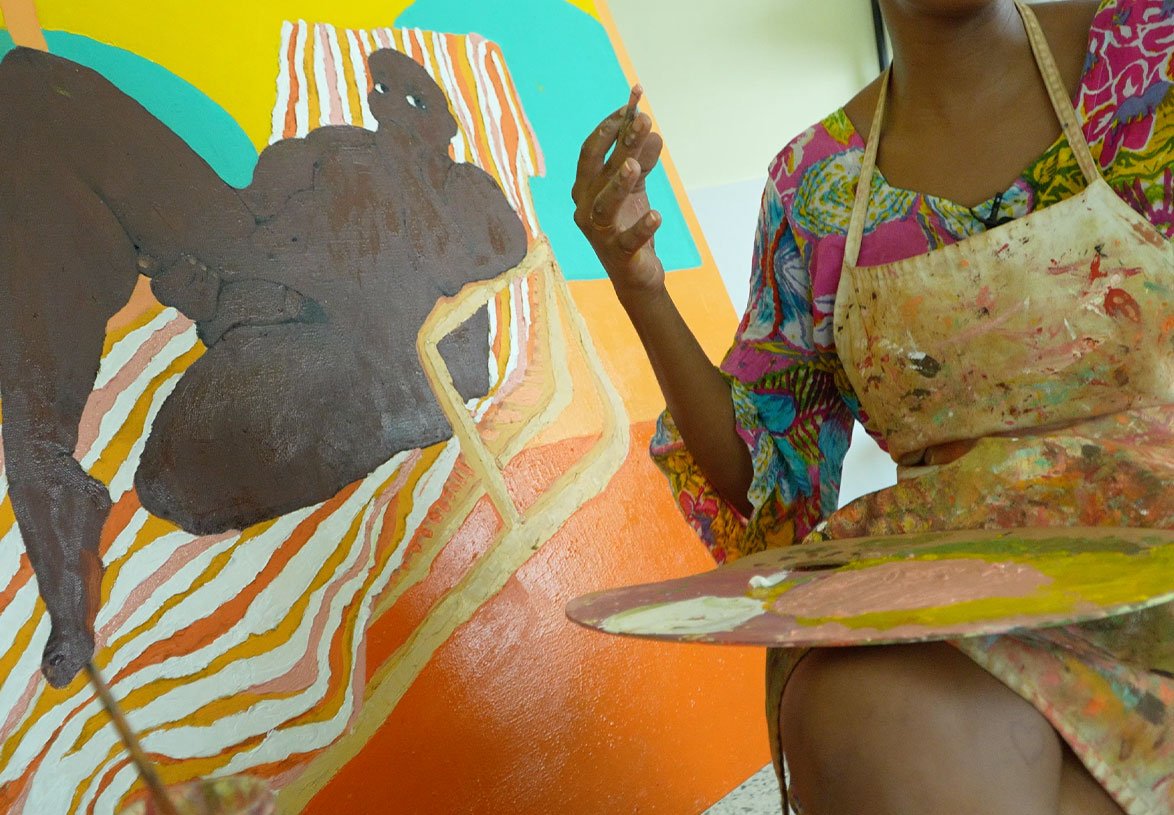
Most artists spend years painting through a borrowed eye before they find their own. Angie paints a cow kicking Napoleon off his horse, titled I push Napoleon by accident, and it is a whole method for how to define your style as an artist. She turned the canvas round to show me in her living room, and the day with the Dominican painter clicked into the clearest thing she said about who art was built for, and how you take it back.
“The title is, I push Napoleon by accident,” she told me, holding up David’s painting of Napoleon crossing the Alps. “I came with my cow and I kicked him. So that’s why his feet are here.”
How to define your style as an artist, kick the canon
To define your style as an artist you do not invent from nothing, you knock the inherited masterpiece off its pedestal to make room for yourself. You cannot build a personal style on an altar you are still worshipping, so the founding move is to stop revering the canon as the only way art can look. Angie does this literally, sending a cow into the most glorious image in Western art.
“It’s not a kicking thing because he’s a man,” she said. “I want to throw this main thing in the art that I like.” The target is the canon itself, the classic style she finds genuinely admirable and which was never built with her in it.
The white lens, and why you copy before you find your style
Most artists absorb a borrowed style first, because the canon presented as “what art is” is the dominant one, not their own. For a black artist this is the white lens, the books, the search results and the classic art that contain no one who looks like you. Defining your style begins with noticing that the default you inherited was never neutral.
“When you start doing art being a black person, the majority of things you find at the beginning, you need to go through a white lens to start having yours,” Angie said. “You can go look at Google and look at classic art, you won’t see a black person there.” The first eye any artist uses is rarely their own.
Stop copying, why an internalised bias damages your work
Copying a borrowed eye smuggles its biases in as your own taste, so you start correcting your work toward someone else’s standard without noticing. Internalised bias does not announce itself, it feels like preference, and the damage is that your style becomes a faithful copy of the thing that erased you. To find your art style you have to catch which tastes are truly yours and which you inherited as default.
It shows up in a thousand small surrenders, the palette you assume is tasteful, the subjects you assume are serious, the bodies you assume are beautiful. In Angie’s world it is the same pressure that tells black women to edit their hair and noses toward a whiter ideal, only turned on the canvas.
Find your artistic voice through the artists who broke the lens
You find your artistic voice by seeing someone like you do it first, so seek out the artists who broke the lens you are stuck under. Their existence is your permission slip. Angie’s whole practice rests on two Dominican painters, Plutarco Andújar and Jorge Severino, who painted countryside women who looked like her, and she wants to be that reference for the next girl.
“Knowing their work has done so much for me, I just want to be a continuation of that,” she said. Severino built a life’s work out of regally dressed black Dominican women, treated as a protest in their favour (the imaginary world of Jorge Severino). Each artist who broke the lens widened the lane for the next.
Develop your style, take the thing not made for you
One of the strongest ways to develop your artistic style is to take an inherited form that excludes you and install yourself at its centre. Keep the grand format, refuse the original content, and the friction between the two becomes your voice. Angie annexes the canon rather than rejecting it, picturing a black woman in the same narrative as the European masters.
“I would like to see an artist remake all these Marie Antoinette paintings and put a black woman in the same narrative,” she told me. “This narrative is so pushed to us that it would be nice to grab it and change it so it’s actually for us.” Take the form, swap the content, that is a generative engine for style.
Interview yourself to find your art style
The fastest route to your own style is to interview yourself, asking why you make what you make until the reasons are yours. Most artists never examine their own reasons, which is how a borrowed eye stays in charge. Your style is hiding in your honest answers, the hard questions and the tender ones alike.
“Have conversations with yourself as if it was an interview, ask yourself why you do the things that you do,” Angie said. The aggressive ones, “why do you paint naked women all the time,” and the gentle, “why is this the most perfect colour in the world.” Knowing the answers is what makes a style yours and not inherited.
Representation in art, the invasive flamboyán in the frame
Representation in art is about asking what belongs in the frame and what was merely planted there, the same question Angie asks of the beloved flamboyán tree, beautiful, everywhere and not native. The prettiest thing in the picture is not always the thing that belongs, and a borrowed reference can crowd out your own the way an invasive species crowds out local ones.
“They’re invasive,” she said of the red flamboyáns everyone loves. “They plant those trees and we are all happy, and they actually kill other trees that are more important for us.” It comes from Madagascar and can crowd out native species (Delonix regia). She questions the art on the walls and the trees in the yard with the same eye.
How to be an original artist, rewrite the canon
To be an original artist you do not wait for permission to make your own references, you take the glorious inherited thing and rewrite who stands at the centre of it. Audit the eye you were handed, find the artists who broke it, steal the form and swap the content, interview yourself until the reasons are yours. Style is what is left once you stop painting through someone else’s eyes.
Most of us inherited a culture that centred someone else, in its art, its fairy tales, its idea of beauty and power. You can feel locked out of it forever, or you can do what Angie does, keep what is genuinely glorious and rewrite the middle of it.
- Slug change: new slug `how-to-define-your-style-as-an-artist`, 301 from `i-push-napoleon-by-accident`.
- Facts to confirm with Angie: that the reference is Jacques-Louis David’s Napoleon Crossing the Alps, the spelling of Plutarco Andújar, and her full name (flag below).
- Photos needed: the cow and Napoleon piece (hero), a flamboyán tree shot. Alt text “how to define your style as an artist, Dominican artist Angie”.
- Keyword gaps: “how to find your art style”, “develop your artistic voice”, “stop copying other artists”, “how to be an original artist”, “representation in art” now placed in H2s and answer paragraphs.

12% Off Sustainable Swimwear
Freedom Ecowear is offering our readers 12% off their eco-friendly swimwear, perfect for your next eco getaway. Use the link and your discount is added automatically.