Is the Best Food in Negril Grown Local, Not Imported and Frozen?
Where does the food at Le Vendome actually come from?
The food at Le Vendome comes mostly from Charela Inn’s own farm, and what the farm does not grow, Daniel buys from local farmers he knows by name. While most Negril restaurants order from a wholesaler off a truck, this kitchen grows its produce on a hillside an hour inland and reduces imported food to the absolute minimum.
“The things that we don’t grow on the farm, we buy from other local farmers from here,” Daniel said. “We try the utmost best to reduce any imported food that we can get here in Jamaica.” The eggs, the goat, the organic produce. He knows where it came from because most of it came from him.
He does not see the farm and the kitchen as two things. “The two of them are natural partners. The restaurant is really the thing that gets the farm and the hotel together.” In his mind the kitchen even comes first. “The first thing we built was this restaurant, because that’s what we really are. Restauranteur more than hotelier.” It is the same instinct that runs through the whole of Charela Inn, and why it ranks with the certified sustainable stays in the Caribbean.
Does what the farm grows really end up on the menu?
Yes, the loop genuinely closes, and you can taste it. When I drove up into the hills to the farm that supplies the kitchen, the farmer walking me through the rows put it plainly.
“There will be cabbage on your menu. Always. Most of the time we have cabbage. And you have it when you do the salad as well.” It is the same story with the rest of the plate, the greens at breakfast, the ackee, the rice and peas.
He swears by the old black gungo peas for that last one. “When you do a good rice and peas you get as much nourishment as a steak,” he told me, as long as you use the original Jamaican gungo rather than the imported kind. That is the difference a working farm makes. I spent a whole morning out on that farm, and it changed how every meal back at Charela Inn tasted.
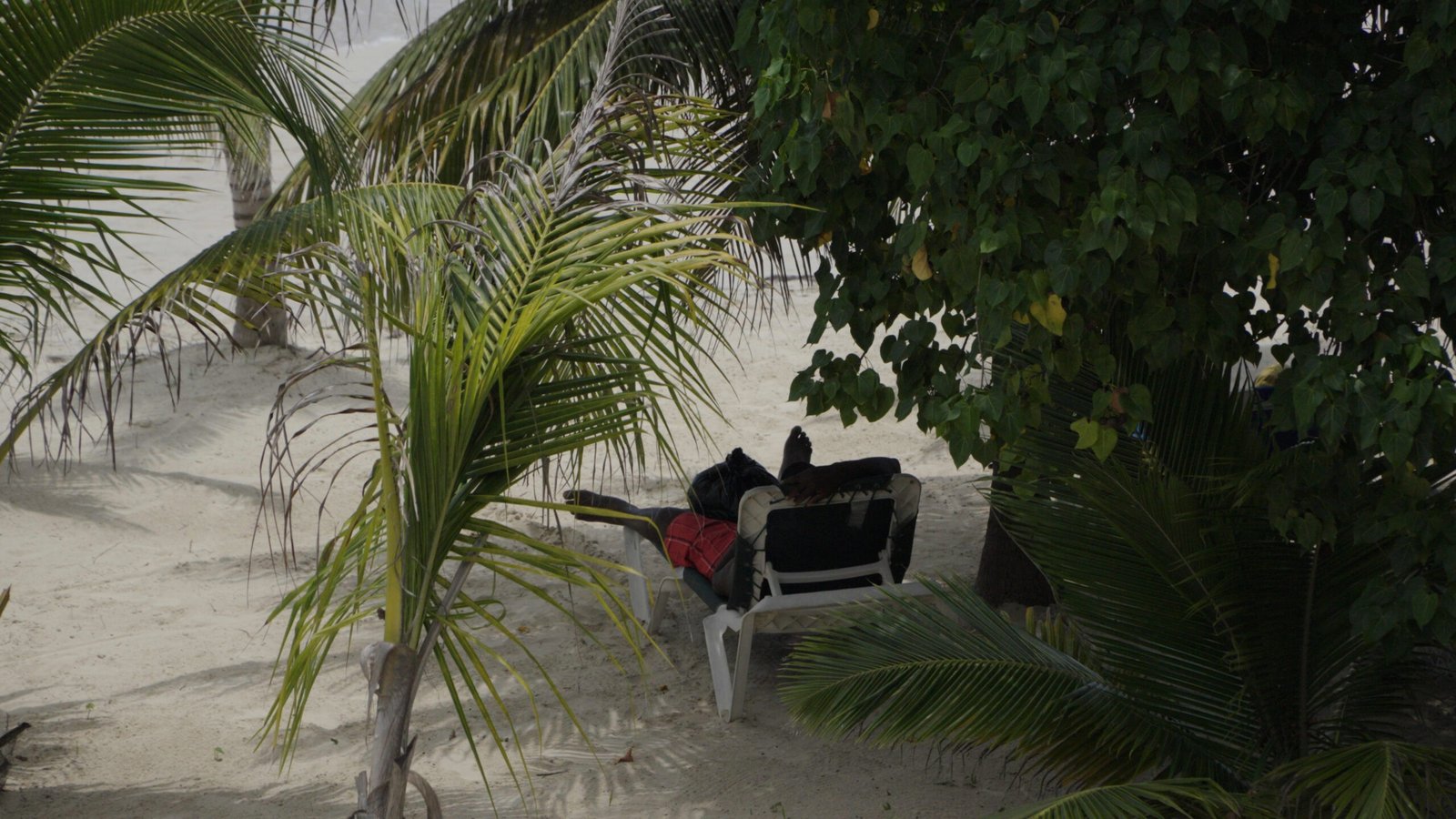
Why did this hotel plant coconut trees instead of plastic beach umbrellas?
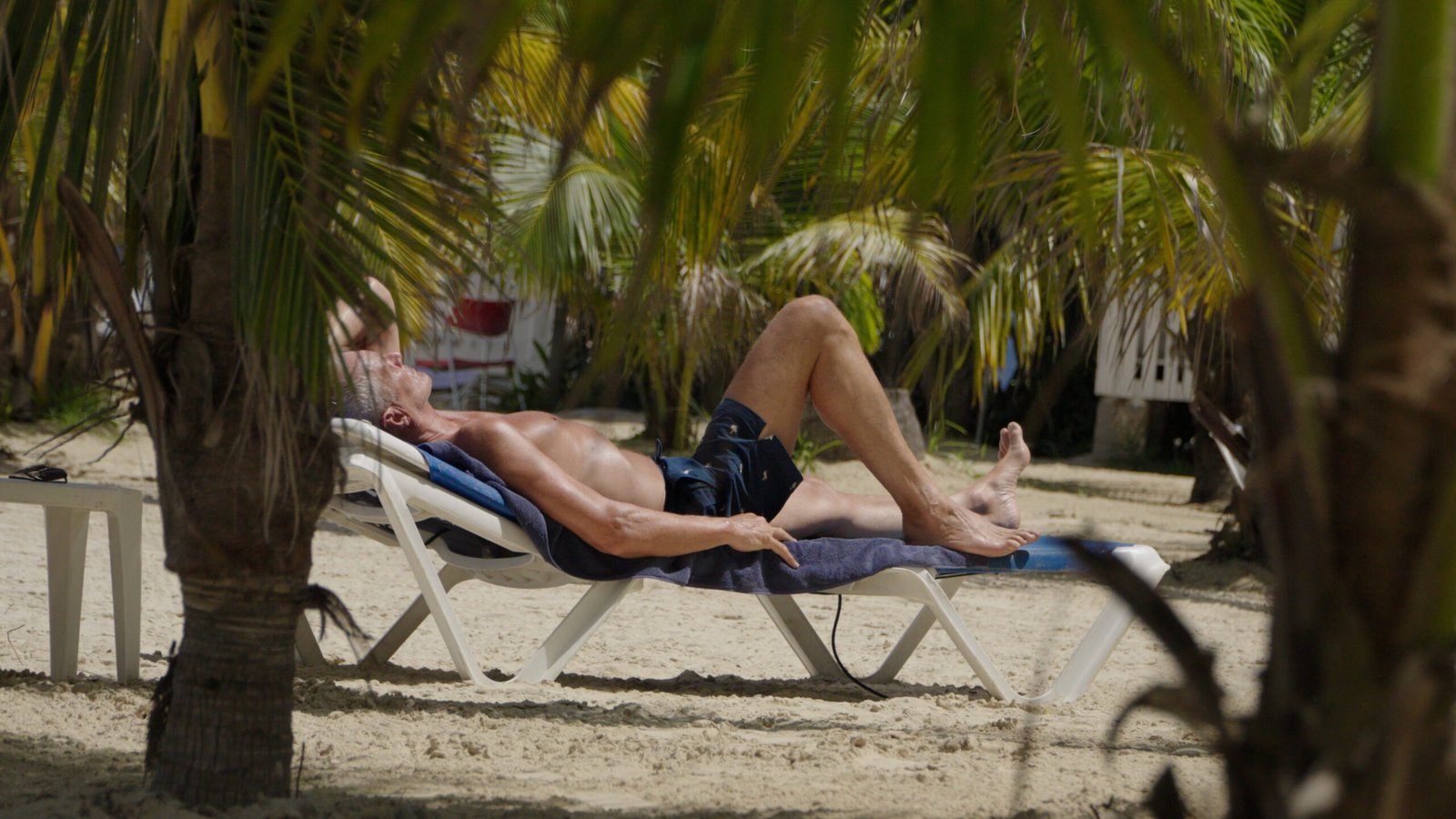
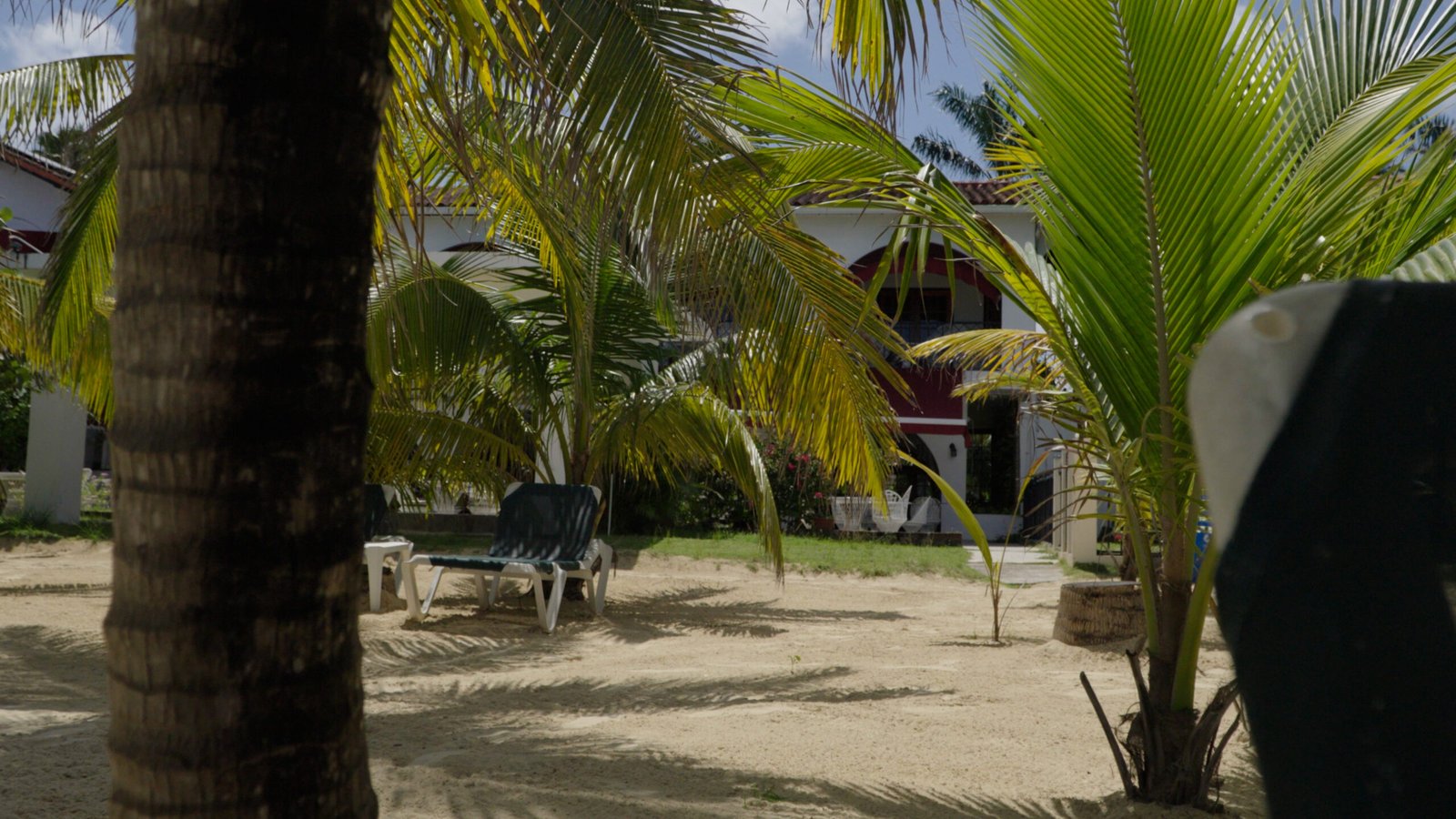
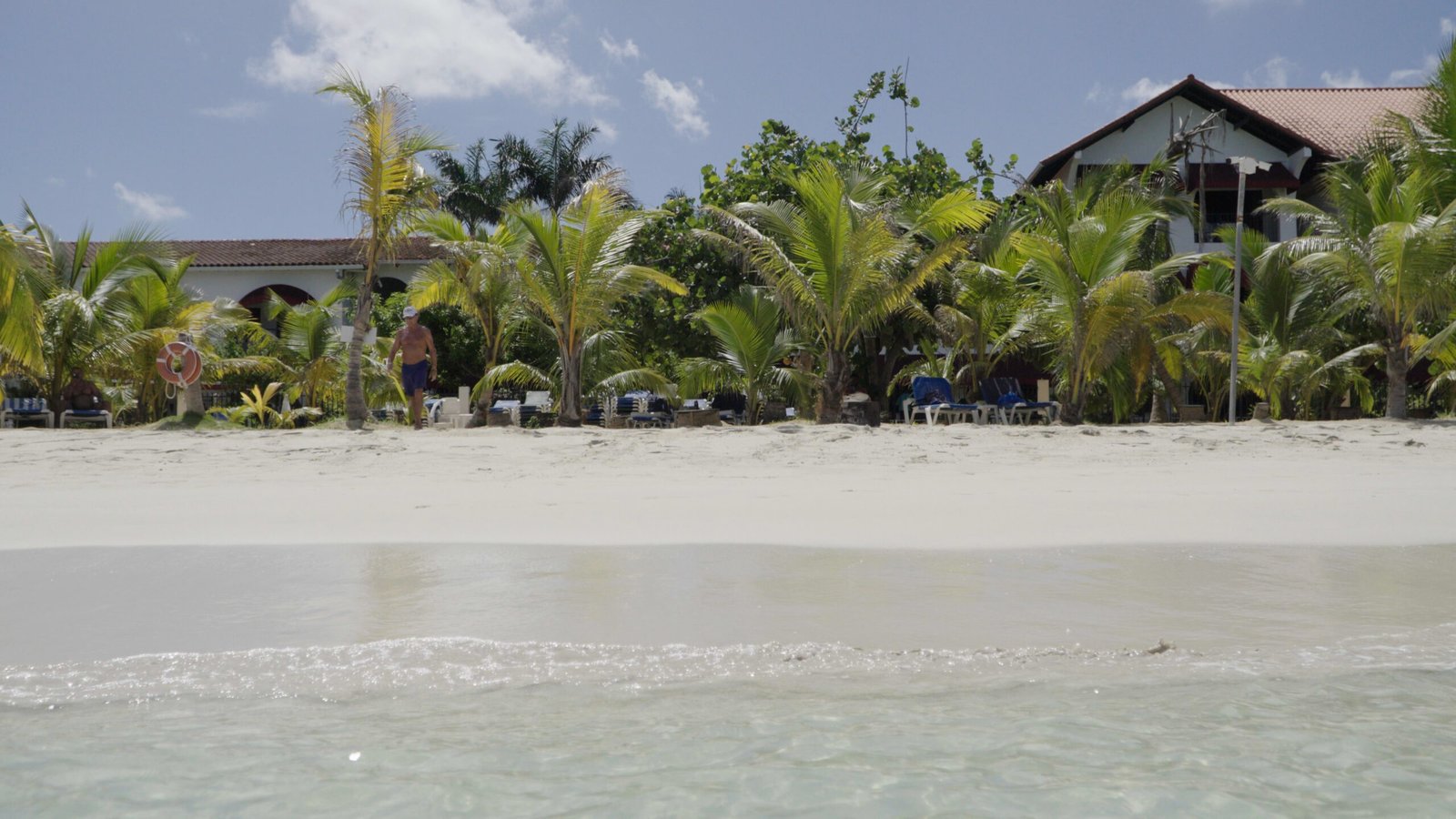
Charela Inn shades its guests with coconut and palm trees instead of plastic beach umbrellas, because a tree does the same job with zero waste. That is the owner’s answer to beach plastic, and it is why his stretch of Seven Mile Beach is genuinely plastic free while the rest of the strip is bolted with faded, salt-eaten umbrellas that get binned and replaced every season.
“Coconut trees shade is more sustainable, it’s more natural,” he told me. “And of course it brings you fruit.”
You have lain on both kinds of beach. On one, the shade is a row of plastic parasols, sun-bleached to a chalky grey, a bit ripped at the seam, the kind a gust flips inside out by noon. Somebody bought them. Somebody will throw them away. Somebody will buy more.
On the second one, Charela’s, the shade is a coconut palm that was a seed in this man’s hand years ago, that drops a coconut you can split and drink, that holds the sand against the next storm, that will still be standing when the plastic ones are landfill. Lie under both and tell me which one feels like a holiday and which one feels like a product.
That is the whole thing in one image. A tree does everything the umbrella does and more, and it never becomes waste, because it was never a product in the first place. The umbrella is bought, used, broken by the next storm, binned, replaced. The palm is planted once and gives for decades. One is consuming shade, the other is growing it.
And on a beach where the sea is right there, a few metres away, ready to receive anything that blows off the sand, that difference stops being poetic and becomes physical. Every plastic umbrella is a future piece of the ocean, just waiting for the wind. Every coconut tree is a piece of the island that stays the island. The owner did not plant trees to make a statement. He planted them because he could not look at the alternative and call it paradise.
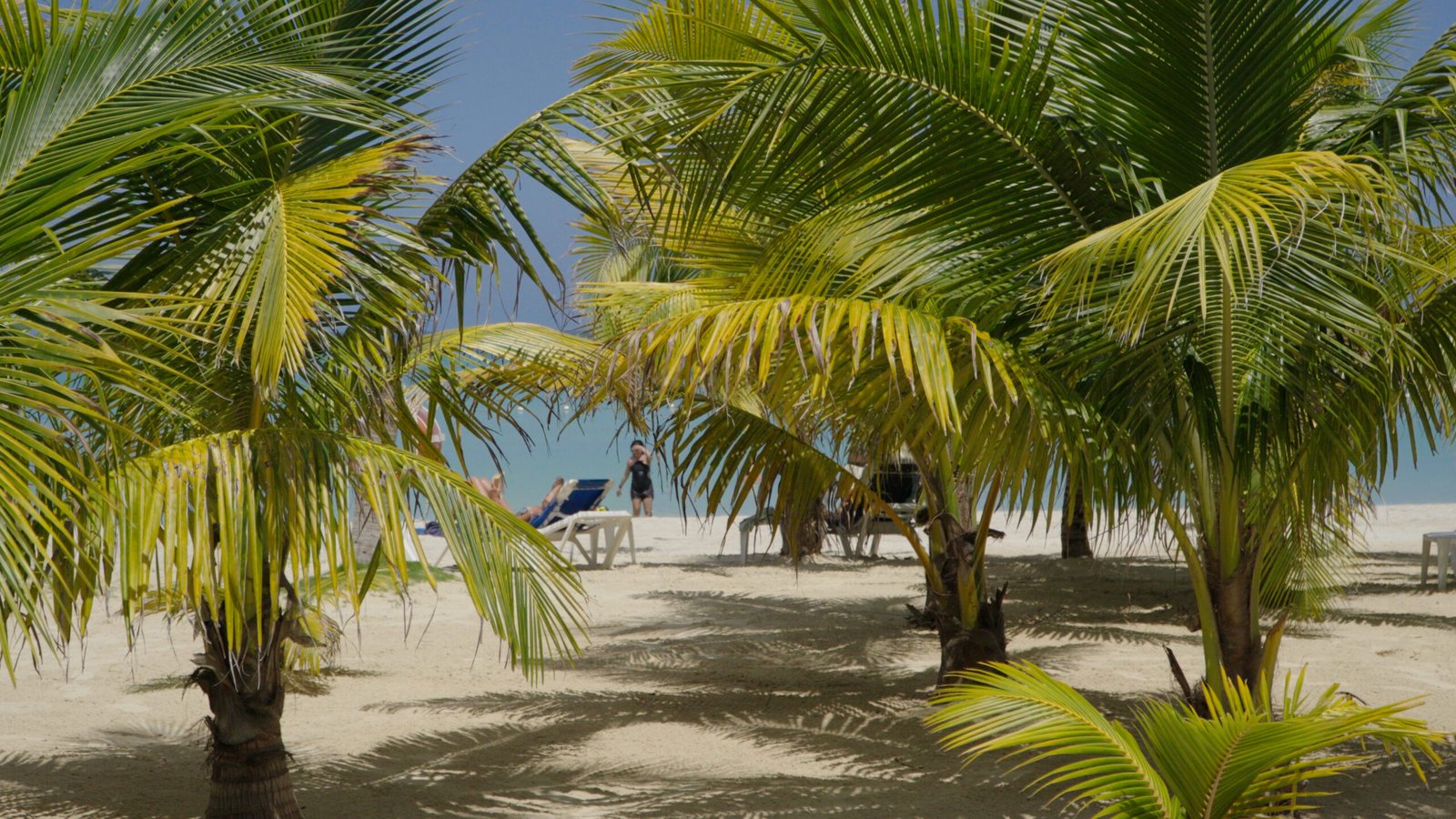
Swapping plastic beach chairs for nature is a start, not the whole answer
Swapping plastic beach chairs and umbrellas for natural shade is a real start on hotel plastic, not the whole answer, and we will be honest about that, because we always are. A few coconut trees do not cancel a resort’s water bottle mountain, and anyone who tells you one green gesture saves the planet is selling you something.
But do not let anyone shrink it either. The swap matters more than its size, because it is visible and it is copyable, and that is exactly how change actually moves. You lie under that coconut tree, and without a single lecture, something clicks. Oh. It can just be a tree.
The next hotelier walks the beach, sees Charela’s guests perfectly shaded under living palms, and quietly wonders why he is signing a purchase order for a hundred plastic ones every season. That is how an industry turns, not through one grand pledge at a conference, but through a thousand small defaults swapped one beach at a time, each one giving the next person permission.
And the bigger wins are the same move, scaled up, replace the disposable with the thing that lasts. The proof is already in. Hotels that committed to it cut amenity plastic by around 30% just with refillable dispensers, and pulled tens of thousands of bottles a year out of a single property with filtered water stations.
Mandarin Oriental eliminated 99% of its single use plastic, nearly 1,000 tonnes a year (Green Hospitality on how hotels can lead the waste reduction revolution). Marriott diverted over 1.7 million pounds of plastic by doing one boring thing, swapping miniature bottles for bulk dispensers (the One Planet Network plastic reduction guide for tourism). None of that was a sacrifice. It was just the end of a stupid habit.
So when you hear “it’s only a few coconut trees”, understand what you are really looking at. You are looking at a small hotel doing the exact thing the giants spend millions on consultants to half-do, and doing it for free, with seeds.
Charela Inn starts where every hotel can, with the shade on its own sand, then carries the same instinct inland to the solar, the water filtration and the farm. The umbrella is just the part you can see from your lounger.
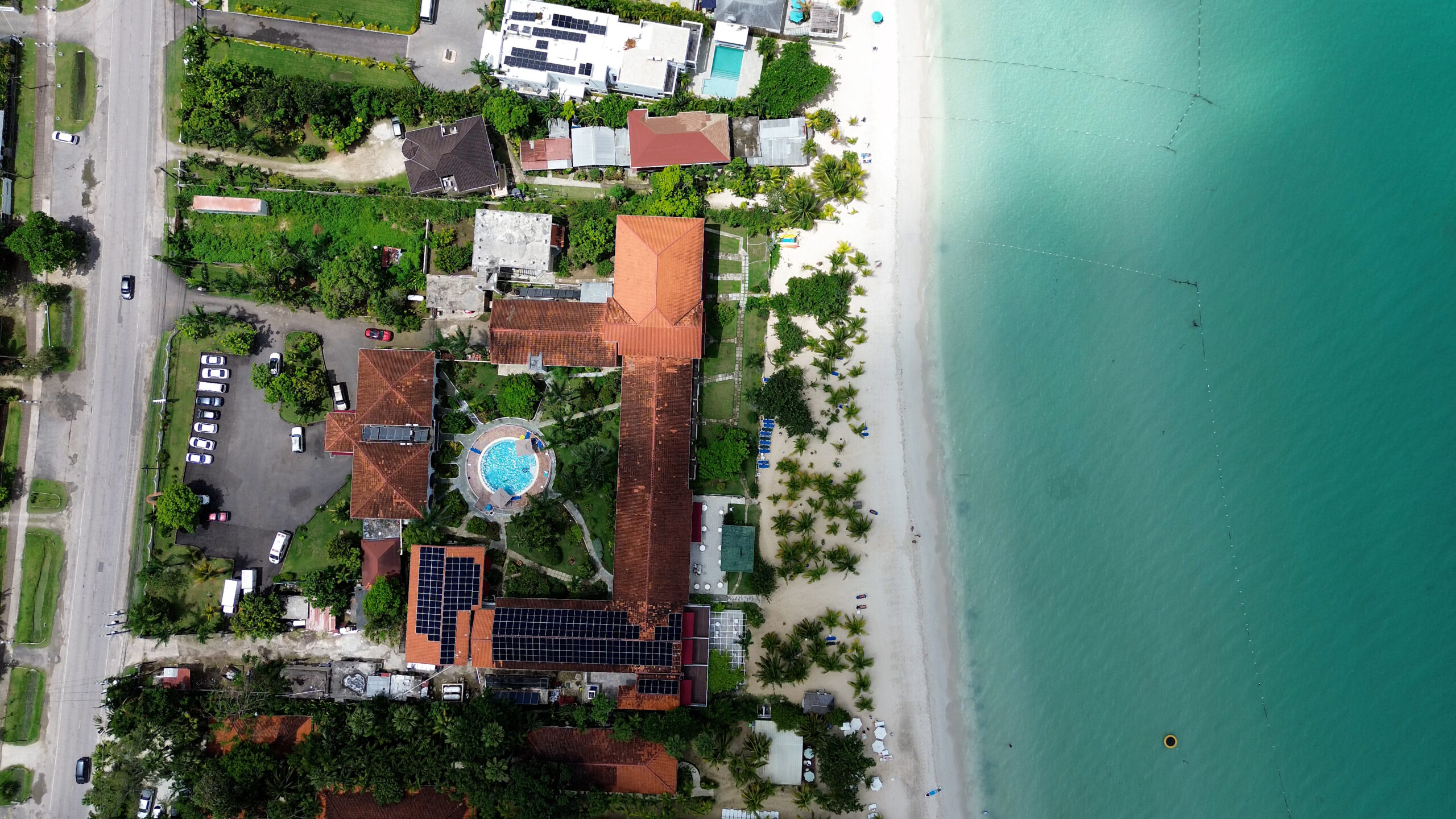
Where does hotel plastic end up? The ocean, the environment and human harm
Most hotel plastic ends up in the sea, because the beautiful hotels are built right on the water and plastic always finds a way out, a storm, a gust, a bin missed by the truck. It does not ride off to a tidy landfill somewhere you will never see. It goes into the exact water you swam in that afternoon. Surveys of tourist seafloors found over 70% of the waste lying on the bottom was plastic (Oceana, Plastic-Free Paradise). The snorkelling spot in the brochure and the dumping ground are the same square of ocean. From there the harm splits three ways, and you want to sit with all three.
Hotel plastic pollution effects on the ocean
Hotel plastic kills the sea life you came to see and poisons the water it sinks into. Oceana counted 1,171 plastic items out of 1,653 pieces of waste on tourist seafloors, nearly 71%, hundreds of pieces per square kilometre. That is not litter you can rake up at dawn before the guests wake. That is plastic that has already sunk, settled into the reef, and started to come apart.
Take the turtle you would pay good money to swim beside on a day trip. To that turtle, the plastic bag from your room’s bin looks exactly like a jellyfish, so it eats it, and it starves with a full stomach. The bottle ring becomes a noose for a seabird. The straps tangle a seal. And the big pieces do not vanish, they grind down into microplastic so fine it drifts through the water like dust, eaten by the smallest creatures in the chain, then by the fish that eat them, then by everything, all the way up. A single plastic umbrella that blows off your beach is not gone. It is the sea’s problem for the next four hundred years, long after everyone who lounged under it is dead.
Hotel plastic pollution damages the environment
Hotel plastic and the development around it are killing the coral reef that is the whole reason the water is that colour. People assume the Caribbean is just born turquoise. It is not. That clarity is a living reef working around the clock, and in Jamaica it is collapsing. Coastal tourism altered the shoreline, the construction clouded the water with sediment, and as far back as the late 1970s scientists were already documenting raw sewage from Negril hotels running straight into the sea (the environmental impact of mass tourism in Negril, 1970s to 2023).
Plastic finishes the job. It smothers the seagrass, it shades and scrapes the coral, it leaches chemicals into the water. Jamaica’s coral reef cover has fallen by more than half since they started counting, and its reef health index recently hit a record low rated “poor”.
Understand what that actually costs, because it is not about a prettier dive. A dead reef is a coastline with nothing standing between the island and the next hurricane, and a sea with far less of the fish the whole island eats. The thing that made the place paradise was also the thing protecting the people who live there, and we are letting it die for the view.
The human harm of hotel plastic pollution
Hotel plastic harms the people who live there long after your flight home, and this is the part nobody puts on the brochure. The woman who made up your room, the man who carried your bag, the chef who cooked your food, they do not leave at checkout. They live here. And the plastic you left behind does not leave either.
Follow whose hands actually touch this place. The same fish that swallowed the microplastic gets caught by a local fisherman, sold in the local market, and eaten by the family of the woman who folded your towels into a swan. The waste was the guest’s convenience for one week. It becomes the worker’s food for a lifetime. They serve you the beauty, and they are served back the bill.
And here is the thing that should sit with you. It still looks pristine. The beach gets raked at dawn before you wake, the bins get emptied out of sight, the bottle disappears from the nightstand. The mask stays on. That is the whole trick of a resort, to let you enjoy a place while the cost of your enjoyment is quietly carried out the back door by someone who cannot afford to leave. You see paradise. They see the part of paradise you do not.
Now bring it home, because this is not a story about somewhere far away that you get to feel sad about and forget. The exact same thing is happening where you live. The clean street, the tidy supermarket, the spotless hotel down the road, all of it runs on a back door too, a landfill someone else lives beside, a water table someone else drinks from, a worker who absorbs what you throw out so your bit of the world can keep looking perfect. Pristine is not the absence of harm. Pristine is the harm, moved somewhere you do not have to look at it.
That is the quiet injustice in a single use cup. The convenience is yours, the cost is theirs, and the cost is always paid by whoever has the least say. This is not personal, and it is not about guilt. It is about looking. Choosing a hotel that never lets the plastic reach the water in the first place is the simplest way to stop being the person whose holiday someone else has to clean up, and it is a real reason Charela earns the booking.
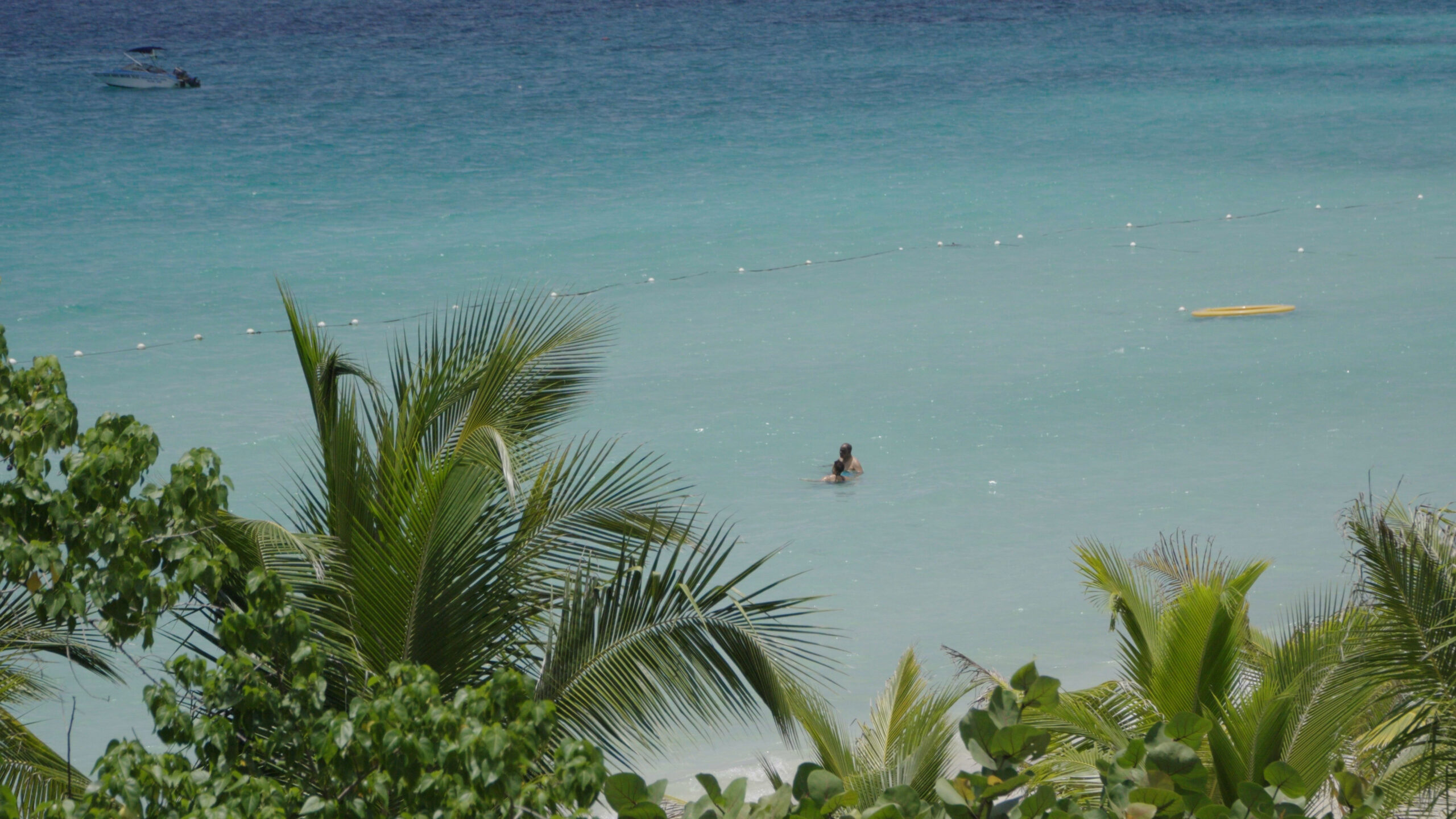
What is the image of Jamaica he refuses to lose?
The Jamaica the owner refuses to lose is the one from before the resorts, a coastline of coconut and breadfruit trees instead of plastic and concrete. This is not nostalgia for nostalgia’s sake, it is a man who watched it happen and decided he would not pretend it did not.
“For those who are old enough, we’ll remember Harry Belafonte singing about the island of coconut and palm trees,” he told me. “That’s the image of Jamaica, our beach, full of coconut and tall banana trees. When we were kids, what I remember was all the coconuts and breadfruit trees.”
He is describing a real place that real people are alive to remember. Within one lifetime, his lifetime, a beach defined by trees became a beach defined by development. Negril was planned as a resort town and built out fast through the 1980s and 1990s with row after row of mostly all inclusive hotels, and the coast paid the bill in concrete, sewage and plastic. He did not read about this loss. He stood on the sand and watched the trees come down and the parasols go up.
And here is the part that should make you uneasy on your own sun lounger, because it is the same story everywhere you have ever holidayed, and everywhere you live. Somebody, somewhere, remembers your nearest beach, your local river, the field behind your childhood house, the way it was before it became a car park, a development, a strip of the same shops.
The mask of “this is just how it is now” only works if nobody is old enough to remember it being different. Daniel is old enough. That is why his coconut trees are not really landscaping. They are an act of memory, a refusal, a small piece of the old island kept stubbornly alive on his own sand while everyone around him sold theirs.
Development on this scale is scarily damaging, and let us be honest about what drove it, it was money, every time. The owner is not anti tourism, he welcomes guests for a living, you are reading this so you can be one. What he refuses is the forgetting, the quiet agreement that a beautiful coast is just raw material for one more resort and that the Jamaica of coconut and breadfruit was a fair price to pay. It was not a fair price. He just decided not to charge it.
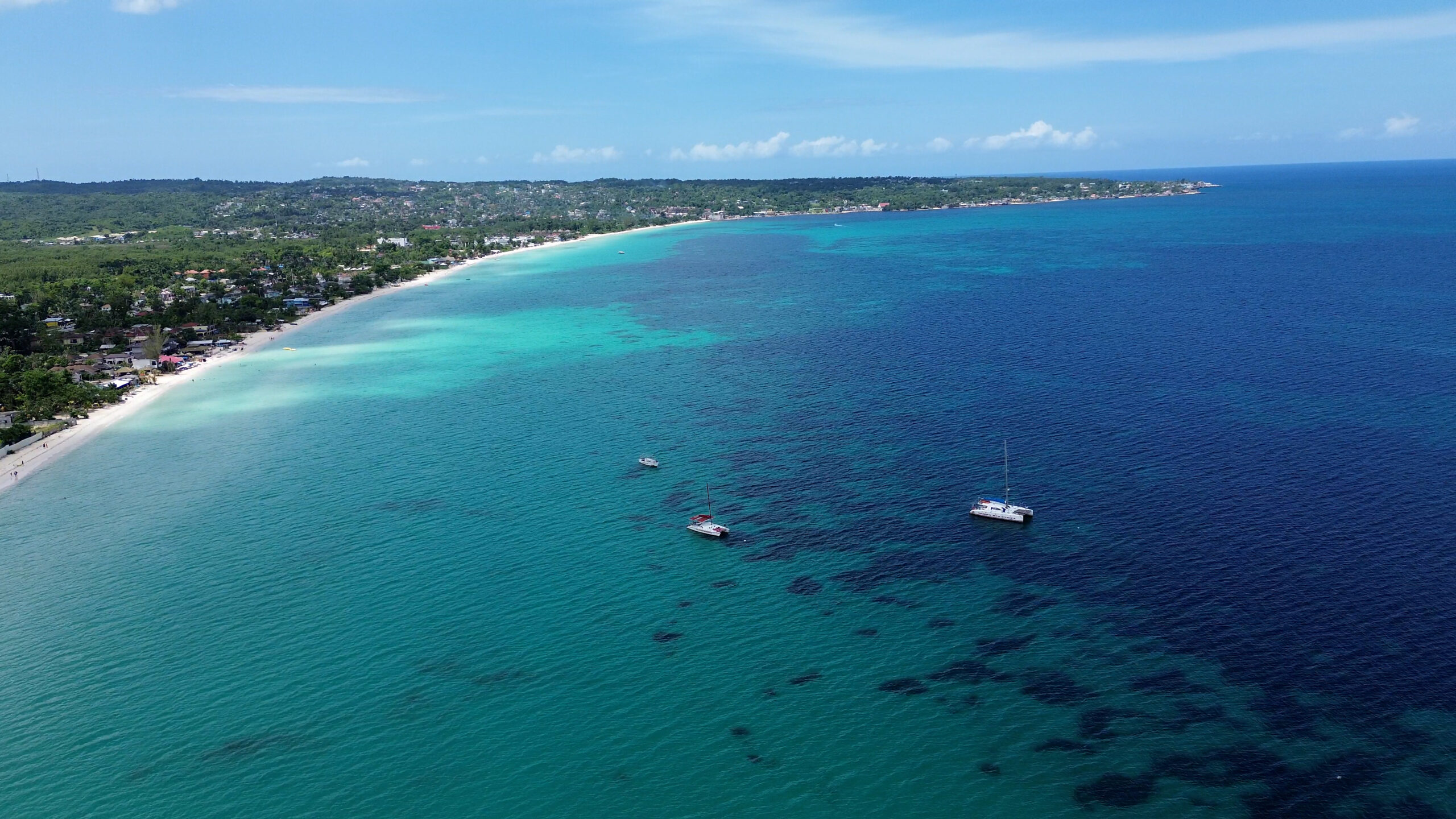
Seven Mile Beach does not need to look the way it does now
Seven Mile Beach, one of the most popular beach destination in Jamaica does not need the wall of plastic umbrellas, concrete and disposable kit that now defines it, because the island already gives the shade, the fruit and the beauty away for free. The plastic is a choice made for speed and money, not a necessity, and once you really see that, it becomes the most hopeful sentence in this whole piece.
Because a choice can be unmade. Nobody handed down the plastic beach from on high. It was built, one purchase order, one shortcut, one “it’s cheaper this way” at a time, which means it can be unbuilt exactly the same way. A hotel that plants shade instead of buying it, filters water instead of selling bottles, grows food instead of importing it, is not pulling off some heroic feat. It is just declining the default, one small refusal at a time, until the refusals add up to a different beach.
And this is where it stops being about Jamaica and starts being about you. Every plastic umbrella on that sand was once a choice someone made without thinking, and so is almost everything in your own life that you have stopped seeing, the bottle, the bag, the wrapped everything, the default you accept because it is what the shelf offered.
Daniel thought about his one default and chose the tree. You get to do the same, dozens of times a week, and the biggest one you get on holiday is where you sleep. When we book the hotel that planted trees instead of the resort that bought parasols, we are not just choosing a nicer beach. We are telling an entire industry which version of the coast we are willing to pay for, and money is the only language it has ever understood.
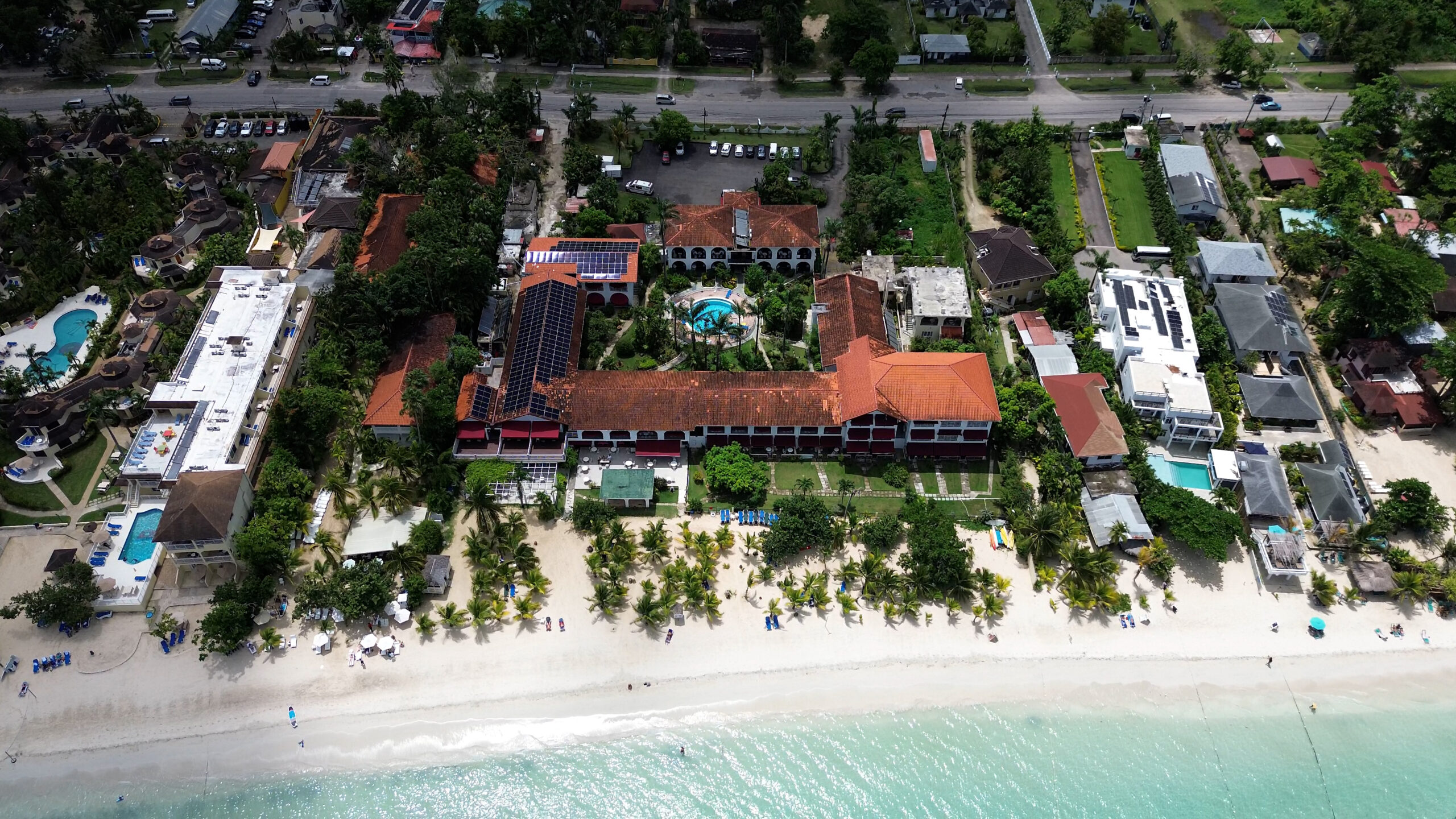
The hotel that grows its answers instead of buying them
Charela Inn answers hotel plastic the way it answers everything, by growing what other resorts buy and bin, and the beach umbrella is just the edge of it you can see from your lounger.
Walk the property and the same instinct is everywhere. It is black owned and female co owned, so the money and the decisions stay with the family and the island, not a head office in another country. It runs on solar off its own roofs. It filters its own water through multi stage carbon filtration, which is the quiet reason there is no pyramid of plastic bottles in your room, because they simply do not need to sell you water that is already clean from the tap.
And it grows most of its food on a 174 acre farm in the hills above Negril, so the callaloo, the cabbage and the coconut come down to the kitchen with dirt still on them instead of up from a shipping container wrapped in film. The trees on the beach and the farm in the hills are the same single idea, use the land you are standing on, not the supply chain you can hide behind.
This is a small inn doing quietly, with seeds and solar panels and a water filter, what the giant resorts next door spend fortunes on consultants to greenwash, and that gap is the whole reason it is worth your booking. You are not paying more to feel virtuous. You are paying the same to stay somewhere that does not need a mask, where the pristine is real because nothing is being carried out the back door for someone else to absorb.
See the whole place, certifications and all, on the Charela Inn eco stays listing, and book direct with the reader discount on charelainn.com. If you want to compare it against everything else on the island, we ranked the best eco stays in Jamaica honestly, and if you are island hopping, our guide to the rest of the eco stays across the Caribbean carries the same standard.
Of every choice you make on a holiday, where you sleep is the loudest. Booking the hotel that refused the plastic is the most direct vote a traveller ever gets to cast.
Why does a French restaurant sit on a Jamaican beach?
Le Vendome is French because of Daniel’s late wife Sylvie, who was French and wanted to share her cooking with the world. That is why the menu reads the way it does, French and Italian technique married to Jamaican produce, an old world croissant in the morning or a full Jamaican breakfast.
Walk ins are welcome, so you do not have to be a guest to eat here. I loved the breakfast most of all, a properly Jamaican plant based spread, callaloo, breadfruit, plantain and ackee, every bit of it naturally vegan, eaten slowly by the water before the beach woke up.
I would fly back for that table alone, and it is one reason the restaurant keeps Charela near the top of the sustainable hotels across the Caribbean.
Why did this hotel plant coconut trees instead of plastic beach umbrellas?
Charela Inn shades its guests with coconut and palm trees instead of plastic beach umbrellas, because a tree does the same job with zero waste. That is the owner’s answer to beach plastic, and it is why his stretch of Seven Mile Beach is genuinely plastic free while the rest of the strip is bolted with faded, salt-eaten umbrellas that get binned and replaced every season.
“Coconut trees shade is more sustainable, it’s more natural,” he told me. “And of course it brings you fruit.”
You have lain on both kinds of beach. On one, the shade is a row of plastic parasols, sun-bleached to a chalky grey, a bit ripped at the seam, the kind a gust flips inside out by noon. Somebody bought them. Somebody will throw them away. Somebody will buy more.
On the second one, Charela’s, the shade is a coconut palm that was a seed in this man’s hand years ago, that drops a coconut you can split and drink, that holds the sand against the next storm, that will still be standing when the plastic ones are landfill. Lie under both and tell me which one feels like a holiday and which one feels like a product.
That is the whole thing in one image. A tree does everything the umbrella does and more, and it never becomes waste, because it was never a product in the first place. The umbrella is bought, used, broken by the next storm, binned, replaced. The palm is planted once and gives for decades. One is consuming shade, the other is growing it.
And on a beach where the sea is right there, a few metres away, ready to receive anything that blows off the sand, that difference stops being poetic and becomes physical. Every plastic umbrella is a future piece of the ocean, just waiting for the wind. Every coconut tree is a piece of the island that stays the island. The owner did not plant trees to make a statement. He planted them because he could not look at the alternative and call it paradise.
Swapping plastic beach chairs for nature is a start, not the whole answer
Swapping plastic beach chairs and umbrellas for natural shade is a real start on hotel plastic, not the whole answer, and we will be honest about that, because we always are. A few coconut trees do not cancel a resort’s water bottle mountain, and anyone who tells you one green gesture saves the planet is selling you something.
But do not let anyone shrink it either. The swap matters more than its size, because it is visible and it is copyable, and that is exactly how change actually moves. You lie under that coconut tree, and without a single lecture, something clicks. Oh. It can just be a tree.
The next hotelier walks the beach, sees Charela’s guests perfectly shaded under living palms, and quietly wonders why he is signing a purchase order for a hundred plastic ones every season. That is how an industry turns, not through one grand pledge at a conference, but through a thousand small defaults swapped one beach at a time, each one giving the next person permission.
And the bigger wins are the same move, scaled up, replace the disposable with the thing that lasts. The proof is already in. Hotels that committed to it cut amenity plastic by around 30% just with refillable dispensers, and pulled tens of thousands of bottles a year out of a single property with filtered water stations.
Mandarin Oriental eliminated 99% of its single use plastic, nearly 1,000 tonnes a year (Green Hospitality on how hotels can lead the waste reduction revolution). Marriott diverted over 1.7 million pounds of plastic by doing one boring thing, swapping miniature bottles for bulk dispensers (the One Planet Network plastic reduction guide for tourism). None of that was a sacrifice. It was just the end of a stupid habit.
So when you hear “it’s only a few coconut trees”, understand what you are really looking at. You are looking at a small hotel doing the exact thing the giants spend millions on consultants to half-do, and doing it for free, with seeds.
Charela Inn starts where every hotel can, with the shade on its own sand, then carries the same instinct inland to the solar, the water filtration and the farm. The umbrella is just the part you can see from your lounger.
Where does hotel plastic end up? The ocean, the environment and human harm
Most hotel plastic ends up in the sea, because the beautiful hotels are built right on the water and plastic always finds a way out, a storm, a gust, a bin missed by the truck. It does not ride off to a tidy landfill somewhere you will never see. It goes into the exact water you swam in that afternoon. Surveys of tourist seafloors found over 70% of the waste lying on the bottom was plastic (Oceana, Plastic-Free Paradise). The snorkelling spot in the brochure and the dumping ground are the same square of ocean. From there the harm splits three ways, and you want to sit with all three.
Hotel plastic pollution effects on the ocean
Hotel plastic kills the sea life you came to see and poisons the water it sinks into. Oceana counted 1,171 plastic items out of 1,653 pieces of waste on tourist seafloors, nearly 71%, hundreds of pieces per square kilometre. That is not litter you can rake up at dawn before the guests wake. That is plastic that has already sunk, settled into the reef, and started to come apart.
Take the turtle you would pay good money to swim beside on a day trip. To that turtle, the plastic bag from your room’s bin looks exactly like a jellyfish, so it eats it, and it starves with a full stomach. The bottle ring becomes a noose for a seabird. The straps tangle a seal. And the big pieces do not vanish, they grind down into microplastic so fine it drifts through the water like dust, eaten by the smallest creatures in the chain, then by the fish that eat them, then by everything, all the way up. A single plastic umbrella that blows off your beach is not gone. It is the sea’s problem for the next four hundred years, long after everyone who lounged under it is dead.
Hotel plastic pollution damages the environment
Hotel plastic and the development around it are killing the coral reef that is the whole reason the water is that colour. People assume the Caribbean is just born turquoise. It is not. That clarity is a living reef working around the clock, and in Jamaica it is collapsing. Coastal tourism altered the shoreline, the construction clouded the water with sediment, and as far back as the late 1970s scientists were already documenting raw sewage from Negril hotels running straight into the sea (the environmental impact of mass tourism in Negril, 1970s to 2023).
Plastic finishes the job. It smothers the seagrass, it shades and scrapes the coral, it leaches chemicals into the water. Jamaica’s coral reef cover has fallen by more than half since they started counting, and its reef health index recently hit a record low rated “poor”.
Understand what that actually costs, because it is not about a prettier dive. A dead reef is a coastline with nothing standing between the island and the next hurricane, and a sea with far less of the fish the whole island eats. The thing that made the place paradise was also the thing protecting the people who live there, and we are letting it die for the view.
The human harm of hotel plastic pollution
Hotel plastic harms the people who live there long after your flight home, and this is the part nobody puts on the brochure. The woman who made up your room, the man who carried your bag, the chef who cooked your food, they do not leave at checkout. They live here. And the plastic you left behind does not leave either.
Follow whose hands actually touch this place. The same fish that swallowed the microplastic gets caught by a local fisherman, sold in the local market, and eaten by the family of the woman who folded your towels into a swan. The waste was the guest’s convenience for one week. It becomes the worker’s food for a lifetime. They serve you the beauty, and they are served back the bill.
And here is the thing that should sit with you. It still looks pristine. The beach gets raked at dawn before you wake, the bins get emptied out of sight, the bottle disappears from the nightstand. The mask stays on. That is the whole trick of a resort, to let you enjoy a place while the cost of your enjoyment is quietly carried out the back door by someone who cannot afford to leave. You see paradise. They see the part of paradise you do not.
Now bring it home, because this is not a story about somewhere far away that you get to feel sad about and forget. The exact same thing is happening where you live. The clean street, the tidy supermarket, the spotless hotel down the road, all of it runs on a back door too, a landfill someone else lives beside, a water table someone else drinks from, a worker who absorbs what you throw out so your bit of the world can keep looking perfect. Pristine is not the absence of harm. Pristine is the harm, moved somewhere you do not have to look at it.
That is the quiet injustice in a single use cup. The convenience is yours, the cost is theirs, and the cost is always paid by whoever has the least say. This is not personal, and it is not about guilt. It is about looking. Choosing a hotel that never lets the plastic reach the water in the first place is the simplest way to stop being the person whose holiday someone else has to clean up, and it is a real reason Charela earns the booking.
What is the image of Jamaica he refuses to lose?
The Jamaica the owner refuses to lose is the one from before the resorts, a coastline of coconut and breadfruit trees instead of plastic and concrete. This is not nostalgia for nostalgia’s sake, it is a man who watched it happen and decided he would not pretend it did not.
“For those who are old enough, we’ll remember Harry Belafonte singing about the island of coconut and palm trees,” he told me. “That’s the image of Jamaica, our beach, full of coconut and tall banana trees. When we were kids, what I remember was all the coconuts and breadfruit trees.”
He is describing a real place that real people are alive to remember. Within one lifetime, his lifetime, a beach defined by trees became a beach defined by development. Negril was planned as a resort town and built out fast through the 1980s and 1990s with row after row of mostly all inclusive hotels, and the coast paid the bill in concrete, sewage and plastic. He did not read about this loss. He stood on the sand and watched the trees come down and the parasols go up.
And here is the part that should make you uneasy on your own sun lounger, because it is the same story everywhere you have ever holidayed, and everywhere you live. Somebody, somewhere, remembers your nearest beach, your local river, the field behind your childhood house, the way it was before it became a car park, a development, a strip of the same shops.
The mask of “this is just how it is now” only works if nobody is old enough to remember it being different. Daniel is old enough. That is why his coconut trees are not really landscaping. They are an act of memory, a refusal, a small piece of the old island kept stubbornly alive on his own sand while everyone around him sold theirs.
Development on this scale is scarily damaging, and let us be honest about what drove it, it was money, every time. The owner is not anti tourism, he welcomes guests for a living, you are reading this so you can be one. What he refuses is the forgetting, the quiet agreement that a beautiful coast is just raw material for one more resort and that the Jamaica of coconut and breadfruit was a fair price to pay. It was not a fair price. He just decided not to charge it.
Seven Mile Beach does not need to look the way it does now
Seven Mile Beach, one of the most popular beach destination in Jamaica does not need the wall of plastic umbrellas, concrete and disposable kit that now defines it, because the island already gives the shade, the fruit and the beauty away for free. The plastic is a choice made for speed and money, not a necessity, and once you really see that, it becomes the most hopeful sentence in this whole piece.
Because a choice can be unmade. Nobody handed down the plastic beach from on high. It was built, one purchase order, one shortcut, one “it’s cheaper this way” at a time, which means it can be unbuilt exactly the same way. A hotel that plants shade instead of buying it, filters water instead of selling bottles, grows food instead of importing it, is not pulling off some heroic feat. It is just declining the default, one small refusal at a time, until the refusals add up to a different beach.
And this is where it stops being about Jamaica and starts being about you. Every plastic umbrella on that sand was once a choice someone made without thinking, and so is almost everything in your own life that you have stopped seeing, the bottle, the bag, the wrapped everything, the default you accept because it is what the shelf offered.
Daniel thought about his one default and chose the tree. You get to do the same, dozens of times a week, and the biggest one you get on holiday is where you sleep. When we book the hotel that planted trees instead of the resort that bought parasols, we are not just choosing a nicer beach. We are telling an entire industry which version of the coast we are willing to pay for, and money is the only language it has ever understood.
The hotel that grows its answers instead of buying them
Charela Inn answers hotel plastic the way it answers everything, by growing what other resorts buy and bin, and the beach umbrella is just the edge of it you can see from your lounger.
Walk the property and the same instinct is everywhere. It is black owned and female co owned, so the money and the decisions stay with the family and the island, not a head office in another country. It runs on solar off its own roofs. It filters its own water through multi stage carbon filtration, which is the quiet reason there is no pyramid of plastic bottles in your room, because they simply do not need to sell you water that is already clean from the tap.
And it grows most of its food on a 174 acre farm in the hills above Negril, so the callaloo, the cabbage and the coconut come down to the kitchen with dirt still on them instead of up from a shipping container wrapped in film. The trees on the beach and the farm in the hills are the same single idea, use the land you are standing on, not the supply chain you can hide behind.
This is a small inn doing quietly, with seeds and solar panels and a water filter, what the giant resorts next door spend fortunes on consultants to greenwash, and that gap is the whole reason it is worth your booking. You are not paying more to feel virtuous. You are paying the same to stay somewhere that does not need a mask, where the pristine is real because nothing is being carried out the back door for someone else to absorb.
See the whole place, certifications and all, on the Charela Inn eco stays listing, and book direct with the reader discount on charelainn.com. If you want to compare it against everything else on the island, we ranked the best eco stays in Jamaica honestly, and if you are island hopping, our guide to the rest of the eco stays across the Caribbean carries the same standard.
Of every choice you make on a holiday, where you sleep is the loudest. Booking the hotel that refused the plastic is the most direct vote a traveller ever gets to cast.
What is Jamaica's national dish, and can you eat it here properly?
Jamaica’s national dish is ackee and saltfish with roast breadfruit, and Le Vendome is a good place to have it made the right way, because growing your own buys you the time to do it properly. The farmer who supplies the kitchen called it the old national dish, going right back to slavery days.
Ackee is not a fruit you rush. It has to ripen and split open on the tree before it is even safe to touch, then it is cleaned of its seed and the soft inner part by hand. “Some restaurants don’t have the time” to do that properly, he admitted. A kitchen that grows its own does have the time, and the breadfruit gets roasted until it turns, the way it has been done forever. That care is exactly what we look for across the water saving and self sufficient eco stays in the Caribbean, and it starts on the farm that feeds this kitchen.
Why did this hotel plant coconut trees instead of plastic beach umbrellas?
Charela Inn shades its guests with coconut and palm trees instead of plastic beach umbrellas, because a tree does the same job with zero waste. That is the owner’s answer to beach plastic, and it is why his stretch of Seven Mile Beach is genuinely plastic free while the rest of the strip is bolted with faded, salt-eaten umbrellas that get binned and replaced every season.
“Coconut trees shade is more sustainable, it’s more natural,” he told me. “And of course it brings you fruit.”
You have lain on both kinds of beach. On one, the shade is a row of plastic parasols, sun-bleached to a chalky grey, a bit ripped at the seam, the kind a gust flips inside out by noon. Somebody bought them. Somebody will throw them away. Somebody will buy more.
On the second one, Charela’s, the shade is a coconut palm that was a seed in this man’s hand years ago, that drops a coconut you can split and drink, that holds the sand against the next storm, that will still be standing when the plastic ones are landfill. Lie under both and tell me which one feels like a holiday and which one feels like a product.
That is the whole thing in one image. A tree does everything the umbrella does and more, and it never becomes waste, because it was never a product in the first place. The umbrella is bought, used, broken by the next storm, binned, replaced. The palm is planted once and gives for decades. One is consuming shade, the other is growing it.
And on a beach where the sea is right there, a few metres away, ready to receive anything that blows off the sand, that difference stops being poetic and becomes physical. Every plastic umbrella is a future piece of the ocean, just waiting for the wind. Every coconut tree is a piece of the island that stays the island. The owner did not plant trees to make a statement. He planted them because he could not look at the alternative and call it paradise.
Swapping plastic beach chairs for nature is a start, not the whole answer
Swapping plastic beach chairs and umbrellas for natural shade is a real start on hotel plastic, not the whole answer, and we will be honest about that, because we always are. A few coconut trees do not cancel a resort’s water bottle mountain, and anyone who tells you one green gesture saves the planet is selling you something.
But do not let anyone shrink it either. The swap matters more than its size, because it is visible and it is copyable, and that is exactly how change actually moves. You lie under that coconut tree, and without a single lecture, something clicks. Oh. It can just be a tree.
The next hotelier walks the beach, sees Charela’s guests perfectly shaded under living palms, and quietly wonders why he is signing a purchase order for a hundred plastic ones every season. That is how an industry turns, not through one grand pledge at a conference, but through a thousand small defaults swapped one beach at a time, each one giving the next person permission.
And the bigger wins are the same move, scaled up, replace the disposable with the thing that lasts. The proof is already in. Hotels that committed to it cut amenity plastic by around 30% just with refillable dispensers, and pulled tens of thousands of bottles a year out of a single property with filtered water stations.
Mandarin Oriental eliminated 99% of its single use plastic, nearly 1,000 tonnes a year (Green Hospitality on how hotels can lead the waste reduction revolution). Marriott diverted over 1.7 million pounds of plastic by doing one boring thing, swapping miniature bottles for bulk dispensers (the One Planet Network plastic reduction guide for tourism). None of that was a sacrifice. It was just the end of a stupid habit.
So when you hear “it’s only a few coconut trees”, understand what you are really looking at. You are looking at a small hotel doing the exact thing the giants spend millions on consultants to half-do, and doing it for free, with seeds.
Charela Inn starts where every hotel can, with the shade on its own sand, then carries the same instinct inland to the solar, the water filtration and the farm. The umbrella is just the part you can see from your lounger.
Where does hotel plastic end up? The ocean, the environment and human harm
Most hotel plastic ends up in the sea, because the beautiful hotels are built right on the water and plastic always finds a way out, a storm, a gust, a bin missed by the truck. It does not ride off to a tidy landfill somewhere you will never see. It goes into the exact water you swam in that afternoon. Surveys of tourist seafloors found over 70% of the waste lying on the bottom was plastic (Oceana, Plastic-Free Paradise). The snorkelling spot in the brochure and the dumping ground are the same square of ocean. From there the harm splits three ways, and you want to sit with all three.
Hotel plastic pollution effects on the ocean
Hotel plastic kills the sea life you came to see and poisons the water it sinks into. Oceana counted 1,171 plastic items out of 1,653 pieces of waste on tourist seafloors, nearly 71%, hundreds of pieces per square kilometre. That is not litter you can rake up at dawn before the guests wake. That is plastic that has already sunk, settled into the reef, and started to come apart.
Take the turtle you would pay good money to swim beside on a day trip. To that turtle, the plastic bag from your room’s bin looks exactly like a jellyfish, so it eats it, and it starves with a full stomach. The bottle ring becomes a noose for a seabird. The straps tangle a seal. And the big pieces do not vanish, they grind down into microplastic so fine it drifts through the water like dust, eaten by the smallest creatures in the chain, then by the fish that eat them, then by everything, all the way up. A single plastic umbrella that blows off your beach is not gone. It is the sea’s problem for the next four hundred years, long after everyone who lounged under it is dead.
Hotel plastic pollution damages the environment
Hotel plastic and the development around it are killing the coral reef that is the whole reason the water is that colour. People assume the Caribbean is just born turquoise. It is not. That clarity is a living reef working around the clock, and in Jamaica it is collapsing. Coastal tourism altered the shoreline, the construction clouded the water with sediment, and as far back as the late 1970s scientists were already documenting raw sewage from Negril hotels running straight into the sea (the environmental impact of mass tourism in Negril, 1970s to 2023).
Plastic finishes the job. It smothers the seagrass, it shades and scrapes the coral, it leaches chemicals into the water. Jamaica’s coral reef cover has fallen by more than half since they started counting, and its reef health index recently hit a record low rated “poor”.
Understand what that actually costs, because it is not about a prettier dive. A dead reef is a coastline with nothing standing between the island and the next hurricane, and a sea with far less of the fish the whole island eats. The thing that made the place paradise was also the thing protecting the people who live there, and we are letting it die for the view.
The human harm of hotel plastic pollution
Hotel plastic harms the people who live there long after your flight home, and this is the part nobody puts on the brochure. The woman who made up your room, the man who carried your bag, the chef who cooked your food, they do not leave at checkout. They live here. And the plastic you left behind does not leave either.
Follow whose hands actually touch this place. The same fish that swallowed the microplastic gets caught by a local fisherman, sold in the local market, and eaten by the family of the woman who folded your towels into a swan. The waste was the guest’s convenience for one week. It becomes the worker’s food for a lifetime. They serve you the beauty, and they are served back the bill.
And here is the thing that should sit with you. It still looks pristine. The beach gets raked at dawn before you wake, the bins get emptied out of sight, the bottle disappears from the nightstand. The mask stays on. That is the whole trick of a resort, to let you enjoy a place while the cost of your enjoyment is quietly carried out the back door by someone who cannot afford to leave. You see paradise. They see the part of paradise you do not.
Now bring it home, because this is not a story about somewhere far away that you get to feel sad about and forget. The exact same thing is happening where you live. The clean street, the tidy supermarket, the spotless hotel down the road, all of it runs on a back door too, a landfill someone else lives beside, a water table someone else drinks from, a worker who absorbs what you throw out so your bit of the world can keep looking perfect. Pristine is not the absence of harm. Pristine is the harm, moved somewhere you do not have to look at it.
That is the quiet injustice in a single use cup. The convenience is yours, the cost is theirs, and the cost is always paid by whoever has the least say. This is not personal, and it is not about guilt. It is about looking. Choosing a hotel that never lets the plastic reach the water in the first place is the simplest way to stop being the person whose holiday someone else has to clean up, and it is a real reason Charela earns the booking.
What is the image of Jamaica he refuses to lose?
The Jamaica the owner refuses to lose is the one from before the resorts, a coastline of coconut and breadfruit trees instead of plastic and concrete. This is not nostalgia for nostalgia’s sake, it is a man who watched it happen and decided he would not pretend it did not.
“For those who are old enough, we’ll remember Harry Belafonte singing about the island of coconut and palm trees,” he told me. “That’s the image of Jamaica, our beach, full of coconut and tall banana trees. When we were kids, what I remember was all the coconuts and breadfruit trees.”
He is describing a real place that real people are alive to remember. Within one lifetime, his lifetime, a beach defined by trees became a beach defined by development. Negril was planned as a resort town and built out fast through the 1980s and 1990s with row after row of mostly all inclusive hotels, and the coast paid the bill in concrete, sewage and plastic. He did not read about this loss. He stood on the sand and watched the trees come down and the parasols go up.
And here is the part that should make you uneasy on your own sun lounger, because it is the same story everywhere you have ever holidayed, and everywhere you live. Somebody, somewhere, remembers your nearest beach, your local river, the field behind your childhood house, the way it was before it became a car park, a development, a strip of the same shops.
The mask of “this is just how it is now” only works if nobody is old enough to remember it being different. Daniel is old enough. That is why his coconut trees are not really landscaping. They are an act of memory, a refusal, a small piece of the old island kept stubbornly alive on his own sand while everyone around him sold theirs.
Development on this scale is scarily damaging, and let us be honest about what drove it, it was money, every time. The owner is not anti tourism, he welcomes guests for a living, you are reading this so you can be one. What he refuses is the forgetting, the quiet agreement that a beautiful coast is just raw material for one more resort and that the Jamaica of coconut and breadfruit was a fair price to pay. It was not a fair price. He just decided not to charge it.
Seven Mile Beach does not need to look the way it does now
Seven Mile Beach, one of the most popular beach destination in Jamaica does not need the wall of plastic umbrellas, concrete and disposable kit that now defines it, because the island already gives the shade, the fruit and the beauty away for free. The plastic is a choice made for speed and money, not a necessity, and once you really see that, it becomes the most hopeful sentence in this whole piece.
Because a choice can be unmade. Nobody handed down the plastic beach from on high. It was built, one purchase order, one shortcut, one “it’s cheaper this way” at a time, which means it can be unbuilt exactly the same way. A hotel that plants shade instead of buying it, filters water instead of selling bottles, grows food instead of importing it, is not pulling off some heroic feat. It is just declining the default, one small refusal at a time, until the refusals add up to a different beach.
And this is where it stops being about Jamaica and starts being about you. Every plastic umbrella on that sand was once a choice someone made without thinking, and so is almost everything in your own life that you have stopped seeing, the bottle, the bag, the wrapped everything, the default you accept because it is what the shelf offered.
Daniel thought about his one default and chose the tree. You get to do the same, dozens of times a week, and the biggest one you get on holiday is where you sleep. When we book the hotel that planted trees instead of the resort that bought parasols, we are not just choosing a nicer beach. We are telling an entire industry which version of the coast we are willing to pay for, and money is the only language it has ever understood.
The hotel that grows its answers instead of buying them
Charela Inn answers hotel plastic the way it answers everything, by growing what other resorts buy and bin, and the beach umbrella is just the edge of it you can see from your lounger.
Walk the property and the same instinct is everywhere. It is black owned and female co owned, so the money and the decisions stay with the family and the island, not a head office in another country. It runs on solar off its own roofs. It filters its own water through multi stage carbon filtration, which is the quiet reason there is no pyramid of plastic bottles in your room, because they simply do not need to sell you water that is already clean from the tap.
And it grows most of its food on a 174 acre farm in the hills above Negril, so the callaloo, the cabbage and the coconut come down to the kitchen with dirt still on them instead of up from a shipping container wrapped in film. The trees on the beach and the farm in the hills are the same single idea, use the land you are standing on, not the supply chain you can hide behind.
This is a small inn doing quietly, with seeds and solar panels and a water filter, what the giant resorts next door spend fortunes on consultants to greenwash, and that gap is the whole reason it is worth your booking. You are not paying more to feel virtuous. You are paying the same to stay somewhere that does not need a mask, where the pristine is real because nothing is being carried out the back door for someone else to absorb.
See the whole place, certifications and all, on the Charela Inn eco stays listing, and book direct with the reader discount on charelainn.com. If you want to compare it against everything else on the island, we ranked the best eco stays in Jamaica honestly, and if you are island hopping, our guide to the rest of the eco stays across the Caribbean carries the same standard.
Of every choice you make on a holiday, where you sleep is the loudest. Booking the hotel that refused the plastic is the most direct vote a traveller ever gets to cast.
The coconut they refuse to waste
Nothing from a coconut gets thrown away at Le Vendome, and it turns up all over the menu. After the milk is squeezed out, the solid part most people bin, the trash, gets mixed into the flour and baked into bun. The rest becomes real homemade coconut oil, the kind used to steam vegetables and fry dumplings.
“It tastes completely different,” the farmer told me, and he is right. Fresh coconut oil carries a smell and a richness the bottled supermarket stuff has lost. He is quietly mournful about how much of this is slipping away. Jamaica is losing its coconut culture to the supermarket aisle, he said, the grated coconut, the fresh oil, the jackfruit juice he swears makes a lovely drink, the cassava and plantain chips fried at home.
At a farm to table kitchen like the one at Charela Inn, all of it is still on the table, which is half the reason to eat here rather than at the imported all inclusive buffets, unlike the garden and farm eco stays across the Caribbean we champion.
Why did this hotel plant coconut trees instead of plastic beach umbrellas?
Charela Inn shades its guests with coconut and palm trees instead of plastic beach umbrellas, because a tree does the same job with zero waste. That is the owner’s answer to beach plastic, and it is why his stretch of Seven Mile Beach is genuinely plastic free while the rest of the strip is bolted with faded, salt-eaten umbrellas that get binned and replaced every season.
“Coconut trees shade is more sustainable, it’s more natural,” he told me. “And of course it brings you fruit.”
You have lain on both kinds of beach. On one, the shade is a row of plastic parasols, sun-bleached to a chalky grey, a bit ripped at the seam, the kind a gust flips inside out by noon. Somebody bought them. Somebody will throw them away. Somebody will buy more.
On the second one, Charela’s, the shade is a coconut palm that was a seed in this man’s hand years ago, that drops a coconut you can split and drink, that holds the sand against the next storm, that will still be standing when the plastic ones are landfill. Lie under both and tell me which one feels like a holiday and which one feels like a product.
That is the whole thing in one image. A tree does everything the umbrella does and more, and it never becomes waste, because it was never a product in the first place. The umbrella is bought, used, broken by the next storm, binned, replaced. The palm is planted once and gives for decades. One is consuming shade, the other is growing it.
And on a beach where the sea is right there, a few metres away, ready to receive anything that blows off the sand, that difference stops being poetic and becomes physical. Every plastic umbrella is a future piece of the ocean, just waiting for the wind. Every coconut tree is a piece of the island that stays the island. The owner did not plant trees to make a statement. He planted them because he could not look at the alternative and call it paradise.
Swapping plastic beach chairs for nature is a start, not the whole answer
Swapping plastic beach chairs and umbrellas for natural shade is a real start on hotel plastic, not the whole answer, and we will be honest about that, because we always are. A few coconut trees do not cancel a resort’s water bottle mountain, and anyone who tells you one green gesture saves the planet is selling you something.
But do not let anyone shrink it either. The swap matters more than its size, because it is visible and it is copyable, and that is exactly how change actually moves. You lie under that coconut tree, and without a single lecture, something clicks. Oh. It can just be a tree.
The next hotelier walks the beach, sees Charela’s guests perfectly shaded under living palms, and quietly wonders why he is signing a purchase order for a hundred plastic ones every season. That is how an industry turns, not through one grand pledge at a conference, but through a thousand small defaults swapped one beach at a time, each one giving the next person permission.
And the bigger wins are the same move, scaled up, replace the disposable with the thing that lasts. The proof is already in. Hotels that committed to it cut amenity plastic by around 30% just with refillable dispensers, and pulled tens of thousands of bottles a year out of a single property with filtered water stations.
Mandarin Oriental eliminated 99% of its single use plastic, nearly 1,000 tonnes a year (Green Hospitality on how hotels can lead the waste reduction revolution). Marriott diverted over 1.7 million pounds of plastic by doing one boring thing, swapping miniature bottles for bulk dispensers (the One Planet Network plastic reduction guide for tourism). None of that was a sacrifice. It was just the end of a stupid habit.
So when you hear “it’s only a few coconut trees”, understand what you are really looking at. You are looking at a small hotel doing the exact thing the giants spend millions on consultants to half-do, and doing it for free, with seeds.
Charela Inn starts where every hotel can, with the shade on its own sand, then carries the same instinct inland to the solar, the water filtration and the farm. The umbrella is just the part you can see from your lounger.
Where does hotel plastic end up? The ocean, the environment and human harm
Most hotel plastic ends up in the sea, because the beautiful hotels are built right on the water and plastic always finds a way out, a storm, a gust, a bin missed by the truck. It does not ride off to a tidy landfill somewhere you will never see. It goes into the exact water you swam in that afternoon. Surveys of tourist seafloors found over 70% of the waste lying on the bottom was plastic (Oceana, Plastic-Free Paradise). The snorkelling spot in the brochure and the dumping ground are the same square of ocean. From there the harm splits three ways, and you want to sit with all three.
Hotel plastic pollution effects on the ocean
Hotel plastic kills the sea life you came to see and poisons the water it sinks into. Oceana counted 1,171 plastic items out of 1,653 pieces of waste on tourist seafloors, nearly 71%, hundreds of pieces per square kilometre. That is not litter you can rake up at dawn before the guests wake. That is plastic that has already sunk, settled into the reef, and started to come apart.
Take the turtle you would pay good money to swim beside on a day trip. To that turtle, the plastic bag from your room’s bin looks exactly like a jellyfish, so it eats it, and it starves with a full stomach. The bottle ring becomes a noose for a seabird. The straps tangle a seal. And the big pieces do not vanish, they grind down into microplastic so fine it drifts through the water like dust, eaten by the smallest creatures in the chain, then by the fish that eat them, then by everything, all the way up. A single plastic umbrella that blows off your beach is not gone. It is the sea’s problem for the next four hundred years, long after everyone who lounged under it is dead.
Hotel plastic pollution damages the environment
Hotel plastic and the development around it are killing the coral reef that is the whole reason the water is that colour. People assume the Caribbean is just born turquoise. It is not. That clarity is a living reef working around the clock, and in Jamaica it is collapsing. Coastal tourism altered the shoreline, the construction clouded the water with sediment, and as far back as the late 1970s scientists were already documenting raw sewage from Negril hotels running straight into the sea (the environmental impact of mass tourism in Negril, 1970s to 2023).
Plastic finishes the job. It smothers the seagrass, it shades and scrapes the coral, it leaches chemicals into the water. Jamaica’s coral reef cover has fallen by more than half since they started counting, and its reef health index recently hit a record low rated “poor”.
Understand what that actually costs, because it is not about a prettier dive. A dead reef is a coastline with nothing standing between the island and the next hurricane, and a sea with far less of the fish the whole island eats. The thing that made the place paradise was also the thing protecting the people who live there, and we are letting it die for the view.
The human harm of hotel plastic pollution
Hotel plastic harms the people who live there long after your flight home, and this is the part nobody puts on the brochure. The woman who made up your room, the man who carried your bag, the chef who cooked your food, they do not leave at checkout. They live here. And the plastic you left behind does not leave either.
Follow whose hands actually touch this place. The same fish that swallowed the microplastic gets caught by a local fisherman, sold in the local market, and eaten by the family of the woman who folded your towels into a swan. The waste was the guest’s convenience for one week. It becomes the worker’s food for a lifetime. They serve you the beauty, and they are served back the bill.
And here is the thing that should sit with you. It still looks pristine. The beach gets raked at dawn before you wake, the bins get emptied out of sight, the bottle disappears from the nightstand. The mask stays on. That is the whole trick of a resort, to let you enjoy a place while the cost of your enjoyment is quietly carried out the back door by someone who cannot afford to leave. You see paradise. They see the part of paradise you do not.
Now bring it home, because this is not a story about somewhere far away that you get to feel sad about and forget. The exact same thing is happening where you live. The clean street, the tidy supermarket, the spotless hotel down the road, all of it runs on a back door too, a landfill someone else lives beside, a water table someone else drinks from, a worker who absorbs what you throw out so your bit of the world can keep looking perfect. Pristine is not the absence of harm. Pristine is the harm, moved somewhere you do not have to look at it.
That is the quiet injustice in a single use cup. The convenience is yours, the cost is theirs, and the cost is always paid by whoever has the least say. This is not personal, and it is not about guilt. It is about looking. Choosing a hotel that never lets the plastic reach the water in the first place is the simplest way to stop being the person whose holiday someone else has to clean up, and it is a real reason Charela earns the booking.
What is the image of Jamaica he refuses to lose?
The Jamaica the owner refuses to lose is the one from before the resorts, a coastline of coconut and breadfruit trees instead of plastic and concrete. This is not nostalgia for nostalgia’s sake, it is a man who watched it happen and decided he would not pretend it did not.
“For those who are old enough, we’ll remember Harry Belafonte singing about the island of coconut and palm trees,” he told me. “That’s the image of Jamaica, our beach, full of coconut and tall banana trees. When we were kids, what I remember was all the coconuts and breadfruit trees.”
He is describing a real place that real people are alive to remember. Within one lifetime, his lifetime, a beach defined by trees became a beach defined by development. Negril was planned as a resort town and built out fast through the 1980s and 1990s with row after row of mostly all inclusive hotels, and the coast paid the bill in concrete, sewage and plastic. He did not read about this loss. He stood on the sand and watched the trees come down and the parasols go up.
And here is the part that should make you uneasy on your own sun lounger, because it is the same story everywhere you have ever holidayed, and everywhere you live. Somebody, somewhere, remembers your nearest beach, your local river, the field behind your childhood house, the way it was before it became a car park, a development, a strip of the same shops.
The mask of “this is just how it is now” only works if nobody is old enough to remember it being different. Daniel is old enough. That is why his coconut trees are not really landscaping. They are an act of memory, a refusal, a small piece of the old island kept stubbornly alive on his own sand while everyone around him sold theirs.
Development on this scale is scarily damaging, and let us be honest about what drove it, it was money, every time. The owner is not anti tourism, he welcomes guests for a living, you are reading this so you can be one. What he refuses is the forgetting, the quiet agreement that a beautiful coast is just raw material for one more resort and that the Jamaica of coconut and breadfruit was a fair price to pay. It was not a fair price. He just decided not to charge it.
Seven Mile Beach does not need to look the way it does now
Seven Mile Beach, one of the most popular beach destination in Jamaica does not need the wall of plastic umbrellas, concrete and disposable kit that now defines it, because the island already gives the shade, the fruit and the beauty away for free. The plastic is a choice made for speed and money, not a necessity, and once you really see that, it becomes the most hopeful sentence in this whole piece.
Because a choice can be unmade. Nobody handed down the plastic beach from on high. It was built, one purchase order, one shortcut, one “it’s cheaper this way” at a time, which means it can be unbuilt exactly the same way. A hotel that plants shade instead of buying it, filters water instead of selling bottles, grows food instead of importing it, is not pulling off some heroic feat. It is just declining the default, one small refusal at a time, until the refusals add up to a different beach.
And this is where it stops being about Jamaica and starts being about you. Every plastic umbrella on that sand was once a choice someone made without thinking, and so is almost everything in your own life that you have stopped seeing, the bottle, the bag, the wrapped everything, the default you accept because it is what the shelf offered.
Daniel thought about his one default and chose the tree. You get to do the same, dozens of times a week, and the biggest one you get on holiday is where you sleep. When we book the hotel that planted trees instead of the resort that bought parasols, we are not just choosing a nicer beach. We are telling an entire industry which version of the coast we are willing to pay for, and money is the only language it has ever understood.
The hotel that grows its answers instead of buying them
Charela Inn answers hotel plastic the way it answers everything, by growing what other resorts buy and bin, and the beach umbrella is just the edge of it you can see from your lounger.
Walk the property and the same instinct is everywhere. It is black owned and female co owned, so the money and the decisions stay with the family and the island, not a head office in another country. It runs on solar off its own roofs. It filters its own water through multi stage carbon filtration, which is the quiet reason there is no pyramid of plastic bottles in your room, because they simply do not need to sell you water that is already clean from the tap.
And it grows most of its food on a 174 acre farm in the hills above Negril, so the callaloo, the cabbage and the coconut come down to the kitchen with dirt still on them instead of up from a shipping container wrapped in film. The trees on the beach and the farm in the hills are the same single idea, use the land you are standing on, not the supply chain you can hide behind.
This is a small inn doing quietly, with seeds and solar panels and a water filter, what the giant resorts next door spend fortunes on consultants to greenwash, and that gap is the whole reason it is worth your booking. You are not paying more to feel virtuous. You are paying the same to stay somewhere that does not need a mask, where the pristine is real because nothing is being carried out the back door for someone else to absorb.
See the whole place, certifications and all, on the Charela Inn eco stays listing, and book direct with the reader discount on charelainn.com. If you want to compare it against everything else on the island, we ranked the best eco stays in Jamaica honestly, and if you are island hopping, our guide to the rest of the eco stays across the Caribbean carries the same standard.
Of every choice you make on a holiday, where you sleep is the loudest. Booking the hotel that refused the plastic is the most direct vote a traveller ever gets to cast.
Is there vegan and vegetarian food in Negril?
Yes, there is excellent vegan and vegetarian food in Negril, more than the jerk and seafood reputation suggests, and at Le Vendome the vegetables are the point rather than an afterthought, because the man cooking believes in them and most come straight from his garden, the same as the garden eco stays across the Caribbean.
They looked after me without any fuss, and I did not eat a scrap of meat the whole stay. A proper stew peas done plant based, just the red peas done right, no pig tail and no salt beef. Sweet potato, big garden salads, and fruit plates that tasted the way fruit only tastes when it was picked that morning, because it was.
I never once felt like I was missing out, though you do not have to be plant based to be happy here. I watched guests at the next table quietly licking their plates clean. The farmer who grows the food has even moved his own breakfast this way, eating nothing but fruit at least three mornings a week, watermelon, pineapple and mango straight off the land. When the person growing your food eats like that, the salads tend to be very good. It is the kind of detail that puts Charela Inn ahead on the best eco stays in Jamaica.
Why did this hotel plant coconut trees instead of plastic beach umbrellas?
Charela Inn shades its guests with coconut and palm trees instead of plastic beach umbrellas, because a tree does the same job with zero waste. That is the owner’s answer to beach plastic, and it is why his stretch of Seven Mile Beach is genuinely plastic free while the rest of the strip is bolted with faded, salt-eaten umbrellas that get binned and replaced every season.
“Coconut trees shade is more sustainable, it’s more natural,” he told me. “And of course it brings you fruit.”
You have lain on both kinds of beach. On one, the shade is a row of plastic parasols, sun-bleached to a chalky grey, a bit ripped at the seam, the kind a gust flips inside out by noon. Somebody bought them. Somebody will throw them away. Somebody will buy more.
On the second one, Charela’s, the shade is a coconut palm that was a seed in this man’s hand years ago, that drops a coconut you can split and drink, that holds the sand against the next storm, that will still be standing when the plastic ones are landfill. Lie under both and tell me which one feels like a holiday and which one feels like a product.
That is the whole thing in one image. A tree does everything the umbrella does and more, and it never becomes waste, because it was never a product in the first place. The umbrella is bought, used, broken by the next storm, binned, replaced. The palm is planted once and gives for decades. One is consuming shade, the other is growing it.
And on a beach where the sea is right there, a few metres away, ready to receive anything that blows off the sand, that difference stops being poetic and becomes physical. Every plastic umbrella is a future piece of the ocean, just waiting for the wind. Every coconut tree is a piece of the island that stays the island. The owner did not plant trees to make a statement. He planted them because he could not look at the alternative and call it paradise.
Swapping plastic beach chairs for nature is a start, not the whole answer
Swapping plastic beach chairs and umbrellas for natural shade is a real start on hotel plastic, not the whole answer, and we will be honest about that, because we always are. A few coconut trees do not cancel a resort’s water bottle mountain, and anyone who tells you one green gesture saves the planet is selling you something.
But do not let anyone shrink it either. The swap matters more than its size, because it is visible and it is copyable, and that is exactly how change actually moves. You lie under that coconut tree, and without a single lecture, something clicks. Oh. It can just be a tree.
The next hotelier walks the beach, sees Charela’s guests perfectly shaded under living palms, and quietly wonders why he is signing a purchase order for a hundred plastic ones every season. That is how an industry turns, not through one grand pledge at a conference, but through a thousand small defaults swapped one beach at a time, each one giving the next person permission.
And the bigger wins are the same move, scaled up, replace the disposable with the thing that lasts. The proof is already in. Hotels that committed to it cut amenity plastic by around 30% just with refillable dispensers, and pulled tens of thousands of bottles a year out of a single property with filtered water stations.
Mandarin Oriental eliminated 99% of its single use plastic, nearly 1,000 tonnes a year (Green Hospitality on how hotels can lead the waste reduction revolution). Marriott diverted over 1.7 million pounds of plastic by doing one boring thing, swapping miniature bottles for bulk dispensers (the One Planet Network plastic reduction guide for tourism). None of that was a sacrifice. It was just the end of a stupid habit.
So when you hear “it’s only a few coconut trees”, understand what you are really looking at. You are looking at a small hotel doing the exact thing the giants spend millions on consultants to half-do, and doing it for free, with seeds.
Charela Inn starts where every hotel can, with the shade on its own sand, then carries the same instinct inland to the solar, the water filtration and the farm. The umbrella is just the part you can see from your lounger.
Where does hotel plastic end up? The ocean, the environment and human harm
Most hotel plastic ends up in the sea, because the beautiful hotels are built right on the water and plastic always finds a way out, a storm, a gust, a bin missed by the truck. It does not ride off to a tidy landfill somewhere you will never see. It goes into the exact water you swam in that afternoon. Surveys of tourist seafloors found over 70% of the waste lying on the bottom was plastic (Oceana, Plastic-Free Paradise). The snorkelling spot in the brochure and the dumping ground are the same square of ocean. From there the harm splits three ways, and you want to sit with all three.
Hotel plastic pollution effects on the ocean
Hotel plastic kills the sea life you came to see and poisons the water it sinks into. Oceana counted 1,171 plastic items out of 1,653 pieces of waste on tourist seafloors, nearly 71%, hundreds of pieces per square kilometre. That is not litter you can rake up at dawn before the guests wake. That is plastic that has already sunk, settled into the reef, and started to come apart.
Take the turtle you would pay good money to swim beside on a day trip. To that turtle, the plastic bag from your room’s bin looks exactly like a jellyfish, so it eats it, and it starves with a full stomach. The bottle ring becomes a noose for a seabird. The straps tangle a seal. And the big pieces do not vanish, they grind down into microplastic so fine it drifts through the water like dust, eaten by the smallest creatures in the chain, then by the fish that eat them, then by everything, all the way up. A single plastic umbrella that blows off your beach is not gone. It is the sea’s problem for the next four hundred years, long after everyone who lounged under it is dead.
Hotel plastic pollution damages the environment
Hotel plastic and the development around it are killing the coral reef that is the whole reason the water is that colour. People assume the Caribbean is just born turquoise. It is not. That clarity is a living reef working around the clock, and in Jamaica it is collapsing. Coastal tourism altered the shoreline, the construction clouded the water with sediment, and as far back as the late 1970s scientists were already documenting raw sewage from Negril hotels running straight into the sea (the environmental impact of mass tourism in Negril, 1970s to 2023).
Plastic finishes the job. It smothers the seagrass, it shades and scrapes the coral, it leaches chemicals into the water. Jamaica’s coral reef cover has fallen by more than half since they started counting, and its reef health index recently hit a record low rated “poor”.
Understand what that actually costs, because it is not about a prettier dive. A dead reef is a coastline with nothing standing between the island and the next hurricane, and a sea with far less of the fish the whole island eats. The thing that made the place paradise was also the thing protecting the people who live there, and we are letting it die for the view.
The human harm of hotel plastic pollution
Hotel plastic harms the people who live there long after your flight home, and this is the part nobody puts on the brochure. The woman who made up your room, the man who carried your bag, the chef who cooked your food, they do not leave at checkout. They live here. And the plastic you left behind does not leave either.
Follow whose hands actually touch this place. The same fish that swallowed the microplastic gets caught by a local fisherman, sold in the local market, and eaten by the family of the woman who folded your towels into a swan. The waste was the guest’s convenience for one week. It becomes the worker’s food for a lifetime. They serve you the beauty, and they are served back the bill.
And here is the thing that should sit with you. It still looks pristine. The beach gets raked at dawn before you wake, the bins get emptied out of sight, the bottle disappears from the nightstand. The mask stays on. That is the whole trick of a resort, to let you enjoy a place while the cost of your enjoyment is quietly carried out the back door by someone who cannot afford to leave. You see paradise. They see the part of paradise you do not.
Now bring it home, because this is not a story about somewhere far away that you get to feel sad about and forget. The exact same thing is happening where you live. The clean street, the tidy supermarket, the spotless hotel down the road, all of it runs on a back door too, a landfill someone else lives beside, a water table someone else drinks from, a worker who absorbs what you throw out so your bit of the world can keep looking perfect. Pristine is not the absence of harm. Pristine is the harm, moved somewhere you do not have to look at it.
That is the quiet injustice in a single use cup. The convenience is yours, the cost is theirs, and the cost is always paid by whoever has the least say. This is not personal, and it is not about guilt. It is about looking. Choosing a hotel that never lets the plastic reach the water in the first place is the simplest way to stop being the person whose holiday someone else has to clean up, and it is a real reason Charela earns the booking.
What is the image of Jamaica he refuses to lose?
The Jamaica the owner refuses to lose is the one from before the resorts, a coastline of coconut and breadfruit trees instead of plastic and concrete. This is not nostalgia for nostalgia’s sake, it is a man who watched it happen and decided he would not pretend it did not.
“For those who are old enough, we’ll remember Harry Belafonte singing about the island of coconut and palm trees,” he told me. “That’s the image of Jamaica, our beach, full of coconut and tall banana trees. When we were kids, what I remember was all the coconuts and breadfruit trees.”
He is describing a real place that real people are alive to remember. Within one lifetime, his lifetime, a beach defined by trees became a beach defined by development. Negril was planned as a resort town and built out fast through the 1980s and 1990s with row after row of mostly all inclusive hotels, and the coast paid the bill in concrete, sewage and plastic. He did not read about this loss. He stood on the sand and watched the trees come down and the parasols go up.
And here is the part that should make you uneasy on your own sun lounger, because it is the same story everywhere you have ever holidayed, and everywhere you live. Somebody, somewhere, remembers your nearest beach, your local river, the field behind your childhood house, the way it was before it became a car park, a development, a strip of the same shops.
The mask of “this is just how it is now” only works if nobody is old enough to remember it being different. Daniel is old enough. That is why his coconut trees are not really landscaping. They are an act of memory, a refusal, a small piece of the old island kept stubbornly alive on his own sand while everyone around him sold theirs.
Development on this scale is scarily damaging, and let us be honest about what drove it, it was money, every time. The owner is not anti tourism, he welcomes guests for a living, you are reading this so you can be one. What he refuses is the forgetting, the quiet agreement that a beautiful coast is just raw material for one more resort and that the Jamaica of coconut and breadfruit was a fair price to pay. It was not a fair price. He just decided not to charge it.
Seven Mile Beach does not need to look the way it does now
Seven Mile Beach, one of the most popular beach destination in Jamaica does not need the wall of plastic umbrellas, concrete and disposable kit that now defines it, because the island already gives the shade, the fruit and the beauty away for free. The plastic is a choice made for speed and money, not a necessity, and once you really see that, it becomes the most hopeful sentence in this whole piece.
Because a choice can be unmade. Nobody handed down the plastic beach from on high. It was built, one purchase order, one shortcut, one “it’s cheaper this way” at a time, which means it can be unbuilt exactly the same way. A hotel that plants shade instead of buying it, filters water instead of selling bottles, grows food instead of importing it, is not pulling off some heroic feat. It is just declining the default, one small refusal at a time, until the refusals add up to a different beach.
And this is where it stops being about Jamaica and starts being about you. Every plastic umbrella on that sand was once a choice someone made without thinking, and so is almost everything in your own life that you have stopped seeing, the bottle, the bag, the wrapped everything, the default you accept because it is what the shelf offered.
Daniel thought about his one default and chose the tree. You get to do the same, dozens of times a week, and the biggest one you get on holiday is where you sleep. When we book the hotel that planted trees instead of the resort that bought parasols, we are not just choosing a nicer beach. We are telling an entire industry which version of the coast we are willing to pay for, and money is the only language it has ever understood.
The hotel that grows its answers instead of buying them
Charela Inn answers hotel plastic the way it answers everything, by growing what other resorts buy and bin, and the beach umbrella is just the edge of it you can see from your lounger.
Walk the property and the same instinct is everywhere. It is black owned and female co owned, so the money and the decisions stay with the family and the island, not a head office in another country. It runs on solar off its own roofs. It filters its own water through multi stage carbon filtration, which is the quiet reason there is no pyramid of plastic bottles in your room, because they simply do not need to sell you water that is already clean from the tap.
And it grows most of its food on a 174 acre farm in the hills above Negril, so the callaloo, the cabbage and the coconut come down to the kitchen with dirt still on them instead of up from a shipping container wrapped in film. The trees on the beach and the farm in the hills are the same single idea, use the land you are standing on, not the supply chain you can hide behind.
This is a small inn doing quietly, with seeds and solar panels and a water filter, what the giant resorts next door spend fortunes on consultants to greenwash, and that gap is the whole reason it is worth your booking. You are not paying more to feel virtuous. You are paying the same to stay somewhere that does not need a mask, where the pristine is real because nothing is being carried out the back door for someone else to absorb.
See the whole place, certifications and all, on the Charela Inn eco stays listing, and book direct with the reader discount on charelainn.com. If you want to compare it against everything else on the island, we ranked the best eco stays in Jamaica honestly, and if you are island hopping, our guide to the rest of the eco stays across the Caribbean carries the same standard.
Of every choice you make on a holiday, where you sleep is the loudest. Booking the hotel that refused the plastic is the most direct vote a traveller ever gets to cast.
What can the garden cure?
Quite a lot, it turns out, because the grounds are full of things you can drink and rub on yourself. “I guess like me will find the lemongrass and the oregano and take some to make tea. We encourage people to drink it.”
Daniel’s daughter Charmaine is the herbal expert, happy to tell you what to sip for what ails you. There is aloe vera growing right there for sunburn. “It’s one of the best remedy you can have.” A kitchen garden that doubles as a medicine cabinet, like the off grid eco stays across the Caribbean, is the sort of thing you only find where the owner farms, and it is part of what makes Charela Inn feel different.
Why did this hotel plant coconut trees instead of plastic beach umbrellas?
Charela Inn shades its guests with coconut and palm trees instead of plastic beach umbrellas, because a tree does the same job with zero waste. That is the owner’s answer to beach plastic, and it is why his stretch of Seven Mile Beach is genuinely plastic free while the rest of the strip is bolted with faded, salt-eaten umbrellas that get binned and replaced every season.
“Coconut trees shade is more sustainable, it’s more natural,” he told me. “And of course it brings you fruit.”
You have lain on both kinds of beach. On one, the shade is a row of plastic parasols, sun-bleached to a chalky grey, a bit ripped at the seam, the kind a gust flips inside out by noon. Somebody bought them. Somebody will throw them away. Somebody will buy more.
On the second one, Charela’s, the shade is a coconut palm that was a seed in this man’s hand years ago, that drops a coconut you can split and drink, that holds the sand against the next storm, that will still be standing when the plastic ones are landfill. Lie under both and tell me which one feels like a holiday and which one feels like a product.
That is the whole thing in one image. A tree does everything the umbrella does and more, and it never becomes waste, because it was never a product in the first place. The umbrella is bought, used, broken by the next storm, binned, replaced. The palm is planted once and gives for decades. One is consuming shade, the other is growing it.
And on a beach where the sea is right there, a few metres away, ready to receive anything that blows off the sand, that difference stops being poetic and becomes physical. Every plastic umbrella is a future piece of the ocean, just waiting for the wind. Every coconut tree is a piece of the island that stays the island. The owner did not plant trees to make a statement. He planted them because he could not look at the alternative and call it paradise.
Swapping plastic beach chairs for nature is a start, not the whole answer
Swapping plastic beach chairs and umbrellas for natural shade is a real start on hotel plastic, not the whole answer, and we will be honest about that, because we always are. A few coconut trees do not cancel a resort’s water bottle mountain, and anyone who tells you one green gesture saves the planet is selling you something.
But do not let anyone shrink it either. The swap matters more than its size, because it is visible and it is copyable, and that is exactly how change actually moves. You lie under that coconut tree, and without a single lecture, something clicks. Oh. It can just be a tree.
The next hotelier walks the beach, sees Charela’s guests perfectly shaded under living palms, and quietly wonders why he is signing a purchase order for a hundred plastic ones every season. That is how an industry turns, not through one grand pledge at a conference, but through a thousand small defaults swapped one beach at a time, each one giving the next person permission.
And the bigger wins are the same move, scaled up, replace the disposable with the thing that lasts. The proof is already in. Hotels that committed to it cut amenity plastic by around 30% just with refillable dispensers, and pulled tens of thousands of bottles a year out of a single property with filtered water stations.
Mandarin Oriental eliminated 99% of its single use plastic, nearly 1,000 tonnes a year (Green Hospitality on how hotels can lead the waste reduction revolution). Marriott diverted over 1.7 million pounds of plastic by doing one boring thing, swapping miniature bottles for bulk dispensers (the One Planet Network plastic reduction guide for tourism). None of that was a sacrifice. It was just the end of a stupid habit.
So when you hear “it’s only a few coconut trees”, understand what you are really looking at. You are looking at a small hotel doing the exact thing the giants spend millions on consultants to half-do, and doing it for free, with seeds.
Charela Inn starts where every hotel can, with the shade on its own sand, then carries the same instinct inland to the solar, the water filtration and the farm. The umbrella is just the part you can see from your lounger.
Where does hotel plastic end up? The ocean, the environment and human harm
Most hotel plastic ends up in the sea, because the beautiful hotels are built right on the water and plastic always finds a way out, a storm, a gust, a bin missed by the truck. It does not ride off to a tidy landfill somewhere you will never see. It goes into the exact water you swam in that afternoon. Surveys of tourist seafloors found over 70% of the waste lying on the bottom was plastic (Oceana, Plastic-Free Paradise). The snorkelling spot in the brochure and the dumping ground are the same square of ocean. From there the harm splits three ways, and you want to sit with all three.
Hotel plastic pollution effects on the ocean
Hotel plastic kills the sea life you came to see and poisons the water it sinks into. Oceana counted 1,171 plastic items out of 1,653 pieces of waste on tourist seafloors, nearly 71%, hundreds of pieces per square kilometre. That is not litter you can rake up at dawn before the guests wake. That is plastic that has already sunk, settled into the reef, and started to come apart.
Take the turtle you would pay good money to swim beside on a day trip. To that turtle, the plastic bag from your room’s bin looks exactly like a jellyfish, so it eats it, and it starves with a full stomach. The bottle ring becomes a noose for a seabird. The straps tangle a seal. And the big pieces do not vanish, they grind down into microplastic so fine it drifts through the water like dust, eaten by the smallest creatures in the chain, then by the fish that eat them, then by everything, all the way up. A single plastic umbrella that blows off your beach is not gone. It is the sea’s problem for the next four hundred years, long after everyone who lounged under it is dead.
Hotel plastic pollution damages the environment
Hotel plastic and the development around it are killing the coral reef that is the whole reason the water is that colour. People assume the Caribbean is just born turquoise. It is not. That clarity is a living reef working around the clock, and in Jamaica it is collapsing. Coastal tourism altered the shoreline, the construction clouded the water with sediment, and as far back as the late 1970s scientists were already documenting raw sewage from Negril hotels running straight into the sea (the environmental impact of mass tourism in Negril, 1970s to 2023).
Plastic finishes the job. It smothers the seagrass, it shades and scrapes the coral, it leaches chemicals into the water. Jamaica’s coral reef cover has fallen by more than half since they started counting, and its reef health index recently hit a record low rated “poor”.
Understand what that actually costs, because it is not about a prettier dive. A dead reef is a coastline with nothing standing between the island and the next hurricane, and a sea with far less of the fish the whole island eats. The thing that made the place paradise was also the thing protecting the people who live there, and we are letting it die for the view.
The human harm of hotel plastic pollution
Hotel plastic harms the people who live there long after your flight home, and this is the part nobody puts on the brochure. The woman who made up your room, the man who carried your bag, the chef who cooked your food, they do not leave at checkout. They live here. And the plastic you left behind does not leave either.
Follow whose hands actually touch this place. The same fish that swallowed the microplastic gets caught by a local fisherman, sold in the local market, and eaten by the family of the woman who folded your towels into a swan. The waste was the guest’s convenience for one week. It becomes the worker’s food for a lifetime. They serve you the beauty, and they are served back the bill.
And here is the thing that should sit with you. It still looks pristine. The beach gets raked at dawn before you wake, the bins get emptied out of sight, the bottle disappears from the nightstand. The mask stays on. That is the whole trick of a resort, to let you enjoy a place while the cost of your enjoyment is quietly carried out the back door by someone who cannot afford to leave. You see paradise. They see the part of paradise you do not.
Now bring it home, because this is not a story about somewhere far away that you get to feel sad about and forget. The exact same thing is happening where you live. The clean street, the tidy supermarket, the spotless hotel down the road, all of it runs on a back door too, a landfill someone else lives beside, a water table someone else drinks from, a worker who absorbs what you throw out so your bit of the world can keep looking perfect. Pristine is not the absence of harm. Pristine is the harm, moved somewhere you do not have to look at it.
That is the quiet injustice in a single use cup. The convenience is yours, the cost is theirs, and the cost is always paid by whoever has the least say. This is not personal, and it is not about guilt. It is about looking. Choosing a hotel that never lets the plastic reach the water in the first place is the simplest way to stop being the person whose holiday someone else has to clean up, and it is a real reason Charela earns the booking.
What is the image of Jamaica he refuses to lose?
The Jamaica the owner refuses to lose is the one from before the resorts, a coastline of coconut and breadfruit trees instead of plastic and concrete. This is not nostalgia for nostalgia’s sake, it is a man who watched it happen and decided he would not pretend it did not.
“For those who are old enough, we’ll remember Harry Belafonte singing about the island of coconut and palm trees,” he told me. “That’s the image of Jamaica, our beach, full of coconut and tall banana trees. When we were kids, what I remember was all the coconuts and breadfruit trees.”
He is describing a real place that real people are alive to remember. Within one lifetime, his lifetime, a beach defined by trees became a beach defined by development. Negril was planned as a resort town and built out fast through the 1980s and 1990s with row after row of mostly all inclusive hotels, and the coast paid the bill in concrete, sewage and plastic. He did not read about this loss. He stood on the sand and watched the trees come down and the parasols go up.
And here is the part that should make you uneasy on your own sun lounger, because it is the same story everywhere you have ever holidayed, and everywhere you live. Somebody, somewhere, remembers your nearest beach, your local river, the field behind your childhood house, the way it was before it became a car park, a development, a strip of the same shops.
The mask of “this is just how it is now” only works if nobody is old enough to remember it being different. Daniel is old enough. That is why his coconut trees are not really landscaping. They are an act of memory, a refusal, a small piece of the old island kept stubbornly alive on his own sand while everyone around him sold theirs.
Development on this scale is scarily damaging, and let us be honest about what drove it, it was money, every time. The owner is not anti tourism, he welcomes guests for a living, you are reading this so you can be one. What he refuses is the forgetting, the quiet agreement that a beautiful coast is just raw material for one more resort and that the Jamaica of coconut and breadfruit was a fair price to pay. It was not a fair price. He just decided not to charge it.
Seven Mile Beach does not need to look the way it does now
Seven Mile Beach, one of the most popular beach destination in Jamaica does not need the wall of plastic umbrellas, concrete and disposable kit that now defines it, because the island already gives the shade, the fruit and the beauty away for free. The plastic is a choice made for speed and money, not a necessity, and once you really see that, it becomes the most hopeful sentence in this whole piece.
Because a choice can be unmade. Nobody handed down the plastic beach from on high. It was built, one purchase order, one shortcut, one “it’s cheaper this way” at a time, which means it can be unbuilt exactly the same way. A hotel that plants shade instead of buying it, filters water instead of selling bottles, grows food instead of importing it, is not pulling off some heroic feat. It is just declining the default, one small refusal at a time, until the refusals add up to a different beach.
And this is where it stops being about Jamaica and starts being about you. Every plastic umbrella on that sand was once a choice someone made without thinking, and so is almost everything in your own life that you have stopped seeing, the bottle, the bag, the wrapped everything, the default you accept because it is what the shelf offered.
Daniel thought about his one default and chose the tree. You get to do the same, dozens of times a week, and the biggest one you get on holiday is where you sleep. When we book the hotel that planted trees instead of the resort that bought parasols, we are not just choosing a nicer beach. We are telling an entire industry which version of the coast we are willing to pay for, and money is the only language it has ever understood.
The hotel that grows its answers instead of buying them
Charela Inn answers hotel plastic the way it answers everything, by growing what other resorts buy and bin, and the beach umbrella is just the edge of it you can see from your lounger.
Walk the property and the same instinct is everywhere. It is black owned and female co owned, so the money and the decisions stay with the family and the island, not a head office in another country. It runs on solar off its own roofs. It filters its own water through multi stage carbon filtration, which is the quiet reason there is no pyramid of plastic bottles in your room, because they simply do not need to sell you water that is already clean from the tap.
And it grows most of its food on a 174 acre farm in the hills above Negril, so the callaloo, the cabbage and the coconut come down to the kitchen with dirt still on them instead of up from a shipping container wrapped in film. The trees on the beach and the farm in the hills are the same single idea, use the land you are standing on, not the supply chain you can hide behind.
This is a small inn doing quietly, with seeds and solar panels and a water filter, what the giant resorts next door spend fortunes on consultants to greenwash, and that gap is the whole reason it is worth your booking. You are not paying more to feel virtuous. You are paying the same to stay somewhere that does not need a mask, where the pristine is real because nothing is being carried out the back door for someone else to absorb.
See the whole place, certifications and all, on the Charela Inn eco stays listing, and book direct with the reader discount on charelainn.com. If you want to compare it against everything else on the island, we ranked the best eco stays in Jamaica honestly, and if you are island hopping, our guide to the rest of the eco stays across the Caribbean carries the same standard.
Of every choice you make on a holiday, where you sleep is the loudest. Booking the hotel that refused the plastic is the most direct vote a traveller ever gets to cast.
It is not only the food, it is the setting
The room earns the meal. You dine right by the water, the decor is splendid, classy without being stiff, and the whole place has a thoughtful, romantic feel that someone clearly fusses over. Dinner here is a date, not a refuel.
There is a beach chic dress code too, which I loved. People make a bit of an effort, so the room looks good and the evening feels like an occasion. Nobody wanders in shirtless or straight off a lounger, because it simply is not allowed. Small thing, big difference.
So if you came to Negril for the food, do not just chase the famous jerk huts and seafood shacks down the beach. Find the quiet table by the water at Charela Inn where the menu starts in the dirt out back, book direct on charelainn.com, and if you are still choosing a base, we ranked the best eco stays in Jamaica honestly. That quiet table is the one I keep going back to.
Why did this hotel plant coconut trees instead of plastic beach umbrellas?
Charela Inn shades its guests with coconut and palm trees instead of plastic beach umbrellas, because a tree does the same job with zero waste. That is the owner’s answer to beach plastic, and it is why his stretch of Seven Mile Beach is genuinely plastic free while the rest of the strip is bolted with faded, salt-eaten umbrellas that get binned and replaced every season.
“Coconut trees shade is more sustainable, it’s more natural,” he told me. “And of course it brings you fruit.”
You have lain on both kinds of beach. On one, the shade is a row of plastic parasols, sun-bleached to a chalky grey, a bit ripped at the seam, the kind a gust flips inside out by noon. Somebody bought them. Somebody will throw them away. Somebody will buy more.
On the second one, Charela’s, the shade is a coconut palm that was a seed in this man’s hand years ago, that drops a coconut you can split and drink, that holds the sand against the next storm, that will still be standing when the plastic ones are landfill. Lie under both and tell me which one feels like a holiday and which one feels like a product.
That is the whole thing in one image. A tree does everything the umbrella does and more, and it never becomes waste, because it was never a product in the first place. The umbrella is bought, used, broken by the next storm, binned, replaced. The palm is planted once and gives for decades. One is consuming shade, the other is growing it.
And on a beach where the sea is right there, a few metres away, ready to receive anything that blows off the sand, that difference stops being poetic and becomes physical. Every plastic umbrella is a future piece of the ocean, just waiting for the wind. Every coconut tree is a piece of the island that stays the island. The owner did not plant trees to make a statement. He planted them because he could not look at the alternative and call it paradise.
Swapping plastic beach chairs for nature is a start, not the whole answer
Swapping plastic beach chairs and umbrellas for natural shade is a real start on hotel plastic, not the whole answer, and we will be honest about that, because we always are. A few coconut trees do not cancel a resort’s water bottle mountain, and anyone who tells you one green gesture saves the planet is selling you something.
But do not let anyone shrink it either. The swap matters more than its size, because it is visible and it is copyable, and that is exactly how change actually moves. You lie under that coconut tree, and without a single lecture, something clicks. Oh. It can just be a tree.
The next hotelier walks the beach, sees Charela’s guests perfectly shaded under living palms, and quietly wonders why he is signing a purchase order for a hundred plastic ones every season. That is how an industry turns, not through one grand pledge at a conference, but through a thousand small defaults swapped one beach at a time, each one giving the next person permission.
And the bigger wins are the same move, scaled up, replace the disposable with the thing that lasts. The proof is already in. Hotels that committed to it cut amenity plastic by around 30% just with refillable dispensers, and pulled tens of thousands of bottles a year out of a single property with filtered water stations.
Mandarin Oriental eliminated 99% of its single use plastic, nearly 1,000 tonnes a year (Green Hospitality on how hotels can lead the waste reduction revolution). Marriott diverted over 1.7 million pounds of plastic by doing one boring thing, swapping miniature bottles for bulk dispensers (the One Planet Network plastic reduction guide for tourism). None of that was a sacrifice. It was just the end of a stupid habit.
So when you hear “it’s only a few coconut trees”, understand what you are really looking at. You are looking at a small hotel doing the exact thing the giants spend millions on consultants to half-do, and doing it for free, with seeds.
Charela Inn starts where every hotel can, with the shade on its own sand, then carries the same instinct inland to the solar, the water filtration and the farm. The umbrella is just the part you can see from your lounger.
Where does hotel plastic end up? The ocean, the environment and human harm
Most hotel plastic ends up in the sea, because the beautiful hotels are built right on the water and plastic always finds a way out, a storm, a gust, a bin missed by the truck. It does not ride off to a tidy landfill somewhere you will never see. It goes into the exact water you swam in that afternoon. Surveys of tourist seafloors found over 70% of the waste lying on the bottom was plastic (Oceana, Plastic-Free Paradise). The snorkelling spot in the brochure and the dumping ground are the same square of ocean. From there the harm splits three ways, and you want to sit with all three.
Hotel plastic pollution effects on the ocean
Hotel plastic kills the sea life you came to see and poisons the water it sinks into. Oceana counted 1,171 plastic items out of 1,653 pieces of waste on tourist seafloors, nearly 71%, hundreds of pieces per square kilometre. That is not litter you can rake up at dawn before the guests wake. That is plastic that has already sunk, settled into the reef, and started to come apart.
Take the turtle you would pay good money to swim beside on a day trip. To that turtle, the plastic bag from your room’s bin looks exactly like a jellyfish, so it eats it, and it starves with a full stomach. The bottle ring becomes a noose for a seabird. The straps tangle a seal. And the big pieces do not vanish, they grind down into microplastic so fine it drifts through the water like dust, eaten by the smallest creatures in the chain, then by the fish that eat them, then by everything, all the way up. A single plastic umbrella that blows off your beach is not gone. It is the sea’s problem for the next four hundred years, long after everyone who lounged under it is dead.
Hotel plastic pollution damages the environment
Hotel plastic and the development around it are killing the coral reef that is the whole reason the water is that colour. People assume the Caribbean is just born turquoise. It is not. That clarity is a living reef working around the clock, and in Jamaica it is collapsing. Coastal tourism altered the shoreline, the construction clouded the water with sediment, and as far back as the late 1970s scientists were already documenting raw sewage from Negril hotels running straight into the sea (the environmental impact of mass tourism in Negril, 1970s to 2023).
Plastic finishes the job. It smothers the seagrass, it shades and scrapes the coral, it leaches chemicals into the water. Jamaica’s coral reef cover has fallen by more than half since they started counting, and its reef health index recently hit a record low rated “poor”.
Understand what that actually costs, because it is not about a prettier dive. A dead reef is a coastline with nothing standing between the island and the next hurricane, and a sea with far less of the fish the whole island eats. The thing that made the place paradise was also the thing protecting the people who live there, and we are letting it die for the view.
The human harm of hotel plastic pollution
Hotel plastic harms the people who live there long after your flight home, and this is the part nobody puts on the brochure. The woman who made up your room, the man who carried your bag, the chef who cooked your food, they do not leave at checkout. They live here. And the plastic you left behind does not leave either.
Follow whose hands actually touch this place. The same fish that swallowed the microplastic gets caught by a local fisherman, sold in the local market, and eaten by the family of the woman who folded your towels into a swan. The waste was the guest’s convenience for one week. It becomes the worker’s food for a lifetime. They serve you the beauty, and they are served back the bill.
And here is the thing that should sit with you. It still looks pristine. The beach gets raked at dawn before you wake, the bins get emptied out of sight, the bottle disappears from the nightstand. The mask stays on. That is the whole trick of a resort, to let you enjoy a place while the cost of your enjoyment is quietly carried out the back door by someone who cannot afford to leave. You see paradise. They see the part of paradise you do not.
Now bring it home, because this is not a story about somewhere far away that you get to feel sad about and forget. The exact same thing is happening where you live. The clean street, the tidy supermarket, the spotless hotel down the road, all of it runs on a back door too, a landfill someone else lives beside, a water table someone else drinks from, a worker who absorbs what you throw out so your bit of the world can keep looking perfect. Pristine is not the absence of harm. Pristine is the harm, moved somewhere you do not have to look at it.
That is the quiet injustice in a single use cup. The convenience is yours, the cost is theirs, and the cost is always paid by whoever has the least say. This is not personal, and it is not about guilt. It is about looking. Choosing a hotel that never lets the plastic reach the water in the first place is the simplest way to stop being the person whose holiday someone else has to clean up, and it is a real reason Charela earns the booking.
What is the image of Jamaica he refuses to lose?
The Jamaica the owner refuses to lose is the one from before the resorts, a coastline of coconut and breadfruit trees instead of plastic and concrete. This is not nostalgia for nostalgia’s sake, it is a man who watched it happen and decided he would not pretend it did not.
“For those who are old enough, we’ll remember Harry Belafonte singing about the island of coconut and palm trees,” he told me. “That’s the image of Jamaica, our beach, full of coconut and tall banana trees. When we were kids, what I remember was all the coconuts and breadfruit trees.”
He is describing a real place that real people are alive to remember. Within one lifetime, his lifetime, a beach defined by trees became a beach defined by development. Negril was planned as a resort town and built out fast through the 1980s and 1990s with row after row of mostly all inclusive hotels, and the coast paid the bill in concrete, sewage and plastic. He did not read about this loss. He stood on the sand and watched the trees come down and the parasols go up.
And here is the part that should make you uneasy on your own sun lounger, because it is the same story everywhere you have ever holidayed, and everywhere you live. Somebody, somewhere, remembers your nearest beach, your local river, the field behind your childhood house, the way it was before it became a car park, a development, a strip of the same shops.
The mask of “this is just how it is now” only works if nobody is old enough to remember it being different. Daniel is old enough. That is why his coconut trees are not really landscaping. They are an act of memory, a refusal, a small piece of the old island kept stubbornly alive on his own sand while everyone around him sold theirs.
Development on this scale is scarily damaging, and let us be honest about what drove it, it was money, every time. The owner is not anti tourism, he welcomes guests for a living, you are reading this so you can be one. What he refuses is the forgetting, the quiet agreement that a beautiful coast is just raw material for one more resort and that the Jamaica of coconut and breadfruit was a fair price to pay. It was not a fair price. He just decided not to charge it.
Seven Mile Beach does not need to look the way it does now
Seven Mile Beach, one of the most popular beach destination in Jamaica does not need the wall of plastic umbrellas, concrete and disposable kit that now defines it, because the island already gives the shade, the fruit and the beauty away for free. The plastic is a choice made for speed and money, not a necessity, and once you really see that, it becomes the most hopeful sentence in this whole piece.
Because a choice can be unmade. Nobody handed down the plastic beach from on high. It was built, one purchase order, one shortcut, one “it’s cheaper this way” at a time, which means it can be unbuilt exactly the same way. A hotel that plants shade instead of buying it, filters water instead of selling bottles, grows food instead of importing it, is not pulling off some heroic feat. It is just declining the default, one small refusal at a time, until the refusals add up to a different beach.
And this is where it stops being about Jamaica and starts being about you. Every plastic umbrella on that sand was once a choice someone made without thinking, and so is almost everything in your own life that you have stopped seeing, the bottle, the bag, the wrapped everything, the default you accept because it is what the shelf offered.
Daniel thought about his one default and chose the tree. You get to do the same, dozens of times a week, and the biggest one you get on holiday is where you sleep. When we book the hotel that planted trees instead of the resort that bought parasols, we are not just choosing a nicer beach. We are telling an entire industry which version of the coast we are willing to pay for, and money is the only language it has ever understood.
The hotel that grows its answers instead of buying them
Charela Inn answers hotel plastic the way it answers everything, by growing what other resorts buy and bin, and the beach umbrella is just the edge of it you can see from your lounger.
Walk the property and the same instinct is everywhere. It is black owned and female co owned, so the money and the decisions stay with the family and the island, not a head office in another country. It runs on solar off its own roofs. It filters its own water through multi stage carbon filtration, which is the quiet reason there is no pyramid of plastic bottles in your room, because they simply do not need to sell you water that is already clean from the tap.
And it grows most of its food on a 174 acre farm in the hills above Negril, so the callaloo, the cabbage and the coconut come down to the kitchen with dirt still on them instead of up from a shipping container wrapped in film. The trees on the beach and the farm in the hills are the same single idea, use the land you are standing on, not the supply chain you can hide behind.
This is a small inn doing quietly, with seeds and solar panels and a water filter, what the giant resorts next door spend fortunes on consultants to greenwash, and that gap is the whole reason it is worth your booking. You are not paying more to feel virtuous. You are paying the same to stay somewhere that does not need a mask, where the pristine is real because nothing is being carried out the back door for someone else to absorb.
See the whole place, certifications and all, on the Charela Inn eco stays listing, and book direct with the reader discount on charelainn.com. If you want to compare it against everything else on the island, we ranked the best eco stays in Jamaica honestly, and if you are island hopping, our guide to the rest of the eco stays across the Caribbean carries the same standard.
Of every choice you make on a holiday, where you sleep is the loudest. Booking the hotel that refused the plastic is the most direct vote a traveller ever gets to cast.
More Caribbean Sustainable Stays
Book Your Next Stay Consciously
Travel is a wonderful opportunity to connect with Mother Earth.
However, it is also frequently undermined by reckless development and disrespectful tourism practices.
This directory is a curated, verified list of hotels, lodges, and resorts that honour our planet and are led by visionary stewards of the environment.
From farm-to-table culinary experiences to dedicated ocean conservation efforts, such as marine protection and coral restoration, these establishments are redefining hospitality.

12% Off Sustainable Swimwear
Freedom Ecowear is offering our readers 12% off their eco-friendly swimwear, perfect for your next eco getaway. Use the link and your discount is added automatically.