Destinations › Europe · The Destination Index · recorded destination information · verify source dates and scope

Greece.

Southern Europe, bordering the Aegean Sea, Ionian Sea, and the Mediterranean Sea, between Albania and Turkey. 131,957 sq km and 10,413,962 people, 13,676 km of coastline, temperate; mild, wet winters; hot, dry summers.
Region · Europe Population · ~10,413,962 Languages · Greek, with Albanian, Turkish, Aromanian and Pomak Eco Index · 68/100 · Passable · ranked 24 of 77
34,005,000 visitors a year · 10,413,962 residents
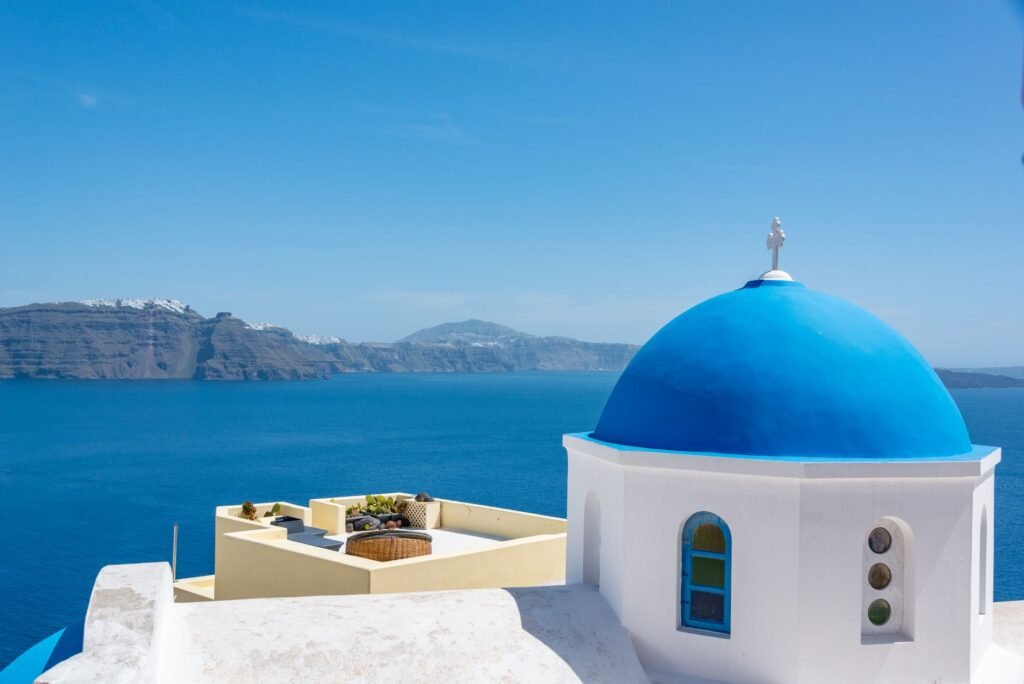
Header photo · Matheus Bertelli

Every figure below carries its named source and year. The Eco Index scores twelve pillars on the same scale everywhere; seven are measured from published data with fixed thresholds, five are assessed from the named sources.

Greece at a Glance.

The score, and the four numbers that set the tone. 12 equally-weighted pillars, every pillar sourced.
Compare with:
Eco IndexPassable
68/100
12 pillars, all sourced, scored below All 77 ranked
Renewable power
50%
of electricity
Food imported
13%
of merchandise imports · ~US$12,092m a year
The Eco Index across 12 pillars · scored 0 to 5 · World Bank, OWID, WHO/UNICEF JMP, FiBL, Protected Planet, IUCN, UNESCO (2023-24)
Water
Food & farming
Plant-based
Organic
Conservation
Wildlife
Materials
Pollution
Recycling
Energy
Culture
Heritage

Facts That Surprise People About Greece.

The numbers and firsts that change how you see Greece, the sobering and the remarkable. Every one is dated and linked to its source.
SoberingFood
Home of the Mediterranean diet, yet heavy
In 2022, 61.4% of adults in Greece were overweight, compared with 51.2% across the EU.
SoberingHealth
Almost a third of adults use tobacco
In 2022, 31.5% of adults in Greece used tobacco, against 26.4% across the EU.
SoberingEnvironment
Fine particle pollution above the EU average
Average exposure to fine particle pollution (PM2.5) in Greece was 14.1 µg/m³ in 2023, against 11.0 µg/m³ in the EU.
RemarkableFood
The Mediterranean diet is world heritage
UNESCO lists the Mediterranean diet, shared by Greece and six other countries, as intangible heritage. It covers crops, harvesting, fishing and above all the sharing of food.
RemarkableFood
Mastic, the resin of Chios
Mastic is a resin from the lentisk shrub cultivated on the island of Chios. UNESCO inscribed the know how of growing it as intangible heritage in 2014.
RemarkableCulture
Rebetiko, the songs of the city poor
Rebetiko music and dance spread among urban working class Greeks in the early twentieth century. UNESCO inscribed it as intangible heritage in 2017.
Worth knowingPeople
Fewer than 1.3 children per woman
Greek women had 1.24 children on average in 2024, below the EU average of 1.34.

The History of Greece.

Greece keeps a living folk culture. UNESCO lists the August 15th festivities of two highland communities in northern Greece, the Momoeria New Year celebration of eight villages near Kozani, Epirus polyphonic song and rebetiko among its intangible heritage.
Where the name comes from
Elláda in modern Greek, formerly Ellás, which is also seen as Hellas, according to the UK Permanent Committee on Geographical Names. The name 'Greek' comes from the Latin graecus, according to Den Store Danske.
The land itself: mountainous throughout, with ranges running out to sea as peninsulas and island chains. Its high point is Mount Olympus, 2,917 m. Source: UK Permanent Committee on Geographical Names toponymic factfile.
Where it starts
Sailing before farming
Franchthi Cave in the Argolid was used from about 39,000 to 7000 BC, through the Upper Palaeolithic and the Mesolithic, and the people there gathered shore foods and shells for food and ornaments. Obsidian from Melos carried across the Aegean shows that Mesolithic groups were crossing open sea before farming spread.
How it got here
City-states to republic
A war of independence fought between 1821 and 1832 established a Greek state, and independence from the Ottoman Empire is dated to 1830. Military rule collapsed in 1974, beginning the transition from dictatorship to multi-party democracy known as the metapolitefsi, and Greece abolished the monarchy to become a parliamentary republic.
The timeline
c. 39,000 to 7000 BC
Franchthi Cave.
A cave in the Argolid where people gathered shore foods and shells for food and ornaments, from the Upper Palaeolithic through the Mesolithic. Source
c. 1900 to 1100 BC
Minoan Crete.
Palaces at Knossos, Phaistos and four other sites on Crete, and Cretan Hieroglyphic and Linear A, the two earliest writing systems in Europe. Source
c. 1600 to 1100 BC
Mycenaean Greece.
Palace citadels such as Mycenae and Tiryns, and Linear B tablets that hold the first written testimony of the Greek language. Source
5th century BC
Classical Athens.
After victory over the Persians and the founding of democracy, Athens leads the Greek city-states, and its age gives the world democracy, philosophy and theatre. Source
4th to 15th century AD
Rome and Byzantium.
Thessaloniki, a provincial capital and port, becomes one of the first bases of Christianity and a leading Byzantine centre, with churches built from the 4th to the 15th century. Source
From the 15th century
Ottoman rule, but not everywhere.
Ottoman power spreads across the Greek lands, but Corfu stays under Venetian rule for some four centuries, its forts defending Venice against the Ottoman army, before passing to French, British and Greek government. Source
1821 to 1832
Independence.
A war of independence fought from 1821 to 1832 establishes a Greek state. Source
1974
The republic.
Military rule ends, and Greece makes its transition from dictatorship to multi-party democracy, known as the metapolitefsi. Source

Nature and Biodiversity in Greece.

About 35.2% of Greek land is designated as protected on paper, largely Natura 2000 (World Bank 2025), but enforcement is chronically under-resourced and many sites function as paper parks. Marine protection stands at just 4.7% of territorial waters, one of the weaker figures in the region.
Is wild Greece protected? 35% of the land is, already past the 30% target for 2030
How protected is nature in Greece?
Forest cover36.95%
Terrestrial protected area35.2%
Marine protected area4.7%
215 (mammals, birds, fish & plants) listed as threatened.
Found only here. Cretan kri-kri wild goat; Skyros pony; dittany of Crete (Origanum dictamnus) and rich island-endemic flora
The watchlist
ThreatenedCommon thread turtle (Mauremys sinensis) Critically Endangered on the IUCN Red List, and recorded in Greece in GBIF occurrence data for this species, with its assessment and occurrence records linked.
ThreatenedGreek Red Damsel (Pyrrhosoma elisabethae) Critically Endangered on the IUCN Red List, and recorded in Greece in GBIF occurrence data (insect).
ThreatenedPen Shell (Pinna nobilis) Critically Endangered on the IUCN Red List, and recorded in Greece in GBIF occurrence data (species).
ThreatenedAnguilla anguilla Critically Endangered on the IUCN Red List, and recorded in Greece in GBIF occurrence data (species).
ThreatenedAndrena chelma Critically Endangered on the IUCN Red List, and recorded in Greece in GBIF occurrence data (insect).
ThreatenedBlue Star (Amsonia orientalis) Critically Endangered on the IUCN Red List, and recorded in Greece in GBIF occurrence data (plant).
What is still here, and what is gone?
Tap a species for the honest status.
Closest to being lost, by name
Common thread turtle (Mauremys sinensis)
Critically Endangered, the last IUCN category before Extinct in the Wild, and still recorded in Greece. GBIF holds 12 verified occurrence records.
Greek Red Damsel (Pyrrhosoma elisabethae)
Critically Endangered, the last IUCN category before Extinct in the Wild, and still recorded in Greece. GBIF holds 173 verified occurrence records.
Pen Shell (Pinna nobilis)
Critically Endangered, the last IUCN category before Extinct in the Wild, and still recorded in Greece. GBIF holds 68 verified occurrence records.
Species named here are drawn from GBIF occurrence records for Greece filtered to the IUCN Red List threatened categories. Species are listed where GBIF holds occurrence records for them in this country. Record counts are not published here because the figure cannot be reproduced from a public GBIF query.
Who is putting it back

Spirit of the Knights
National park in Central Macedonia, mapped and named in the open record for Greece. OpenStreetMap.
National park in Epirus and Western Macedonia, mapped and named in the open record for Greece. OpenStreetMap.
National park in Thessaly and Central Greece, mapped and named in the open record for Greece. OpenStreetMap.
National park in Eastern Macedonia and Thrace, mapped and named in the open record for Greece. OpenStreetMap.
National park in Ioanian Islands, mapped and named in the open record for Greece. OpenStreetMap.
National park in Attica, mapped and named in the open record for Greece. OpenStreetMap.

Water and Ocean in Greece.

Mainland cities draw on mountain springs, reservoirs and groundwater, and the Joint Monitoring Programme models 96.9% of the population on safely managed water in 2023. Many arid islands, however, rely on desalination or shipped supply and face real summer stress, so tap water is safe on the mainland but locals drink bottled on much of the Aegean.
Does Greece have enough fresh water? Yes, with headroom
96.7% of people here have safely managed drinking water at home (2024, WHO/UNICEF JMP). Tap water is safe for a visitor nearly everywhere.
Cleanest water: Ionian islands (Kefalonia, Zakynthos) and the small Cyclades; Greece ranks among the top countries for Blue Flag beaches
How much fresh water does Greece have, per person?
5,557 m³
Greece
1,000 m³
the UN “water scarce” line
Greece withdraws about 10,047 million cubic metres of fresh water a year (2022). That is 20.3% of the fresh water actually available to it, which FAO counts as medium water stress. Of what is taken, farming takes 80%, homes and towns 17%, industry 3%. Source: FAO AQUASTAT.
What are the rules on Greece beaches?
·Tap water: Varies.
✓Plastic rules: EU single-use-plastic ban (national Law 4736/2020) since 2021, plus levies on plastic cups and food containers.
✓Solo travel: rated easy on the record for this destination.
✕Marine protection: 4.5% of the sea is protected. The 30x30 pledge for 2030 is not met yet.
Named on the open map: Aghiofili Beach, Alonaki Bay, Bouka Beach, Kristina Beach, Megas Limnionas Beach, Paralia Alexander, Pebblestone Beach, Skafidia Beach. That is 14 named beaches in the public record for Greece, each one a place you can look up before you go. OpenStreetMap.
Where does the sewage go?
92.9%
of people have safely managed sanitation
92.9% of people here use a safely managed sanitation service, meaning waste is contained, emptied and treated rather than reaching the ground or the sea untreated (2024, World Bank / WHO-UNICEF JMP, SDG 6.2.1). That is close to universal coverage.
How is the sea around Greece doing?
One cross-section, every answer measured.
Surface
What the coast carries
Hot dry summers with meltemi winds on the islands; winters are mild.
Nearshore
Protected water
4.7% of territorial waters are protected, against the 30% pledged for 2030 under the Global Biodiversity Framework.
Cleanest
Where the water is cleanest
Ionian islands (Kefalonia, Zakynthos) and the small Cyclades; Greece ranks among the top countries for Blue Flag beaches.
The record
Measured
Mainland cities draw on mountain springs, reservoirs and groundwater, and the Joint Monitoring Programme models 96.9% of the population on safely managed water in 2023. Many arid islands, however, rely on desalination or shipped supply and face real summer stress, so tap water is safe on the mainland but locals drink bottled on much of the Aegean.
Greece scored 76 out of 100 on the Ocean Health Index in its 2025 assessment, above the global average of 72, and ranked 52nd of 220 coastal regions. The index team says it is no longer updating scores, so the 2025 figures may be the last.
Sea protected
4.7%
Against the 30% pledged for 2030 under the Global Biodiversity Framework.
Threatened species
215 (mammals, birds, fish & plants)
Mammals, birds, fish and higher plants on the IUCN list.
Is the tap water safe in Greece?
96.7% of people have safely managed drinking water at home (2024, WHO/UNICEF JMP). Renewable fresh water works out at about 5,557 cubic metres per person a year (World Bank).
How hard is the water supply being pushed?
Of every 10 buckets nature refills, 2 are already taken. Withdrawals run at 20.3% of what Greece renews internally each year (2022, World Bank / FAO AQUASTAT). That is inside the 25% mark generally treated as water stress, so the supply has headroom.
When is the best time to visit Greece? Tap your month.
Tap your month.
How much fresh water does Greece actually have?
Nature renews about 5,557 cubic metres of fresh water per person per year here. That ranks Greece 138 of 208 countries measured, putting it in the wetter half of the world. The UN treats anything under 1,000 cubic metres as water scarce, and this is above that line. World Bank / FAO AQUASTAT.

Food and Drink in Greece.

Greece grows about 80% of the European Union's cotton, by both area and production. Its farming rests on about 600,000 farms, mostly small family holdings.
Where does the food in Greece come from?
13.1% imported
about US$12,092m a year
On the plate: Legumes (fasolada, gigantes, lentils, chickpeas), fava, horta wild greens, olives and olive oil, tomatoes, aubergine, courgette and stuffed vegetables (gemista)
1 of 10
bites are imported
The island buys in more food energy than it eats. About US$12,092m a year leaves the country to pay for it. The green slice is roughly what still grows here.
About 13.1% of everything Greece buys in from abroad is food, roughly 1 in every 10 imported items on the dock (2024, World Bank). Farming itself is 3.6% of the economy and 38.9% of the land is agricultural, of which 14.4% is arable. The green slice is roughly what still grows here.
What is killing people in Greece? The imported diet.
Cause of death, and the diet behind it.
Non-communicable diseases, all combined77.2%
Diabetes8%
Greece reports no diabetes amputation rate to the OECD. At a press conference in Thessaloniki in February 2023, the Hellenic Society for the Study of Diabetic Foot Diseases (EMEDIP) said about 3,000 lower limb amputations take place in Greece each year, that 4 to 5 per cent of people with diabetes develop foot ulcers, leaving 40,000 to 50,000 at immediate risk, and that 60 to 85 per cent of amputations caused by diabetes could be prevented. Source: in.gr.
Adults living with overweight or obesity. 61.4%.
Can Greece feed itself?
14.4%
Arable land
38.9%
Agricultural land
503,512
Farmers
4,599,002
Arable acres
3.6%
Agriculture, share of GDP
Harvest: Olive harvest October to December; grapes in late summer; summer vegetables and tomatoes
Feeding itself
Greece is a major producer of olive oil, table and oil olives, fruit and cotton, and grows about 80% of the European Union's cotton area and production. It remains a net importer of meat, cereals, animal feed and dairy.
Certification
Eurostat records 12.2% of Greek agricultural land as organic in 2021, above the EU average. Olives, olive oil and produce dominate the organic area.
Water for crops
Mainland cities draw on mountain springs, reservoirs and groundwater, and the Joint Monitoring Programme models 96.9% of the population on safely managed water in 2023. Many arid islands, however, rely on desalination or shipped supply and face real summer stress, so tap water is safe on the mainland but locals drink bottled on much of the Aegean.
Why the organic number looks like that. Certification covers only part of what is grown cleanly, so a small certified share is a gap in the paperwork rather than proof that nothing is. What the official land record does show: 38.9% of the country is agricultural land and 14.4% is arable (2023, World Bank). Certification is paid for per farm per year by a foreign body, which prices out smallholders, so the organic number reads worse than the practice.
What actually grows here
MaizeWheatOrangesTomatoesPeaches/nectarinesGrapesWatermelonsBarley
The food that already fits
The plant-based kitchen here is not an import. By tonnage, the largest crops grown in Greece are olives, maize, wheat, oranges and tomatoes (FAO, FAOSTAT crop production, 2023, the latest year with olive data). That is what the land itself puts on a plate.
Buy direct where residents buy: Athens and Piraeus have about 195 laiki, the weekly street markets where farmers sell their own produce, and every neighbourhood has at least one. Among them: Kallidromiou Street in Exarchia on Saturdays; Pangrati on Tuesdays and Fridays; Kypseli on Tuesdays and Thursdays; Koukaki and Kolonaki on Fridays; and the organic farmers market at 46 Lambrou Katsoni in Ambelokipi on Tuesdays, with another in Ambelokipi on Saturdays. The Varvakios central market is the city's main fish and meat hall. This is Athens.
Not yet checked by us. Plant based kitchens listed publicly: Rhino Vegan Beat, vegan street food near Syntagma and Monastiraki, Athens: vegan gyros, souvlaki, burgers and salads; Mother Vegan Bistro, organic vegan bistro in Koukaki, Athens: traditional Greek dishes and house desserts; Peas, vegan eatery in Koukaki, Athens: Greek dishes, pitas, burgers and raw, sugar free sweets; Veganaki, vegan restaurant in Athens: all day Mediterranean food including falafel and moussaka; Holy Llama, vegan bakehouse in Syntagma, Athens: baked goods, brunch, organic coffee and juices. Tell us how they are.
Is this grown in Greece?
Tap a food for the honest answer.
GigantesLentilsFavaHorta wild greensOlivesOlive oil

Climate and Energy in Greece.

Greece has moved renewables to roughly half of electricity generation, about 48 to 51 per cent in 2024, with solar exceeding 20 per cent and wind a major contributor, while natural gas and a shrinking share of lignite make up much of the rest. Per person emissions are mid range at 5.31 tonnes of CO2 in 2024. The country has committed to closing its lignite (brown coal) plants by 2028 and runs a national energy and climate plan aligned with EU targets. The direction is strongly positive, but gas dependence and remaining lignite keep it in the middle band.
What powers Greece?
Renewable 49.7%Fossil 50.3%
The high voltage grid is run by IPTO (ADMIE). ADMIE Holding, a listed company, holds 51 per cent of IPTO, and the state company DES ADMIE, set up in 2017 so the state could own part of IPTO, says it holds 51 per cent of IPTO's shares directly and indirectly through ADMIE Holding. China's State Grid bought 24 per cent from the Public Power Corporation for 320 million euros in June 2017, and the unbundling plan set aside the remaining 25 per cent for a state company. The distribution network is run by HEDNO; in February 2022 the Public Power Corporation completed the sale of 49 per cent of HEDNO to Macquarie Asset Management for 1,320 million euros. The sector is overseen by the national energy regulator (RAAEY, formerly RAE).
Climate pollution per person
The safe amount, what the planet can absorb
2 tonnes
One person here
5.05 tonnes
The world average, for comparison
4.7 tonnes
The worst it ever got
9.59 tonnes
The grid
Greece has moved renewables to roughly half of electricity generation, about 48 to 51 per cent in 2024, with solar exceeding 20 per cent and wind a major contributor, while natural gas and a shrinking share of lignite make up much of the rest. Per person emissions are mid range at 5.31 tonnes of CO2 in 2024.
Pollution
The EU single-use-plastics ban is in force through national Law 4736/2020, alongside levies on plastic cups and food containers. Air quality is only moderate, with population-weighted PM2.5 at 14.1 µg/m³ in 2023 (World Bank), well above the WHO guideline, and popular islands face heavy summer waste pressure.
Water stress
Mainland cities draw on mountain springs, reservoirs and groundwater, and the Joint Monitoring Programme models 96.9% of the population on safely managed water in 2023. Many arid islands, however, rely on desalination or shipped supply and face real summer stress, so tap water is safe on the mainland but locals drink bottled on much of the Aegean.
What pollutes most here
1The grid The share of electricity still generated from fossil fuel.50.8%
2Industry Lignite (brown-coal) mining and power (Western Macedonia, Megalopolis); island over-tourism.named
3Air Modelled annual mean against a WHO guideline of 5 µg/m³.14.12
4On the record The EU single-use-plastics ban is in force through national Law 4736/2020, alongside levies on plastic cups and food containers.
What has Greece promised on climate?
Net zero, whole economy2050
Electricity renewable today40.6% (2021)
Land protected, against a 30% target35% by 2025
Sea protected, against a 30% target4.7% by 2025
The net-zero target year on file with Climate Watch is 2050, status: in law. Measured against it, 40.6% of electricity is already renewable (2021, World Bank), so 59.4% of the grid is still to be converted. The pledge on file is measured here against what has actually been delivered, not taken on its own (UNFCCC NDC Registry, CBD Kunming-Montreal Target 3).
The biggest line item
One return flight against a whole year of living.
A resident's entire year5.05 t CO2e
Safe-climate budget, per year2 t CO2e
Sydney return, economy2.76 t CO2e
Los Angeles return, economy2 t CO2e
Singapore return, economy1.63 t CO2e
New York return, economy1.43 t CO2e
Johannesburg return, economy1.29 t CO2e
How much CO2 does flying to Greece emit?
Tap where you would fly from. One return flight, economy.
Firsts on climate finance. Greece's largest source of climate money is its EU recovery and resilience plan, approved by the Council on 13 July 2021 and revised in December 2023 to add a REPowerEU chapter. The plan is worth about 36.61 billion euros including national co financing, made up of 18.22 billion euros in grants and 17.73 billion euros in loans, and 38 per cent of the funds support climate objectives. The REPowerEU chapter adds 768 million euros in grants, and at least 38.5 per cent of the loans passed on through financial institutions must go to the climate transition. The Commission approved the seventh payment on 20 April 2026.

AI and Data Centres in Greece.

Every prompt runs on a machine in a building on somebody’s grid. What that costs the planet depends less on the prompt than on what is burning to power it. Here is what would power one in Greece.
Data centres
10
Registered colocation and interconnection facilities, PeeringDB, 2026
Grid renewable
49.7 %
What a machine here runs on.
What powers a data centre in Greece?
Most of the power behind a machine here is still burned.
Renewable 49.7%Fossil 50.3%
Cooling water. Every one of those halls runs on the national grid, which is 40.6% renewable today (World Bank). A data centre is only as clean as the electricity behind it, so the same figure that decides this country's climate score also decides the footprint of the AI running inside it. Cooling water use is not separately published by facility, and no operator here reports it.
The rules. Greece has 10 colocation and interconnection facilities on the public PeeringDB register, concentrated in Thessaloniki (4), Athens (3), Koropi (1), alongside 8 internet exchanges (GR-IX::Athens, GR-IX::Thessaloniki, SEECIX, THESS-IX). Named sites include Digital Realty ATH1/2/3 - Athens, Synapsecom SNC-2 Athens, Εθνικό Ίδρυμα Ερευνών / National Hellenic Research Foundation (EIE/NHRF), TI Sparkle Greece (IDC).
Where the cables land. 36 landing points · Aethos, Agios Sostis, Athens, Baxedes

Economy and Tourism in Greece.

23% residents to 77% visitors across a year. 34,005,000 international arrivals in 2019 against 10,413,962 people who live here (2025, World Bank / UN Tourism).
Where a visitor dollar goes in Greece
7,406k
Visitors a year
0.7
Visitors per resident
How deep in debt is Greece?· for every $100 Greece earns in a year, it owes…
Pay to the order of: the creditorsmemo · the 2020 peak
$ 210The worst year on the IMF record. Greece owed $210 for every $100 it earned.
IMF World Economic Outlook, 2020signed, the creditors
Pay to the order of: the creditorsmemo · today
$ 137What is owed now, for every $100 of national income (2026).
IMF World Economic Outlook, 2026signed, the creditors
Pay to the order of: the creditorsmemo · projected 2031
$ 111The IMF's own forecast has this falling to $111 by 2031.
IMF World Economic Outlook projection, 2031signed, the forecast
For every $100 Greece earns in a year, it owes $137 (2026, IMF World Economic Outlook). That is more than a full year of national income, and the interest is paid before anything else.
$Where does a tourist dollar actually go in Greece?
Play one tourist dollar around the board. Every square is a measured fact from this page.
START!
1
GO: a visitor lands
$100 goes on the table. 34,005,000 international arrivals in 2019 against 10,413,962 residents, 3.3 visitors for every resident (World Bank / UN Tourism).
$100 in play
2
The bed
Who owns the largest places to stay in Greece is not published in the records we can check, so this square is left open rather than guessed. Where a listing names its owner, it is shown in the ownership table below.
not published
3
The plate
Food is only 13.1% of everything Greece imports (2024, World Bank), so most of a meal is bought from producers inside the country. Eating what the land here actually grows, maize, wheat, oranges, tomatoes, peaches/nectarines, grapes, watermelons, barley, keeps that money with the grower.
mostly home-grown
4
The power
40.6% of the electricity is renewable (2021, World Bank), so the energy on the bill is mostly generated inside the country rather than shipped in.
made at home
5
What actually stays
Of the two parts of a visitor's bill that can be measured here, the plate and the power stay inside Greece. This is not an economy where a visitor's money drains away, and the board is shorter for it.
most of it
6
Pay the bank first
Greece owes $137 for every $100 it earns (IMF World Economic Outlook, 2026 projection). The interest is paid before anything else on this board.
$137 per $100
7
No plan B
32.4% of everything Greece sells abroad is mineral fuels and oils (2023, UN Comtrade). One market moving takes the whole board with it.
32.4% one export
8
Community chest
Tourism earns 10.5% of everything Greece makes from exports (2020, World Bank / UN Tourism). That is how much of the economy depends on the game continuing.
10.5% of exports
9
The flight
Getting here is usually the biggest single line on the bill. From Sydney a return economy seat is 2.76 t CO2, on the UK Government's published conversion factors. It is the one part of the trip this board cannot reduce.
2.76 t CO2
10
Back to GO
The economy turns over about US$308 billion a year (IMF World Economic Outlook, 2026 projection). Every lap of this board is a choice about how much of it stays.
US$308bn
GDPUS$280.6bn
Agriculture, share of GDP3.6%
Visitors a year7,406,000
Visitors per resident0.7
Residents~10,413,962
Agriculture
Farming is 3.6% of the economy. Greece is a major producer of olive oil, table and oil olives, fruit and cotton, and grows about 80% of the European Union's cotton area and production.
Natural materials
Living wool crafts persist, from 100%-wool flokati rugs to mountain-village weaving, and cotton is a major field crop. The historic Soufli silk industry in Thrace was a major centre from the 19th century until the post-war period, declined after the Second World War as nylon and rayon took over, and survives mainly as heritage and boutique output rather than a living mass trade.
Energy
Greece has moved renewables to roughly half of electricity generation, about 48 to 51 per cent in 2024, with solar exceeding 20 per cent and wind a major contributor, while natural gas and a shrinking share of lignite make up much of the rest. Per person emissions are mid range at 5.31 tonnes of CO2 in 2024.
Who owns the biggest hotels in Greece?
By rooms · company records and press.
Spirit of the Knights · ~6 roomsIndependentnot published
Visitors, over time
201526,114k
201628,071k
201730,161k
201833,072k
201934,005k
20207,406k
International tourism receipts run at about US$6.19 billion in 2020 (World Bank / UN Tourism). That is 10.5% of everything the country earns from exports.
How much of your money actually stays here?
Tap the holiday you are planning.

Visiting Greece, whoever you are.

Resort guest, villa renter, family, nomad or backpacker. The honest playbook for each, from the same sourced numbers.
Already booked a resort? · the rescue list
Five swaps that move your money back on-island
1. Eat where the country eats Choose kitchens cooking legumes (fasolada, gigantes, lentils, chickpeas), fava, horta wild greens, olives and olive oil, tomatoes, aubergine, courgette and stuffed vegetables (gemista) over imported menus. The checked list
2. Book with a local operator Never the lobby desk. The margin on a tour is the part that stays.
3. Stay somewhere locally owned Ownership decides where the room rate books. Eco stays
4. Use the transport residents use Extensive ferry network from the Piraeus hub, KTEL intercity buses, domestic flights and the Athens metro
5. Buy the craft, not the souvenir Natural-materials work made here pays the maker directly; imported gifts pay a shipping line.
Swipe
First time here
Home to one of Europe's most plant-forward cuisines, rare monk seals and loggerhead turtles and rich island-endemic flora, though recycling lags.
Best time: May to June and September to early October, warm with calmer seas and fewer crowds
Getting around
Extensive ferry network from the Piraeus hub, KTEL intercity buses, domestic flights and the Athens metro
Transport is where the fare either stays or leaves.
Eating here
The everyday plate is legumes (fasolada, gigantes, lentils, chickpeas), fava, horta wild greens, olives and olive oil, tomatoes, aubergine, courgette and stuffed vegetables (gemista). Greek cooking is among Europe's most plant-forward, built on legumes such as bean soup, giant baked beans, lentils and chickpeas, on fava, on horta wild greens, and on olives and olive oil with abundant stuffed and roasted vegetables.
Eating what the country grows is the cheapest way to cut the import bill.
Breathtaking view of Santorini's blue-domed church overlooking the Aegean Sea, capturing Greek architecture.
Good to know
Cards widely accepted; EUR. Cash on the smaller islands.
Rate my hotel. Tap yours for the honest verdict.
Ownership from company records and press.
Who owns the place to stay
Spirit of the KnightsIndependent · 6 rooms
The one property listed here does not publish who ultimately owns it, so no claim is made either way. Ownership is what decides how much of a room rate stays in the country, which is why we show it when a listing states it.

Society and Governance in Greece.

How well is Greece actually run?
Governance, measured · World Bank WGI
Four measured answers, none of them opinion. Averaged across corruption control, delivery and accountability, Greece scores 60 out of 100 (2024, World Bank Worldwide Governance Indicators). That matters here because every pledge on this page is only as good as the machinery meant to deliver it.
What is daily life in Greece really like? Measured
Getting around, breathing, throwing away, learning. The honest checklist.
TransportAirWaterWastePower
✓How you get around Extensive ferry network from the Piraeus hub, KTEL intercity buses, domestic flights and the Athens metro
93.9%
literacy. Public spending on education runs at 3.4% of GDP and 6.4% of all government spending, and secondary enrolment stands at 105.2% gross (UNESCO Institute for Statistics, 2022 to 2023).

Made in Greece.

Living wool crafts persist, from 100%-wool flokati rugs to mountain-village weaving, and cotton is a major field crop. The historic Soufli silk industry in Thrace was a major centre from the 19th century until the post-war period, declined after the Second World War as nylon and rayon took over, and survives mainly as heritage and boutique output rather than a living mass trade. Every step of processing done at home is value that stops leaving the country.
What Greece actually sells the world
The single biggest thing Greece sells the world is mineral fuels and oils, 32.4% of all exports in 2023 (about US$17.82 billion, UN Comtrade). The next four are pharmaceuticals at 5.5%, aluminium at 4.9%, electrical machinery and electronics at 4.3%, machinery and mechanical appliances at 4.3%.
Sells now · 32.4% of exports
Mineral fuels and oils
Mineral fuels and oils is 32.4% of everything Greece sold abroad in 2023, worth about US$17.82 billion. UN Comtrade.
Sells now · 5.5% of exports
Pharmaceuticals
Pharmaceuticals is 5.5% of everything Greece sold abroad in 2023, worth about US$3.02 billion. UN Comtrade.
Sells now · 4.9% of exports
Aluminium
Aluminium is 4.9% of everything Greece sold abroad in 2023, worth about US$2.72 billion. UN Comtrade.
Sells now · 4.3% of exports
Electrical machinery and electronics
Electrical machinery and electronics is 4.3% of everything Greece sold abroad in 2023, worth about US$2.38 billion. UN Comtrade.
Sells now · 4.3% of exports
Machinery and mechanical appliances
Machinery and mechanical appliances is 4.3% of everything Greece sold abroad in 2023, worth about US$2.37 billion. UN Comtrade.
Buys in · 5.4% of imports
Vehicles
Greece imported US$4.81 billion of vehicles in 2023, 5.4% of everything it bought abroad, and sells none of it back. Every point of that is a business that could be built at home rather than shipped in. UN Comtrade.
Buys in · 3.4% of imports
Other
Greece imported US$2.99 billion of other in 2023, 3.4% of everything it bought abroad, and sells none of it back. Every point of that is a business that could be built at home rather than shipped in. UN Comtrade.
Buys in · 3.2% of imports
Plastics
Greece imported US$2.81 billion of plastics in 2023, 3.2% of everything it bought abroad, and sells none of it back. Every point of that is a business that could be built at home rather than shipped in. UN Comtrade.
Buys in · 2.7% of imports
Organic chemicals
Greece imported US$2.42 billion of organic chemicals in 2023, 2.7% of everything it bought abroad, and sells none of it back. Every point of that is a business that could be built at home rather than shipped in. UN Comtrade.
The maths for an entrepreneur. Greece produces about US$281 billion a year, which is roughly US$26,948 per person (2025, World Bank). Farming is 3.6% of that, while food is 13.1% of everything the country imports. The country buys in more food than its own farms contribute to the economy, and every point of that gap is a business someone could build here rather than ship in. With 14.4% of the land arable, the raw material for that is already in the ground.
See the verified makers

Culture in Greece.

Kalamatianos
In parts of Greece the names syrtos and kalamatianos are used for the same widely danced motif, and Cretans call that motif kalamatianos. On the island of Kythnos the kalamatianos is a dance for couples in 7/8 rhythm.
Syrtos
Thought of as the dance of all Greeks, danced at least once at almost every gathering. In most of Greece it is an open circle that anyone can join, though the same name can mean quite a different dance from place to place.
Tsamiko
A line dance that is really a solo for the leader, who improvises while the others follow. Leaders take turns to show their skill, and there are hundreds of tsamiko songs.
Pontic folk dances
A few Greek dances were traditionally danced in a closed circle with no apparent leader, mainly by Pontic Greeks and some Greeks from Eastern Thrace. Most of them are now danced in an open circle.
Rebetiko (UNESCO)Song and dance that first spread among the urban lower and working classes in the early twentieth century and is now heard at almost every social occasion. UNESCO inscribed it in 2017.
Nisiotika
The dances of the Greek islands, which some see as having an undulating flow that echoes the sea.
Does Greece protect its heritage by law?
Partly, and the gaps say as much as the protections.
What is kept alive. Greece keeps an unusually alive folk culture. Regional circle dances such as kalamatianos, syrtos, tsamiko and the pontic dances are danced at weddings, saints' day panigyria and village festivals across the country. Rebetiko, the urban song tradition inscribed by UNESCO, and island nisiotika and mainland dimotika music remain widely played.
Who it belongs to. Greece has many living island and mountain-village communities, from Zagori and the Mani to Crete and the Chios mastic villages, and a growing agrotourism scene of farm stays and food and wine tourism. Revenue reaches locals unevenly, since family tavernas, guesthouses and ferries capture some spending while all-inclusive resorts and cruise calls concentrate the rest.
Only here. Chios mastic (Mastiha), the resin produced only in southern Chios's mastic villages; an EU Protected Designation of Origin and UNESCO Intangible Cultural Heritage.

The Future of Greece.

Three futures for Greece, every one run forward from measured data.
Where the making actually happens
Named cultural and craft sites on the open map: Kangaroo Craft (Athens), Armonia craft (Attica). OpenStreetMap. Named craft workshops on the open map: Argalios, Art-Shop, Atelier Sud, Craft Thrift, Cristofle, Dim.Arg.
Every measured trend on one line
Run forward at the pace already recorded.
+28%
Forest cover
1995: 28.8% to 2024: 36.9%
1995202436.9%
+373%
Renewable electricity
1995: 8.58% to 2021: 40.6%
1995202140.6%
-37%
CO2 per person
1995: 7.98 t to 2024: 5.05 t
199520245 t
-31%
Tourist arrivals
1995: 10,712k to 2020: 7,406k
199520207,406k
-0%
Protected land
2013: 35.1% to 2025: 35%
2013202535%
-45%
Farm workforce
1995: 19.3% to 2025: 10.7%
1995202510.7%
+213%
Protected sea
2013: 1.5% to 2025: 4.7%
201320254.7%
-45%
Agricultural land
1995: 71.1% to 2024: 38.9%
1995202438.9%
+10%
Urban population
1995: 72.1% to 2025: 79.2%
1995202579.2%
-46%
Air pollution
1995: 26 µg/m³ to 2023: 14.1 µg/m³
1995202314.1 µg/m³
+1%
Fresh water per person
1995: 5,491 m³ to 2022: 5,557 m³
199520225,556.7 m³
+20%
Adult overweight
1995: 51.3% to 2022: 61.4%
1995202261.4%
+0%
Electricity access
1995: 100% to 2024: 100%
19952024100%
+111%
GDP per person
1995: 12,779 to 2025: 26,948
1995202526,948
-1%
Population
1995: 10,562k to 2025: 10,414k
1995202510,414k
+159%
Renewable energy use
1995: 8.3% to 2021: 21.5%
1995202121.5%
-9%
Energy per person
1995: 2,147 kg to 2024: 1,956 kg
199520241,956.1 kg
+30%
Protected area, total
2013: 8.6% to 2025: 11.2%
2013202511.2%
+5%
Life expectancy
1995: 77.6 yrs to 2024: 81.8 yrs
1995202481.8 yrs
+8%
Cereal yield
1995: 3,751 kg/ha to 2024: 4,053 kg/ha
199520244,052.9 kg/ha
+4%
Fertiliser use
1995: 179 kg/ha to 2024: 187 kg/ha
19952024186.6 kg/ha
-26%
Rural population
1995: 27.9% to 2025: 20.8%
1995202520.8%
-1%
Water productivity
1995: 21.5 $/m3 to 2022: 21.3 $/m3
1995202221.3 $/m3
+12%
Health spending
2000: 7.51% to 2023: 8.39%
200020238.4%
+28%
Forest area
1995: 37,089 km2 to 2025: 47,628 km2
1995202547,628 km2
+29%
Electric power use
1995: 3,709 kWh to 2025: 4,782 kWh
199520254,782.2 kWh
-31%
Emissions: Agriculture
1990: 10.1 MtCO2e to 2023: 7 MtCO2e
199020237 MtCO2e
-17%
Emissions: Building
1990: 5.47 MtCO2e to 2023: 4.55 MtCO2e
199020234.6 MtCO2e
-48%
Emissions: Electricity/Heat
1990: 37.2 MtCO2e to 2023: 19.4 MtCO2e
1990202319.4 MtCO2e
-33%
Emissions: Energy
1990: 72.1 MtCO2e to 2023: 48.4 MtCO2e
1990202348.4 MtCO2e
+22%
Emissions: Industrial Processes
1990: 9 MtCO2e to 2023: 11 MtCO2e
1990202311 MtCO2e
-58%
Emissions: Manufacturing/Construction
1990: 9.7 MtCO2e to 2023: 4.09 MtCO2e
199020234.1 MtCO2e
+22%
Emissions: Transportation
1990: 15.4 MtCO2e to 2023: 18.8 MtCO2e
1990202318.8 MtCO2e
World Bank open data, recorded series
How much forest is left?
1995202436.9%
Forest cover moved from 28.8% to 36.9% across 29 recorded years.
How clean is the grid?
1995202140.6%
Renewable electricity moved from 8.58% to 40.6% across 26 recorded years.
How much climate pollution per person?
199520245 t
CO2 per person moved from 7.98 t to 5.05 t across 29 recorded years.
How many people visit?
199520207,406k
Tourist arrivals moved from 10,712k to 7,406k across 25 recorded years.
How much land is protected?
2013202535%
Protected land moved from 35.1% to 35% across 12 recorded years.
How many people still farm?
1995202510.7%
Farm workforce moved from 19.3% to 10.7% across 30 recorded years.
How much sea is protected?
201320254.7%
Protected sea moved from 1.5% to 4.7% across 12 recorded years.
How much land is farmed?
1995202438.9%
Agricultural land moved from 71.1% to 38.9% across 29 recorded years.
How fast is it urbanising?
1995202579.2%
Urban population moved from 72.1% to 79.2% across 30 recorded years.
Is the air getting cleaner?
1995202314.1 µg/m³
Air pollution moved from 26 µg/m³ to 14.1 µg/m³ across 28 recorded years.
Is water getting scarcer?
199520225,556.7 m³
Fresh water per person moved from 5,491 m³ to 5,557 m³ across 27 recorded years.
Is diet-related disease rising?
1995202261.4%
Adult overweight moved from 51.3% to 61.4% across 27 recorded years.
Who has power?
19952024100%
Electricity access moved from 100% to 100% across 29 recorded years.
Is income rising?
1995202526,948
GDP per person moved from 12,779 to 26,948 across 30 recorded years.
How fast is it growing?
1995202510,414k
Population moved from 10,562k to 10,414k across 30 recorded years.
What share of all energy is renewable?
1995202121.5%
Renewable energy use moved from 8.3% to 21.5% across 26 recorded years.
How much energy does one person use?
199520241,956.1 kg
Energy per person moved from 2,147 kg to 1,956 kg across 29 recorded years.
How much land and sea is protected together?
2013202511.2%
Protected area, total moved from 8.6% to 11.2% across 12 recorded years.
How long do people live?
1995202481.8 yrs
Life expectancy moved from 77.6 yrs to 81.8 yrs across 29 recorded years.
How much does a hectare of cereal produce?
199520244,052.9 kg/ha
Cereal yield moved from 3,751 kg/ha to 4,053 kg/ha across 29 recorded years.
How much fertiliser goes on the land?
19952024186.6 kg/ha
Fertiliser use moved from 179 kg/ha to 187 kg/ha across 29 recorded years.
How many people still live rurally?
1995202520.8%
Rural population moved from 27.9% to 20.8% across 30 recorded years.
How much value per cubic metre of water?
1995202221.3 $/m3
Water productivity moved from 21.5 $/m3 to 21.3 $/m3 across 27 recorded years.
How much goes on health?
200020238.4%
Health spending moved from 7.51% to 8.39% across 23 recorded years.
How much forest is there in total?
1995202547,628 km2
Forest area moved from 37,089 km2 to 47,628 km2 across 30 recorded years.
How much electricity per person?
199520254,782.2 kWh
Electric power use moved from 3,709 kWh to 4,782 kWh across 30 recorded years.
How have agriculture emissions moved?
199020237 MtCO2e
Agriculture emissions moved from 10.11 to 7.01 MtCO2e across 33 recorded years.
Climate Watch (WRI), historical emissions
How have building emissions moved?
199020234.6 MtCO2e
Building emissions moved from 5.47 to 4.55 MtCO2e across 33 recorded years.
Climate Watch (WRI), historical emissions
How have electricity/heat emissions moved?
1990202319.4 MtCO2e
Electricity/Heat emissions moved from 37.24 to 19.44 MtCO2e across 33 recorded years.
Climate Watch (WRI), historical emissions
How have energy emissions moved?
1990202348.4 MtCO2e
Energy emissions moved from 72.06 to 48.35 MtCO2e across 33 recorded years.
Climate Watch (WRI), historical emissions
How have industrial processes emissions moved?
1990202311 MtCO2e
Industrial Processes emissions moved from 8.99 to 11.01 MtCO2e across 33 recorded years.
Climate Watch (WRI), historical emissions
How have manufacturing/construction emissions moved?
199020234.1 MtCO2e
Manufacturing/Construction emissions moved from 9.7 to 4.09 MtCO2e across 33 recorded years.
Climate Watch (WRI), historical emissions
How have transportation emissions moved?
1990202318.8 MtCO2e
Transportation emissions moved from 15.42 to 18.84 MtCO2e across 33 recorded years.
Climate Watch (WRI), historical emissions
Worst caseCurrent pathBest case
Worst case
Every measured decline continues at the pace already recorded. The weakest pillar, recycling at 2/5, is the one that gives way first.
Computed from: recorded series extended with no policy change
What the best case actually asks for
Lift recycling
It scores 2 out of 5 today, among the weakest parts of Greece's record. Eurostat puts Greece's municipal recycling rate at 17.4% for 2023, among the five lowest in the European Union and well below the EU average of 47.9%. More than 80% of Greek municipal waste goes to landfill.
measured each year
Costs: spending and enforcement, not new technology
Lift energy
It scores 2 out of 5 today, among the weakest parts of Greece's record. Greece has moved renewables to roughly half of electricity generation, about 48 to 51 per cent in 2024, with solar exceeding 20 per cent and wind a major contributor, while natural gas and a shrinking share of lignite make up much of the rest.
measured each year
Costs: spending and enforcement, not new technology
Lift food and farming
It scores 3 out of 5 today, among the weakest parts of Greece's record. Greece is a major producer of olive oil, table and oil olives, fruit and cotton, and grows about 80% of the European Union's cotton area and production. It remains a net importer of meat, cereals, animal feed and dairy.
measured each year
Costs: spending and enforcement, not new technology

Government and Goals in Greece.

Who is in charge of Greece now · Office-holders from the UN Protocol and Liaison Service public list of Heads of State and Heads of Government, 20 October 2026. Legislature and election dates from IFES ElectionGuide. Constitution dates from the Constitute Project. Governance scores from the World Bank Worldwide Governance Indicators 2024.
Kyriakos Mitsotakis
Prime Minister
Kyriakos Mitsotakis is the head of government of Greece, in office since 26 June 2023. Every climate, protection and energy pledge on this page is delivered, or not, under this administration.
Public opinion, measured
Voice and accountability, the freedom to question government scores 73.5 out of 100 in 2025. On this World Bank scale, 100 is the strongest governance measured. Down from 74.0 in 2024. World Bank Worldwide Governance Indicators, 2025 data (updated 25 September 2026)
Control of corruption scores 53.1 out of 100 in 2025. On this World Bank scale, 100 is the strongest governance measured. Down from 53.9 in 2024. World Bank Worldwide Governance Indicators, 2025 data (updated 25 September 2026)
Political stability and absence of violence scores 70.5 out of 100 in 2025. On this World Bank scale, 100 is the strongest governance measured. Up from 70.1 in 2024. World Bank Worldwide Governance Indicators, 2025 data (updated 25 September 2026)
Rule of law scores 63.3 out of 100 in 2025. On this World Bank scale, 100 is the strongest governance measured. Up from 62.3 in 2024. World Bank Worldwide Governance Indicators, 2025 data (updated 25 September 2026)
Regulatory quality scores 62.7 out of 100 in 2025. On this World Bank scale, 100 is the strongest governance measured. Down from 63.2 in 2024. World Bank Worldwide Governance Indicators, 2025 data (updated 25 September 2026)
Kyriakos MitsotakisPrime Minister
Hellenic Parliament (Vouli Ton Ellinon)Legislature, unicameral
Last election25 June 2023
Constitution1975, as revised to 2019
Government typeparliamentary republic
Greece national goals: climate commitments on record · as recorded by Climate Watch, World Resources Institute
2050
Net zero
In Law
Net-zero target as recorded by Climate Watch. Status: In Law (05/26/2022) Source
Gases covered
All GHGs Covered Source
Sectors covered
All Sectors Source
International offsets
International Offsets Included Source

Plain Answers About Greece.

The questions people actually type, answered in full sentences from the sourced data above.
Swipe
Is Greece sustainable?
Greece scores 68 out of 100 on the Throne Eco Index, across twelve equally weighted pillars. Home to one of Europe's most plant-forward cuisines, rare monk seals and loggerhead turtles and rich island-endemic flora, though recycling lags.
Is the water in Greece safe and plentiful?
Mainland cities draw on mountain springs, reservoirs and groundwater, and the Joint Monitoring Programme models 96.9% of the population on safely managed water in 2023. Many arid islands, however, rely on desalination or shipped supply and face real summer stress, so tap water is safe on the mainland but locals drink bottled on much of the Aegean.
Can Greece feed itself?
Greece is a major producer of olive oil, table and oil olives, fruit and cotton, and grows about 80% of the European Union's cotton area and production. It remains a net importer of meat, cereals, animal feed and dairy.
Is it easy to eat plant-based in Greece?
Greek cooking is among Europe's most plant-forward, built on legumes such as bean soup, giant baked beans, lentils and chickpeas, on fava, on horta wild greens, and on olives and olive oil with abundant stuffed and roasted vegetables. Orthodox nistisima fasting food, which is effectively vegan, is observed across a large share of the calendar, giving the country a deep and genuinely traditional plant-based repertoire.
How much of Greece is actually protected?
About 35.2% of Greek land is designated as protected on paper, largely Natura 2000 (World Bank 2025), but enforcement is chronically under-resourced and many sites function as paper parks. Marine protection stands at just 4.7% of territorial waters, one of the weaker figures in the region.
What wildlife is left in Greece?
Greece shelters the Mediterranean monk seal, listed Vulnerable since December 2023 after two downlistings from Critically Endangered,, one of the world's rarest seals, with strongholds around Alonnisos and Zakynthos, and Laganas Bay on Zakynthos, together with Kyparissia Bay on the Peloponnese, holds more than 57% of all loggerhead-turtle nests in the European Union, with Kyparissia Bay first in Greece and the Mediterranean for nest numbers. Island and Cretan endemism is rich, from the Cretan kri-kri wild goat and the Skyros pony to endemic flora such as dittany of Crete.
Is Greece on clean energy?
Greece has moved renewables to roughly half of electricity generation, about 48 to 51 per cent in 2024, with solar exceeding 20 per cent and wind a major contributor, while natural gas and a shrinking share of lignite make up much of the rest. Per person emissions are mid range at 5.31 tonnes of CO2 in 2024. The country has committed to closing its lignite (brown coal) plants by 2028 and runs a national energy and climate plan aligned with EU targets.
How polluted is Greece?
The EU single-use-plastics ban is in force through national Law 4736/2020, alongside levies on plastic cups and food containers. Air quality is only moderate, with population-weighted PM2.5 at 14.1 µg/m³ in 2023 (World Bank), well above the WHO guideline, and popular islands face heavy summer waste pressure.
Does recycling work in Greece?
Eurostat puts Greece's municipal recycling rate at about 17% for 2023, among the five lowest in the European Union and well below the EU average of around 43%.
Is the farming in Greece organic?
Eurostat records 12.2% of Greek agricultural land as organic in 2021, above the EU average. Olives, olive oil and produce dominate the organic area.
Are there natural materials and craft in Greece?
Living wool crafts persist, from 100%-wool flokati rugs to mountain-village weaving, and cotton is a major field crop. The historic Soufli silk industry in Thrace was a major centre from the 19th century until the post-war period, declined after the Second World War as nylon and rayon took over, and survives mainly as heritage and boutique output rather than a living mass trade.
Is there living culture in Greece?
Greece has many living island and mountain-village communities, from Zagori and the Mani to Crete and the Chios mastic villages, and a growing agrotourism scene of farm stays and food and wine tourism. Revenue reaches locals unevenly, since family tavernas, guesthouses and ferries capture some spending while all-inclusive resorts and cruise calls concentrate the rest.
What heritage does Greece keep alive?
Greece keeps an unusually alive folk culture. Regional circle dances such as kalamatianos, syrtos, tsamiko and the pontic dances are danced at weddings, saints' day panigyria and village festivals across the country. Rebetiko, the urban song tradition inscribed by UNESCO, and island nisiotika and mainland dimotika music remain widely played.
So is Greece actually green? The measured answer
What is working: land protected at 35%.
What is not: sea protected at 4.7% against a 30% mark, renewable electricity at 40.6% against a 100% mark.

How Greece Ranks, region and world.

Where Greece sits on the Eco Index, against its Europe neighbours and the 77 destinations scored worldwide.
How does Greece compare in Europe?
Scored Europe destinations, Eco Index.
The global top 10 of the 77 destinations scored
10Spain73
Greece sits 24 of 77 at 68/100. Every name links to its own destination page, built exactly like this one. The full ranking
What is Greece particularly good at?
✓ Plant-based eating, scored 5/5. Greek cooking is among Europe's most plant-forward, built on legumes such as bean soup, giant baked beans, lentils and chickpeas, on fava, on horta wild greens, and on olives and olive oil with abundant stuffed and roasted vegetables. Orthodox nistisima fasting food, which is effectively vegan, is observed across a large share of the calendar, giving the country a deep and genuinely traditional plant-based repertoire.
✓ Water, scored 4/5. Mainland cities draw on mountain springs, reservoirs and groundwater, and the Joint Monitoring Programme models 96.9% of the population on safely managed water in 2023. Many arid islands, however, rely on desalination or shipped supply and face real summer stress, so tap water is safe on the mainland but locals drink bottled on much of the Aegean.
✓ Organic farming, scored 4/5. Eurostat records 12.2% of Greek agricultural land as organic in 2021, above the EU average. Olives, olive oil and produce dominate the organic area.
Where does Greece score worst?
✕ Recycling, scored 2/5. Eurostat puts Greece's municipal recycling rate at 17.4% for 2023, among the five lowest in the European Union and well below the EU average of 47.9%. More than 80% of Greek municipal waste goes to landfill.
✕ Energy, scored 2/5. Greece has moved renewables to roughly half of electricity generation, about 48 to 51 per cent in 2024, with solar exceeding 20 per cent and wind a major contributor, while natural gas and a shrinking share of lignite make up much of the rest. Per person emissions are mid range at 5.31 tonnes of CO2 in 2024. The country has committed to closing its lignite (brown coal) plants by 2028 and runs a national energy and climate plan aligned with EU targets. The direction is strongly positive, but gas dependence and remaining lignite keep it in the middle band.
✕ Food and farming, scored 3/5. Greece is a major producer of olive oil, table and oil olives, fruit and cotton, and grows about 80% of the European Union's cotton area and production. It remains a net importer of meat, cereals, animal feed and dairy.
A note from the lens of mother natureSwipe
Recycling, 2/5
Eurostat puts Greece's municipal recycling rate at 17.4% for 2023, among the five lowest in the European Union and well below the EU average of 47.9%. More than 80% of Greek municipal waste goes to landfill.
Consequence: It is the lowest-scoring part of Greece's record, so it is where the score moves first.
Energy, 2/5
Greece has moved renewables to roughly half of electricity generation, about 48 to 51 per cent in 2024, with solar exceeding 20 per cent and wind a major contributor, while natural gas and a shrinking share of lignite make up much of the rest. Per person emissions are mid range at 5.31 tonnes of CO2 in 2024.
Food and farming, 3/5
Greece is a major producer of olive oil, table and oil olives, fruit and cotton, and grows about 80% of the European Union's cotton area and production. It remains a net importer of meat, cereals, animal feed and dairy.

The Greece Directory.

Everything on Hold The Throne that sits in Greece, checked and listed.
How the rest of the world scores Greece
Independent global indices, for calibration.
Forest cover
36.9
World Bank, 2024.
Protected land
35.0
World Bank, 2025.
Protected sea
4.7
World Bank, 2025.
Renewable grid
40.6
World Bank, 2021.
CO2 per person
5.0
World Bank, 2024.
Threatened species
215 (mammals, birds, fish & plants)
Recorded figure, sourced on this page.
Control of corruption
53.1 / 100
World Bank Worldwide Governance Indicators, 2025. Score from 0 to 100, where 100 is the strongest governance.
Government effectiveness
58.9 / 100
World Bank Worldwide Governance Indicators, 2025. Score from 0 to 100, where 100 is the strongest governance.
Rule of law
63.3 / 100
World Bank Worldwide Governance Indicators, 2025. Score from 0 to 100, where 100 is the strongest governance.
Political stability
70.5 / 100
World Bank Worldwide Governance Indicators, 2025. Score from 0 to 100, where 100 is the strongest governance.
Voice and accountability
73.5 / 100
World Bank Worldwide Governance Indicators, 2025. Score from 0 to 100, where 100 is the strongest governance.
Environmental Performance Index
66.0 / 100 · 13 of 177
Yale Environmental Performance Index 2026, ranked 13 of 177 countries assessed.
Ecosystem vitality
56.4 / 100 · 22 of 177
Yale Environmental Performance Index 2026, ranked 22 of 177 countries assessed.
Biodiversity and habitat
56.0 / 100 · 39 of 177
Yale Environmental Performance Index 2026, ranked 39 of 177 countries assessed.
Air quality
68.9 / 100 · 26 of 177
Yale Environmental Performance Index 2026, ranked 26 of 177 countries assessed.
Terrestrial biomes protected
100.0 / 100 · 1 of 177
Yale Environmental Performance Index 2026, ranked 1 of 177 countries assessed.
Marine habitat protected
34.1 / 100 · 36 of 111
Yale Environmental Performance Index 2026, ranked 36 of 111 countries assessed.

How Greece Is Scored. The Throne Standard.

Every destination on the index is scored the same way, so a 4 in Barbados means exactly what a 4 means in Iceland. No self-declared data and no brochure claims are accepted. Seven pillars are scored from published measurements with the same fixed thresholds everywhere: energy (low-carbon share of electricity, 90% or more scores 5, 70% 4, 50% 3, 25% 2), conservation (land and sea protected), water (safe drinking water, wastewater treated, water stress), organic farmland, recycling, food import dependence and air quality. Where a measurement is not published for a place, that pillar keeps its source-assessed score and is labelled as such. Wildlife, culture, heritage, materials and plant-based eating have no comparable measurement and are assessed from the named sources. The Eco Index is the average of the twelve pillar scores multiplied by 20. Every figure on this page carries its named source and year, and the history on each page names what empire took as plainly as it scores the present.
The 12 pillars every destination is scored on, equally weighted
01
Water
Safe drinking water, wastewater treated and water stress. Measured.
02
Food & farming
How much of the import bill is food: whether the place feeds itself. Measured.
03
Plant-based
How easy it is to eat plant-based, from documented sources.
04
Organic
Certified organic share of farmland. Measured.
05
Conservation
Land and sea legally protected, against the 30 by 30 goal. Measured.
06
Wildlife
What survives, what is endemic, what is lost, from documented sources.
07
Materials
Local natural fibres and craft, from documented sources.
08
Pollution
Air quality (PM2.5, measured) and plastics and waste policy.
09
Recycling
Share of municipal waste recycled. Measured.
10
Energy
Low-carbon share of electricity, nuclear included. Measured.
11
Culture
Living culture and community-led visits, from documented sources.
12
Heritage
What the law keeps standing, from documented sources.
What each 0 to 5 pillar score means, in plain words
0
Absent
nothing verifiable exists
1
Failing
measurably going the wrong way
2
Weak
claims outrun delivery
3
Fair
real effort, mixed results
4
Strong
genuinely good, evidence named
5
Leading
world class, and the trend holds
Where the numbers come from.
World Bank logo
Eurostat logo
IUCN logo
Ember logo
Our World in Data logo
UNEP-WCMC logo
UNESCO logo
BirdLife International logo
WHO/UNICEF Joint Monitoring Programme logo
Climate Watch (WRI) logo
European Commission logo
FAO logo
IEA logo
The institutions above are the ones cited on this page, ranked by how many of its figures they carry. This same sectioned page renders for all 77 scored destinations, each with its own researched history, comparison charts and three-way future. Read the full methodology
Every figure on this page, and where it came from: 80 sources across 29 institutions
World Bank22 FIGURES
  • Forest area (% of land area) AG.LND.FRST.ZS, 2023 check
  • Marine protected areas (% of territorial waters) ER.MRN.PTMR.ZS, 2025 check
  • PM2.5 mean annual exposure EN.ATM.PM25.MC.M3, 2023 check
  • Threatened species (mammals EN.MAM.THRD.NO, birds EN.BIR.THRD.NO, fish EN.FSH.THRD.NO, higher plants EN.HPT.THRD.NO), 2022 check
  • Renewable electricity output (% of total) EG.ELC.RNEW.ZS, 2021 check
  • CO2 emissions per capita EN.GHG.CO2.PC.CE.AR5, 2024 check
  • GDP (current US$) NY.GDP.MKTP.CD, 2025 check
  • International tourist arrivals ST.INT.ARVL, 2020 check
  • Agricultural land (% of land area) AG.LND.AGRI.ZS, 2023 check
  • Arable land (% of land area) AG.LND.ARBL.ZS, 2023 check
  • Agriculture, value added (% of GDP) NV.AGR.TOTL.ZS, 2025 check
  • Adult literacy rate SE.ADT.LITR.ZS, 2009 check
  • Renewable internal freshwater per capita (m3) ER.H2O.INTR.PC, 2022 check
  • Safely managed sanitation (% of population) SH.STA.SMSS.ZS, 2024 check
  • Overweight prevalence, adults (%) SH.STA.OWAD.ZS, 2022 check
  • Population total SP.POP.TOTL, 2025 check
  • Terrestrial protected areas (% of total land area), Greece (underlying data: UNEP-WCMC and IUCN World Database on Protected Areas), About 35.2% of Greek land is designated as protected on paper, largely Natura 2000 (World Bank 2023), but enfo check
  • Terrestrial protected areas (% of total land area), Greece (underlying data: UNEP-WCMC and IUCN World Database on Protected Areas) corroboration check
  • Terrestrial protected areas (% of total land area), Greece (underlying data: UNEP-WCMC and IUCN World Database on Protected Areas) corroboration check
  • Terrestrial protected areas (% of total land area), Greece (underlying data: UNEP-WCMC and IUCN World Database on Protected Areas) corroboration check
  • Terrestrial protected areas (% of total land area), Greece (underlying data: UNEP-WCMC and IUCN World Database on Protected Areas) corroboration check
  • Terrestrial protected areas (% of total land area), Greece (underlying data: UNEP-WCMC and IUCN World Database on Protected Areas) corroboration check
Hellenic Ministry of Culture11 FIGURES
  • National Inventory of Intangible Cultural Heritage, Know-how of cultivating mastic on Chios, Chios mastic (Mastiha), the resin produced only in southern Chios's mastic villages; an EU Protected Designati check
  • National Inventory of Intangible Cultural Heritage, Know-how of cultivating mastic on Chios corroboration check
  • National Inventory of Intangible Cultural Heritage, Know-how of cultivating mastic on Chios corroboration check
  • National Inventory of Intangible Cultural Heritage, Rebetiko, Rebetiko, the urban song tradition inscribed by UNESCO, and island nisiotika and mainland dimotika music remai check
  • National Inventory of Intangible Cultural Heritage, Rebetiko corroboration check
  • National Inventory of Intangible Cultural Heritage, Rebetiko corroboration check
  • National Inventory of Intangible Cultural Heritage, Kalamatianos dance, Kalamatianos, syrtos, tsamiko and pontic folk dances; rebetiko (UNESCO), nisiotika and dimotika music; panigyr check
  • National Inventory of Intangible Cultural Heritage, Kalamatianos dance corroboration check
  • National Inventory of Intangible Cultural Heritage, Kalamatianos dance corroboration check
  • National Inventory of Intangible Cultural Heritage, Kalamatianos dance corroboration check
  • National Inventory of Intangible Cultural Heritage, Kalamatianos dance corroboration check
Aenos National Park6 FIGURES
  • managed by NECCA, Greece's Natural Environment and Climate Change Agency, Dark Sky Park, Aenos National Park (Mount Ainos), Cephalonia - Greece's first International Dark Sky Park, designated June 20 check
  • managed by NECCA, Greece's Natural Environment and Climate Change Agency, Dark Sky Park corroboration check
  • managed by NECCA, Greece's Natural Environment and Climate Change Agency, Dark Sky Park corroboration check
  • managed by NECCA, Greece's Natural Environment and Climate Change Agency, Dark Sky Park corroboration check
  • managed by NECCA, Greece's Natural Environment and Climate Change Agency, Dark Sky Park corroboration check
  • managed by NECCA, Greece's Natural Environment and Climate Change Agency, Dark Sky Park corroboration check
Eurostat6 FIGURES
  • Area under organic farming sdg_02_40, 2021 check
  • Municipal waste statistics (recycling rate about 17%), 2023 check
  • Renewable energy statistics, 2026 check
  • UN SDG Global Database, electronic waste recycled (%) EN_EWT_RCYR, Greece, 2018 (80.7%), country-reported check
  • recycling rate of municipal waste (cei_wm011) check
  • municipal waste by treatment operation (env_wasmun) check
BirdLife International, IUCN and UNEP-WCMC3 FIGURES
  • UN SDG Global Database, terrestrial Key Biodiversity Areas covered by protected areas (%) ER_PTD_TERR, Greece, 2025 (87.3%), country-reported check
  • UN SDG Global Database, marine Key Biodiversity Areas covered by protected areas (%) ER_MRN_MPA, Greece, 2025 (88.3%), country-reported check
  • UN SDG Global Database, freshwater Key Biodiversity Areas covered by protected areas (%) ER_PTD_FRHWTR, Greece, 2025 (90.4%), country-reported check
GBIF occurrence search3 FIGURES
  • Greece, IUCN category Critically Endangered, class Insecta, Critically Endangered on the IUCN Red List, and recorded in Greece in GBIF occurrence data (insect). check
  • Greece, IUCN category Critically Endangered, class Insecta corroboration check
  • Greece, IUCN category Critically Endangered, kingdom Plantae, Critically Endangered on the IUCN Red List, and recorded in Greece in GBIF occurrence data (plant). check
Our World in Data / Ember3 FIGURES
  • Share of electricity from renewables, 2024 check
  • share of electricity from renewables check
  • share of electricity from fossil fuels check
UNESCO Institute for Statistics3 FIGURES
  • World Bank, Government expenditure on education, total (% of GDP), Greece, Public spending on education runs at 3.4% of GDP and 6.4% of all government spending, and secondary enrolment check
  • World Bank, Government expenditure on education, total (% of GDP), Greece corroboration check
  • World Bank, Government expenditure on education, total (% of GDP), Greece corroboration check
IUCN Red List2 FIGURES
  • threatened species by country (Summary Statistics, Table 5) check
  • Monachus monachus (Mediterranean monk seal), assessed Vulnerable, December 2023 check
WHO/UNICEF Joint Monitoring Programme2 FIGURES
  • UN SDG Global Database, population using safely managed drinking water (%) SH_H2O_SAFE, Greece, 2024 (96.7%), modelled estimate check
  • UN SDG Global Database, population using safely managed sanitation (%) SH_SAN_SAFE, Greece, 2024 (92.9%), modelled estimate check
An important centre into the post-war period1 FIGURE
  • declining after the Second World War with the rise of nylon and rayon check
Climate Watch (WRI)1 FIGURE
Constitute Project1 FIGURE
  • Greece 1975 (rev. 2019) check
Ember1 FIGURE
  • Global Electricity Review 2025, 2025 check
European Commission1 FIGURE
  • eAmbrosia geographical indications register check
FAO, Global Forest Resources Assessment1 FIGURE
  • UN SDG Global Database, forest area (% of land area) AG_LND_FRST, Greece, 2025 (37.0%), modelled estimate check
IEA, World Energy Balances1 FIGURE
  • UN SDG Global Database, renewable share of total final energy consumption (%) EG_FEC_RNEW, Greece, 2023 (23.3%), modelled estimate check
IFES ElectionGuide1 FIGURE
  • Greece elections and chambers check
IUCN Species Survival Commission1 FIGURE
  • IUCN Red List Categories and Criteria: Version 3.1, Second edition, IUCN 2012, Critically Endangered, the last IUCN category before Extinct in the Wild, and still recorded in Greece. check
Laganas Bay had about 21 FIGURE
  • 155 nests in 2025 against about 6,100 at Kyparissia Bay, which ARCHELON now ranks first in Greece and the Mediterranean; the two sites together hold over 57% of EU nests check
Land is 35.2% protected1 FIGURE
  • already above 30%; the marine network covers 18.3% of Greek waters, of which only 3.4% of national waters carry any measures check
National Documentation Centre / Hellenic statistics portal1 FIGURE
  • national statistical authority for Greece check
National Observatory of Athens1 FIGURE
  • national research institution for Greece check
Other published sources1 FIGURE
  • FAOSTAT has no 2024 olive figure for Greece; on the latest year with olive data, 2023, the order is olives 2.50 Mt, maize 1.42 Mt, wheat 1.31 Mt, oranges 0.87 Mt, tomatoes 0.75 Mt check
Our World in Data1 FIGURE
  • CO2 emissions country profile (Greece), 2024 check
UN Protocol and Liaison Service1 FIGURE
  • Heads of State, Heads of Government and Ministers for Foreign Affairs, public list dated 20 October 2026 check
UNESCO1 FIGURE
  • Rebetiko (Representative List of the Intangible Cultural Heritage), 2017 check
World Bank / UNEP-WCMC WDPA1 FIGURE
  • Terrestrial protected areas ER.LND.PTLD.ZS, 2023 check
World Bank / WHO-UNICEF JMP1 FIGURE
  • Safely managed drinking water SH.H2O.SMDW.ZS, 2023 check