Mate The Label Sustainability Report Results
Mate The Label Analysis
What materials do Mate The Label use for their clothes?
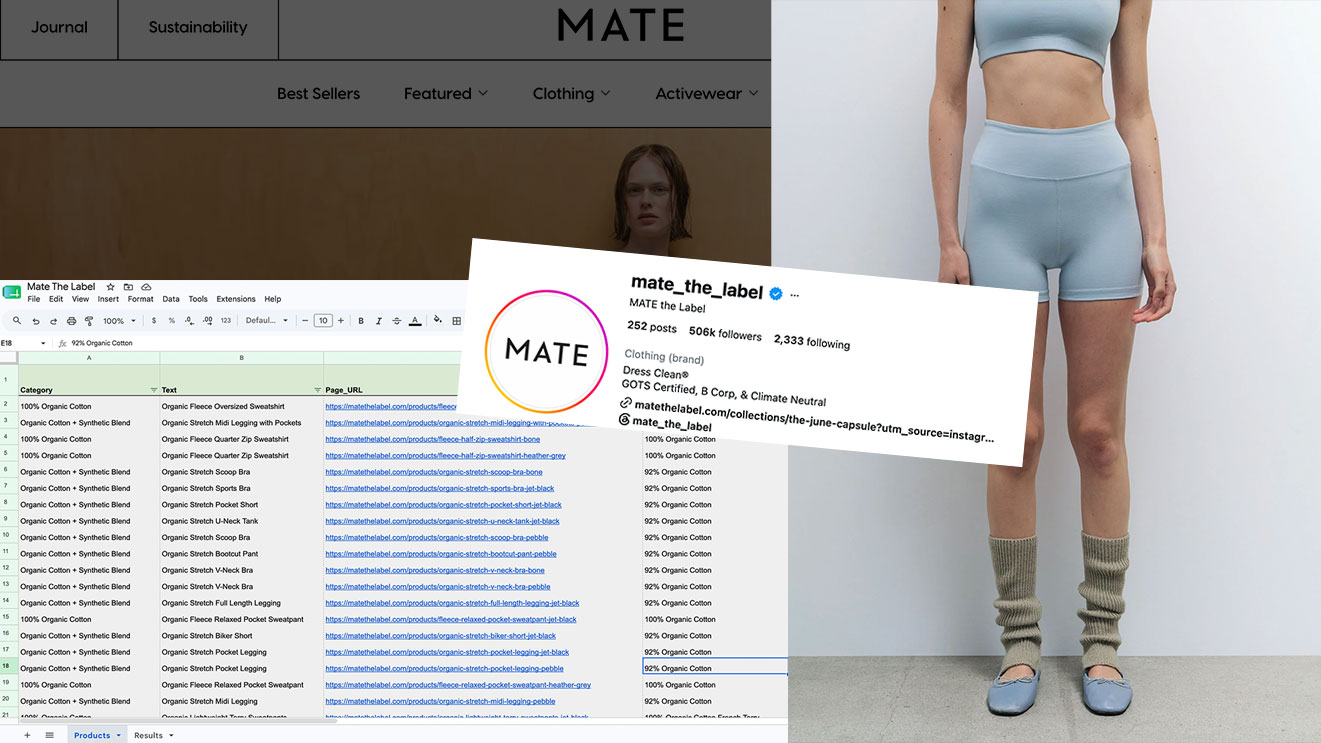
My full-catalogue scan on 13 June 2026 covered all 90 live styles, one row per style.
57.8% of the collection is plant-fibre with no plastic and no animal product: organic cotton, linen, and hemp-cotton blends. Half the catalogue, 50%, is a single pure fibre, 100% Organic Cotton or 100% Linen.
The other 42.2% is not natural. It carries petroleum synthetics (spandex, nylon, elastane) or chemically-regenerated semi-synthetics (Tencel, lyocell, modal, viscose, the same family as bamboo). 30% is organic cotton spun with spandex. A further 8.9% sits in the worst tier, a semi-synthetic and a synthetic blended into the same garment.
Mate The Label Fibre Composition: What Mate The Label Clothes Are Made Of
The best Mate The Label alternatives that only sell 100% natural clothing



Best Sustainable Underwear
Kent
The world’s first verified compostable underwear.
100% GOTS-certified organic pima cotton with no spandex, nylon, elastane or polyester, designed to return to the earth in 90 days. Free of plastics, pesticides, PFAS and petrochemicals, right down to the packaging.



best sustainable clothing brand for basics
Harvest & Mill
Organic cotton basics grown, milled and sewn entirely in the USA on a “seed to stitch” model, direct from American farmers, heritage mills and local sewing teams.
Vegan and PETA-approved, with much of the range left undyed, plus low-waste cutting and compostable or recyclable packaging.


Best Sustainable activewear
Eco Aya
100% plastic-free clothing made from regenerative organic Pima cotton, with the entire supply chain based in a single origin: Peru.
No polyester, nylon, acrylic or elastane, so the fabric sheds zero micro- or nano-fibers.
Why do Mate The Label call themselves sustainable, ethical or eco friendly?
What Mate The Label Gets Right, And Where Mate The Label Uses 100% Organic Cotton
The brand themselves, along with other directories, influencers and bloggers, call Mate the Label sustainable, ethical or eco friendly because parts of their business genuinely earn it.
They’re a Certified B Corporation which use to mean something.
They’re Climate Neutral and Climate Label certified, measuring their Scope 1, 3 emissions every year and publishing a reduction plan.
The bulk of their cut-and-sew happens within 15 miles of their Los Angeles HQ, and they keep a restricted-substances list to keep the worst carcinogens and endocrine disruptors out of the supply chain.
On paper, that’s a better-run company than almost anything on the high street, and I’m not going to pretend otherwise.
But almost half their range isn't a natural material
This is the part the ‘eco lists’ and badges skip over: almost half of what Mate the Label sell isn’t a natural fibre at all.
That 42.2% leans on Tencel, lyocell, spandex, nylon and elastane. Lyocell, and its cousin bamboo viscose, gets sold to you as “plant-based,” but it is regenerated cellulose: wood pulp chemically dissolved and extruded into a fibre in a factory.
Calling that natural is like calling petrol “plant-based” because it started as ancient ferns.
Spandex, nylon and elastane skip the euphemism entirely. They are plastic. Petroleum. Oil.
Funding the industry they claim to fight
The same supply chain that’s marketed as clean is partly funded by, and dependent on, the fossil-fuel industry, the same industry behind the drilling, the pollution, the funding policies and the geopolitics and wars that “sustainable fashion” is supposed to be moving us away from.
Mate the Label both fund the problem and sell themselves as the solution.
Is Mate the Label Non-Toxic? Microplastics, your skin and landfill
Every single wash, synthetic and semi-synthetic blends shed microfibres that slip straight through wastewater treatment and into our rivers, our oceans, and eventually back into us.
You’re also wearing this against your skin for twelve, sixteen hours a day, and plastic stretch fibres, plus the finishing chemistry that comes with them, are not something you want pressed against your body that long.
A 100% organic cotton or linen piece composts and returns to the soil.
A blend of cotton, spandex and lyocell cannot be cleanly separated, cannot be recycled, and cannot biodegrade.
Good to workers
Mate The Label’s Code of Conduct sets real baselines across partner factories: every worker is 18 or over, employment and overtime are voluntary, overtime is paid at 1.5×, local minimum-wage law applies, and no one works more than six consecutive days. Most of their cut-and-sew is in Los Angeles, close enough to actually walk the floor, which is rarer than it should be. On labour, the marketing mostly holds up.
Our focus is what those workers are sewing, the materials.
Treating people well while you stitch them into a petroleum-blend garment doesn’t make the garment sustainable, it just makes it an ethically-made plastic product.
Good labour which should be the standard anyway, and good materials are two different boxes. A genuinely sustainable brand has to tick both. Mate ticks one.
Offers traceability to a point
Mate is more transparent than most, and that’s the “traceability” the directories love to quote.
They publish their factory standards, they report emissions year on year, they hold B Corp and Climate Label certification, and they’ll happily tell you their garments are sewn within 15 miles of HQ.
To a point. Dig a little and “made in LA” gets fuzzier, ready-made garments also ship in from factories in India, with occasional runs from Türkiye and Peru.
But the bigger issue is this: traceability tells you where and how something was made, never what it’s made of.
You can trace a plastic-blend shirt back to a solar-powered factory full of happy, fairly-paid people and it is still a plastic shirt. Certifications and supply-chain maps measure process. Our list measures the actual fibre, and on the fibre, the numbers stare right back at you.
Is Mate the Label's cotton actually 100% organic cotton even organic, or a scam?
Here’s the uncomfortable part nobody on those “best sustainable brands” lists wants to print: even the half that is “100% organic cotton or linen” is only as honest as its paper trail.
Unless that cotton can be traced back to the actual farmer who grew it, you don’t actually know it’s organic, you know someone said it was.
This is how the biggest scandal in the fibre industry happened.
On 30 October 2020, GOTS, the gold-standard certifier brands love to wave around, published documentary evidence of systematic fraud abusing India’s government organic-cotton certification system.
Fraudsters had forged Raw Cotton Transaction Certificates using fake QR codes that linked to a cloned copy of the Indian government’s APEDA website, dressing up ordinary, conventionally-grown cotton as “certified organic.” GOTS confirmed knowledge of 20,000 metric tonnes of fake material, banned 11 companies, and terminated its contract with one approved certifier.
To put 20,000 tonnes in perspective: that’s roughly one-sixth of India’s entire organic cotton output for the year. And India grows about half the world’s organic cotton. This was not a rounding error.
And it wasn’t a one-off. A 2022 New York Times investigation estimated that 50 to 80% of the cotton India sells as “organic” may not be organic at all, for the simple reason that far more “organic cotton” is sold each year than there are organic, non-GMO seeds in circulation to grow it. The maths has never added up. As recently as 2025, the Indian government was being pressed in parliament to launch a fresh probe into the scam.
I am collecting every GOTS and certification investigation in one place. Read the full file at my GOTS organic certification hub.
So when Mate The Label buys cotton in bulk through layers of importers, mills and middlemen, the honest answer to “is this organic?” is: they don’t actually know, and realistically they can’t.
A logo on a hangtag is not traceability.
That’s the whole reason our list leans on brands that grow, mill and sew in one place, Harvest & Mill’s seed-to-stitch USA cotton, Eco Aya’s single-origin Peruvian Pima, where the chain is short enough to actually verify. A bulk-buying brand sourcing ready-made garments from factories across three countries cannot give you that, no matter how good the certificate looks.
Quick Tip About Traceability
Remember, brands like Tony’s Chocolonely offer traceability, but year after year they publicly report that they find hundreds or thousands of cases of child labour in their supply chain, despite there being hundreds of bean-to-bar brands, because they are mass market.
Be mindful of wording and marketing, and don’t fall for the shiny pendulum. These brands admit it themselves, but they word and market it so people look past the obvious. It’s all marketing, and sadly it works. But when in doubt, just look at the real numbers and the answers stare you in the face.
Final verdict, is Mate the Label legit?
Mate the Label is owned by Kayti O'Connell Carr, based in Los Angeles
Kayti O’Connell Carr started the brand in Los Angeles in 2013. The mission, in her words, is to make essentials that are “clean from seed to skin” and to “clean up the fashion industry one garment at a time.” The brand even lists “plastic-free” as one of its core pillars, alongside clean, organic, ethical, women-centred, circular and local.
But they actually sell a collection where almost half the line is petroleum plastic and chemically-regenerated fibre, Tencel, lyocell, spandex, nylon and elastane blended into the cotton. A brand can’t credibly print “plastic-free” on the about page and “5% Spandex” on the care label of the same garment.
So yes, Mate The Label is real. They’ll deliver your order, the quality is well-reviewed, and they clearly have a huge following of people who love the product. I’m not calling them a scam.
Their materials are not sustainable based on their own product data.
- Almost half is not natural fibre. Half the catalogue is a single pure fibre, organic cotton or linen, and another 7.8% is an all-plant hemp-cotton blend. The remaining 42.2% carries spandex, nylon, elastane, Tencel or lyocell. A plastic blend can never be composted, recycled cleanly, or verified the way a single fibre can.
- Mate the Label still feed the industry doing the damage. Every metre of spandex, nylon and elastane is petroleum, oil. That purchase funds the fossil-fuel supply chain behind the drilling, the pollution, the funding policies, the geopolitics and the conflict that “sustainable fashion” claims to oppose. Buy the garment and you help fund it.
- Mate the Label sell plastic you wear on your skin. Elastane, spandex and nylon are plastic. Lyocell and Tencel are wood pulp dissolved in chemical solvents and re-spun into fibre, the same process as bamboo viscose. None of it is a natural fibre, none of it breathes like one, and all of it sheds microplastic into the water, and into you, every wash.
- You can’t fully verify the “organic” half either. Organic-cotton certification out of bulk supply chains has a documented fraud problem. Short, single-origin chains can be checked. Multi-country bulk sourcing can’t.
Why avoid Mate the Label?
- Avoid Mate the Label if you have sensitive skin, you don’t want polyurethane stretch fibre and its finishing chemistry pressed against your body for 12+ hours a day.
- Avoid them if you don’t want to fund the plastics and fossil-fuel industry, half their range depends on it.
- Avoid them if landfill and microplastic pollution matter to you, blended fabric can’t biodegrade and sheds plastic with every wash.
- Avoid them if you want certainty, not certificates, a logo on a hangtag isn’t the same as a traceable, single-fibre, single-origin garment.
- Avoid them if you just want 100% natural materials from 100% ethical brands (it exisits).
Mate the Label are better run than most of the high street.
But they are not sustainable through and through, and our clothing list shows that other brands genuinely are.
Want the receipts?
Download the Mate the Label data sheet to get every brand’s raw material data.
What Wearing Mate The Label 100% Organic Cotton Against Your Skin Means For Your Health
Clothing is intimate. It lives against our skin and moves with us through the world. Yet fast fashion has made it a source of harm, flooding the planet with pollution, toxic chemicals, and synthetic fibers that dishonor both people and Earth. Choose to dress with intention. Explore brands crafted with natural fibers, fair wages, and reverence for the body and the planet.
-15% off Eco Friendly Washing | Kind Laundry
You switched to plant-fibre clothing, now wash it in something just as clean. Kind Laundry’s plastic-free, plant-based strips skip the synthetic detergents and plastic jugs, and you get 15% off.

-12% Off Exclusive Discount On Sustainable Swimwear
Freedom Ecowear have given us a discount of -12% off to share with our website visitors. Use the link to claim your discount.