Where to Stay in Jamaica: Best Areas and Eco Lodges, Hotels and Resorts
Where to stay in Jamaica
The best areas to stay in Jamaica range from a Black and family owned beachfront hotel with its own 174 acre farm and a farm to table kitchen, to an off grid cliffside lodge under the stars, a rainforest hideaway with its own recording studio, and a Green Globe certified oceanfront estate funding coral restoration. The Westmoreland interior is the place for genuine off grid quiet, Negril for the famous Seven Mile Beach and sunsets, Montego Bay for easy first time resorts near the airport, Ocho Rios for families and the big attractions, Port Antonio for lush, crowd free nature, and Treasure Beach for slow, authentic south coast life.
Every stay we recommend below is genuinely sustainable, Jamaican rooted where possible, and chosen so your money stays on the island.
Where to stay in Jamaica by area, at a glance
Westmoreland is best for nature lovers, off grid adventurers and independent travellers who want the green interior over the beach strip
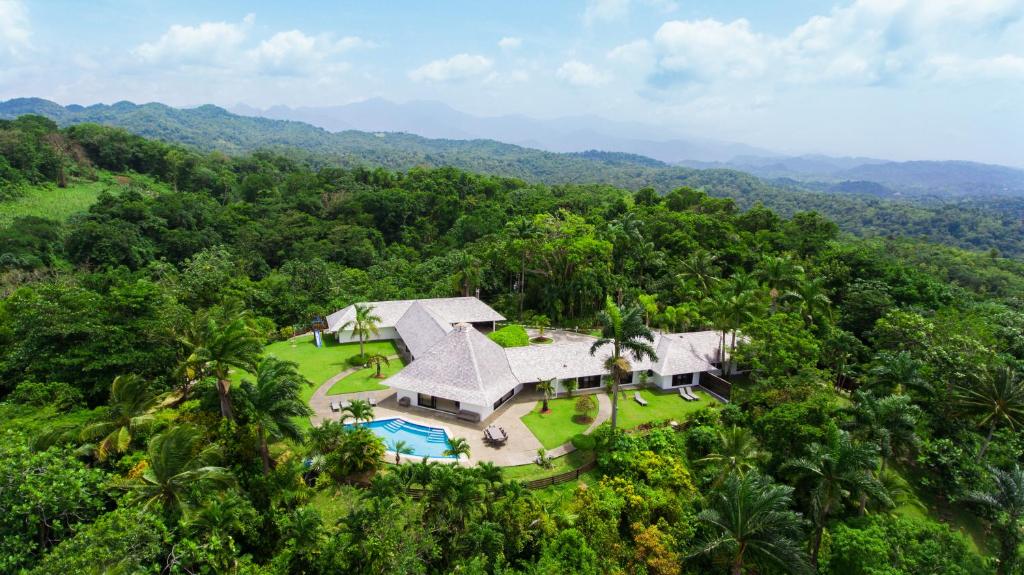
Westmoreland is Jamaica’s westernmost parish, home to the bustling market town of Savanna la Mar along with the country corners of Petersfield and the hills above Cabarita, sitting at the far west of the island just inland from the Negril coast. The Westmoreland interior is rural, green and far quieter than the famous beach strips, the place to come for inland nature like Roaring River and Mayfield Falls and a genuinely off grid stay. It suits adventurous, independent travellers happy to be away from the sand, nature lovers drawn to rivers and forest, and anyone who wants the Jamaica that still feels unhurried. The closest gateway is Sangster International in Montego Bay, roughly 90km away by road, and the Knutsford Xpress coach runs into the west from Montego Bay and Kingston, though the final climb into the hills is best done by car or private transfer.
The difference between Westmoreland and other popular beach areas like Negril and Montego Bay is that Westmoreland trades the resort coastline for the working farms, rivers and forest of the interior, so instead of all inclusive towers and crowded sand you get birdsong, fresh water swimming and a slow, lived in pace, with the beaches still close enough for a day trip whenever you want them.
Where to stay in Westmoreland: Top Pick

Camp Cabarita is the best place to stay in Westmoreland, Jamaica
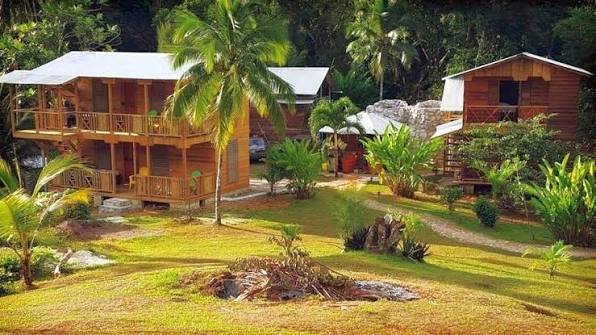
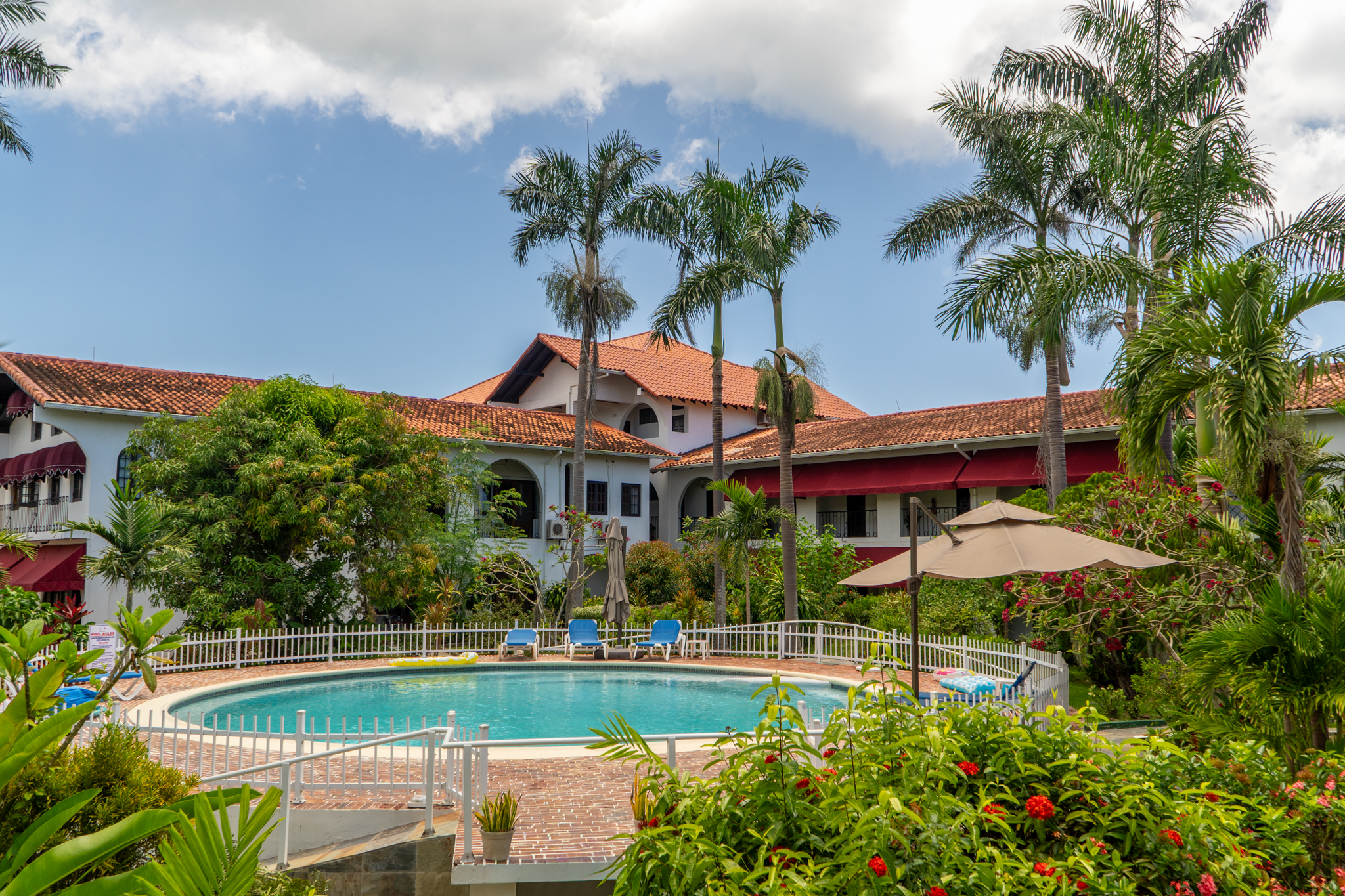
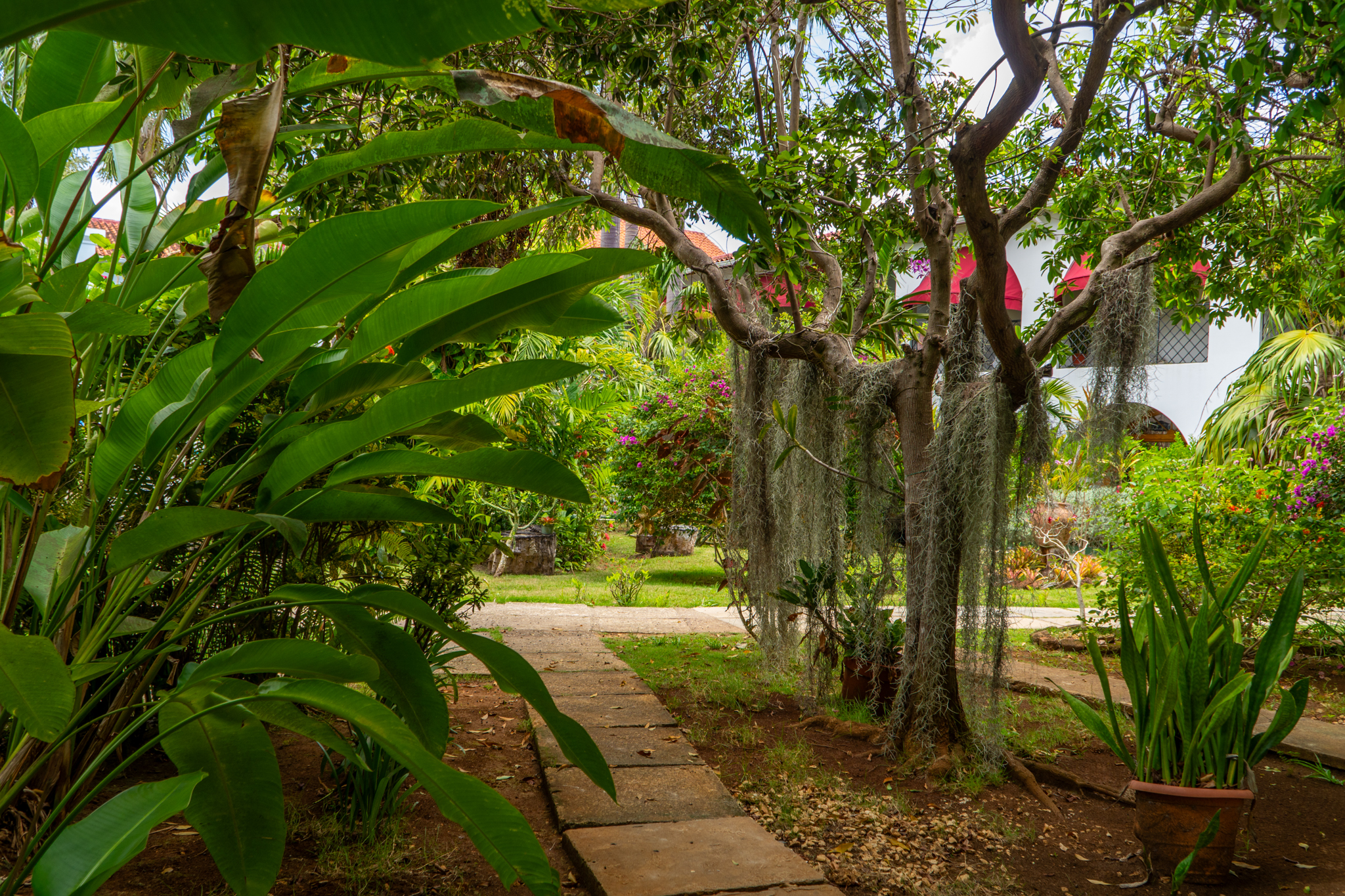
Camp Cabarita is our pick for the interior, a low impact eco resort set high in the hills of Westmoreland where an organic garden and a Jamaican farm to table menu feed you. It sits beside the Cabarita River in the green heart of the parish, set well above the coast road so you wake to birdsong and running water rather than traffic, and close enough to the land that the whole place feels grown out of it.
Who owns Camp Cabarita?
Camp Cabarita is a small, independently run eco resort rather than part of a chain, and the team who run it live and work the site itself. That means the welcome is personal and the knowledge of the surrounding habitat is first hand, with the same people who tend the garden and care for the river also looking after guests. It gives the place the feel of staying with knowledgeable hosts in their own corner of the parish rather than checking into a faceless resort.
About the rooms in Camp Cabarita
The lodging is simple and honest rather than glossy, built to tread lightly on the land it sits in. There is a handful of private rooms and cabins that open onto the trees and the water, keeping you connected to the surroundings instead of sealing you off from them. Expect comfortable, unfussy spaces designed for a rural escape, where the point is waking to the forest and the sound of the Cabarita River rather than polished hotel finishes.
What food is available at Camp Cabarita?
The kitchen leans on the camp’s own organic garden and on nearby growers, so meals arrive as proper Jamaican cooking made from what the soil and the season give. This is the farm to table promise made plain on the plate, with fresh produce, local ingredients and genuine home style Jamaican dishes rather than buffet resort fare. Eating here is part of the experience, tied directly to the land the camp sits on.
Sustainability features of Camp Cabarita
The eco credentials here are concrete rather than decorative: an organic garden, composting that returns organic waste to the soil, and a genuine effort to keep waste to a minimum. The setting is prized for its biodiversity, and the camp actively cares for the river and forest habitats it sits beside so the wildlife and the water stay healthy. This is a place that gives back to the land it borrows from rather than just trading on a green label.
Who is Camp Cabarita for?
Camp Cabarita is perfect for nature lovers who want to disappear into the real green heart of Jamaica and connect with the land during their stay. It suits independent and solo travellers after a quiet rural base, families who want safe fresh water river days paired with easy beach trips, and anyone keen to taste real Jamaican culture and food away from the resort strip. If you want sand, swim up bars and nightlife on your doorstep, the coast will serve you better, but for off grid calm this is the spot.
How to get to Camp Cabarita from the airport
The closest airport to Camp Cabarita is Sangster International Airport in Montego Bay (MBJ), the main gateway for western Jamaica, around 90km away and roughly a two hour drive into the hills of Westmoreland. The final stretch leaves the coast road and climbs inland on quieter country lanes towards Cabarita. Norman Manley International in Kingston (KIN) is the alternative, but the Montego Bay approach is far shorter and the obvious choice.
Private transfer or taxi to Camp Cabarita
The simplest last leg is a pre arranged private transfer, which the camp can help organise so a driver who knows the rural turns meets you at arrivals. This is the easiest option given the inland route, and a single fare covers the whole journey door to door. A licensed JUTA taxi from Montego Bay airport will also make the run, and a hire car works well too if you want the freedom to explore Negril, Mayfield Falls and the country markets on your own schedule.
Public transport to Camp Cabarita
Public transport into the Westmoreland interior is limited, so a car or transfer is strongly recommended for the final leg. If you do want to travel by coach, the Knutsford Xpress runs a comfortable scheduled service from Montego Bay and Kingston towards Savanna la Mar and the west, and from there local route taxis and shared minibuses serve the inland villages. These connections can be slow and infrequent into the hills, so most guests arrange a private transfer or drive themselves rather than rely on them.
Things to do while staying at Camp Cabarita
Things to do around Camp Cabarita range from slow mornings on the Cabarita River, where you can swim and tube in fresh water and watch for the birds the surrounding habitat protects, to a short run down to the famous Seven Mile Beach at Negril for sunset and reggae on the sand. The contrast of quiet river days and lively coast is part of the appeal of this inland base.
Nearby you can visit the dramatic cliffs and the Negril Lighthouse, take a trip to Mayfield Falls for a guided river walk over twenty one cascades, explore the working farms and country markets of inland Westmoreland for jerk and fresh produce, and head out to the Royal Palm Reserve and the Negril Great Morass wetlands for birdwatching. Roaring River and its blue hole make another easy excursion into the parish’s spring fed landscape.
It suits families who want safe river days and easy beach trips, solo travellers after a quiet rural base, nature lovers drawn to the biodiversity and the wildlife, and anyone keen to taste real Jamaican culture and food away from the resort strip. Those craving nightlife and big resort facilities will find Negril a better fit, but for an off grid green escape Camp Cabarita is hard to beat.
Negril is best for beach lovers, sunset chasers, couples and families after relaxed Caribbean days
Negril sits at the far western tip of Jamaica, spread across the parishes of Westmoreland and Hanover, about a ninety minute to two hour drive from Sangster International Airport in Montego Bay, which is the airport you want for the whole west coast. It is the classic Jamaica beach base, a laid back stretch of the Seven Mile Long Bay beach in the north and dramatic limestone cliffs at the West End where the sun goes down over Rick’s Cafe. It suits couples, sunset chasers and anyone who wants relaxed beach days with a bit of nightlife nearby, while the calmer Bloody Bay end works well for families with younger children.
The difference between Negril and other popular Jamaican beach resorts like Montego Bay and Ocho Rios is that Negril feels softer and slower, built around one long unbroken stretch of sand rather than a cluster of big walled all inclusive complexes. Montego Bay leans towards busy resort strips and nightlife, and Ocho Rios is geared to cruise day trippers and waterfall tours, whereas Negril keeps a barefoot, low rise, sunset over the cliffs character that draws people who want the beach itself to be the main event.
Where to stay in Negril: Top Pick

Charela Inn is the best place to stay in Negril, Jamaica
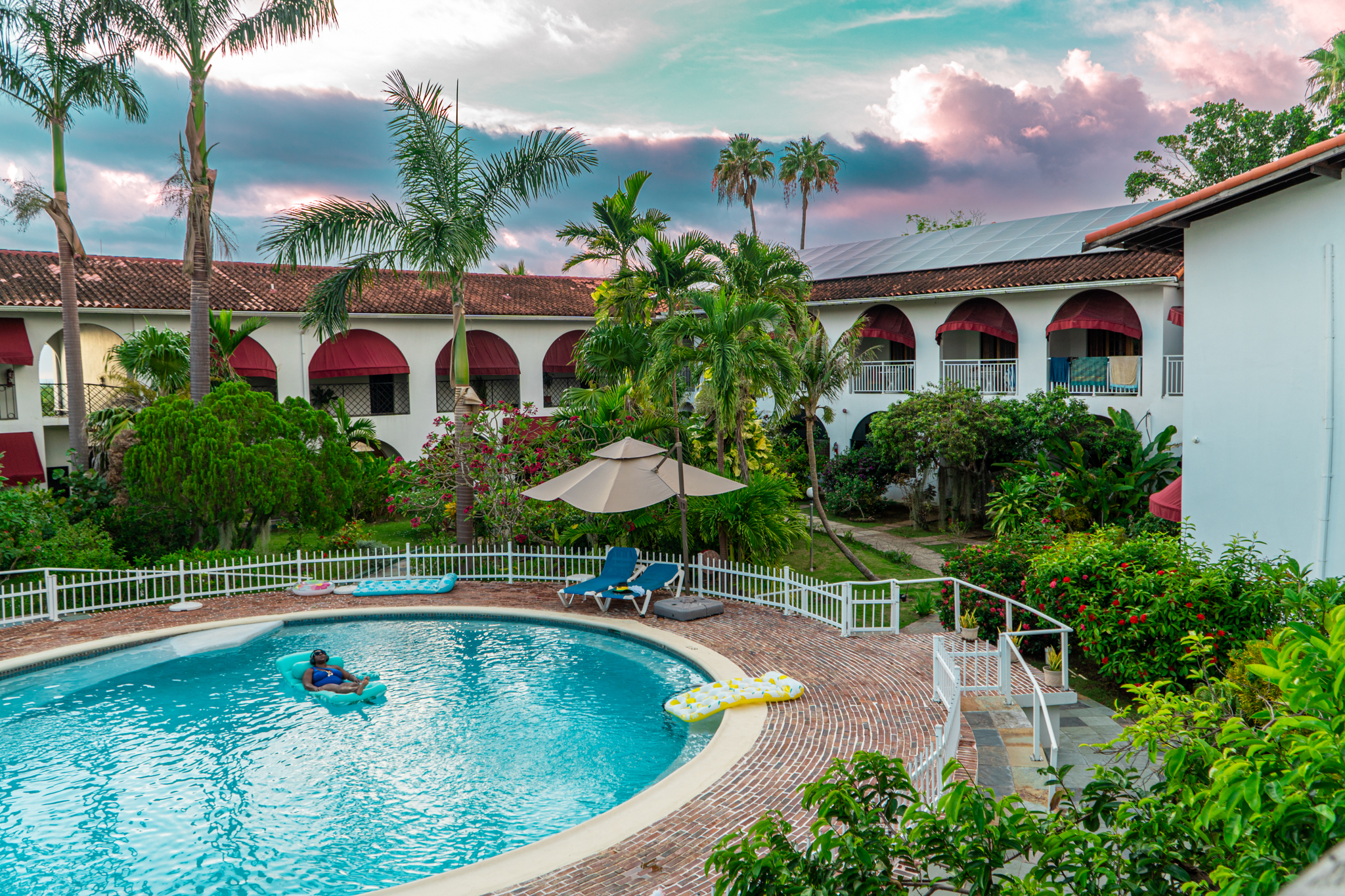
Charela Inn sits right on Seven Mile Beach, soft sand and calm Caribbean water on one side and a relaxed low rise property of around sixty rooms on the other. It has been run with real warmth since 1980, the kind of intimate, unhurried beachfront base where the welcome feels personal rather than processed and the sea and the people do the talking.
Who owns Charela Inn?
Charela Inn is a family owned and family run hotel that has been in the same hands since it opened in 1980. That long family ownership is the heart of its character, with a personal welcome and a genuinely local feel that you simply do not get from a sealed off corporate resort. The same family also runs a working farm that supplies the kitchen, tying the hotel closely to the land around it.
About the rooms in Charela Inn
The property keeps things intimate with around sixty rooms in a low rise layout that never feels like a mass tourism machine. Rooms are simple, comfortable and full of character, the kind of beachfront base that lets the setting shine rather than chasing polished corporate gloss. With the sand right at the front door, this is somewhere you stay for the location and the warmth rather than for showy gadgetry.
What food is available at Charela Inn?
The food is one of the real joys here. The kitchen is farm to table French Jamaican, supplied by the family’s own working farm, so much of what reaches the plate has travelled only a short distance, keeping food miles modest and flavours fresh. This is the antidote to the all inclusive buffet conveyor belt: proper cooking, local produce and a dining experience that feels like a genuine taste of the island.
Sustainability features of Charela Inn
On the eco side the credentials are concrete rather than cosmetic. The family farm supplies the kitchen with seasonal vegetables, eggs and meat grown using sustainable methods, and in recent years the family has planted hundreds of trees, tying the property to the land in a way few beach hotels manage. The result is a stunning beachfront stay without the mass tourism footprint.
Who is Charela Inn for?
Charela Inn is perfect for couples and families who want the famous Seven Mile sand alongside a genuinely local, warm welcome. It also suits solo travellers after an easy beach base with friendly faces, and nature lovers drawn to the nearby reefs and wetlands. Anyone keen to soak up real Negril culture rather than a sealed off resort bubble will feel at home here.
How to get to Charela Inn from the airport
The closest airport to Charela Inn is Sangster International Airport (MBJ) in Montego Bay, roughly 85km away, which works out at about a 90 minute drive down the coast to Negril.
Private transfer or taxi to Charela Inn
The simplest last leg is a pre booked private transfer, which most guests arrange ahead of time so a driver is waiting in arrivals when they land. Licensed JUTA taxis and hire cars are both easy to organise at the airport too if you would rather set your own pace along the Seven Mile Beach road. Agree the fare or confirm your transfer booking before you set off, as it is a long run along the coast.
Public transport to Charela Inn
Public transport to Negril is limited and slower than a transfer, so a private car or pre booked transfer is by far the easiest option. If you do want to travel independently, the Knutsford Express coach runs from Montego Bay towards the west, and shared route taxis and the local guagua style minibuses connect Montego Bay, Savanna-la-Mar and Negril for a fraction of the price, though they involve changes and are not designed for heavy luggage. For most visitors heading straight to the beach, a transfer or hire car is the better choice.
Things to do while staying at Charela Inn
Things to do around Charela Inn range from a sunset cliff walk at Negril’s famous West End, where you can watch the divers leap from the rocks at Rick’s Cafe with a cold drink in hand, to a simple stroll along the full length of Seven Mile Beach right from the front door.
From there you can take a boat trip out to snorkel the reef, visit the Negril Lighthouse, or head a little further afield to the Royal Palm Reserve and the Great Morass wetlands for birdlife and quiet nature. The calm, shallow water at the Bloody Bay end is ideal for an easy swim, and there is plenty of relaxed beach bar life and live music to fill the evenings.
It suits families who want safe sand and shallow water, solo travellers after an easy beach base with friendly faces, nature lovers drawn to the reefs and wetlands, and anyone keen to soak up genuine local culture rather than a sealed off resort bubble.
Montego Bay is best for first time visitors, resort lovers, families and travellers who want comfort minutes from the airport
Montego Bay sits on the north west coast in the parish of St James, just minutes from Sangster International Airport, which makes it the easiest landing for a first trip. The Knutsford Express links it to Negril, Ocho Rios and Kingston, so it works well as a first base before you move on. This is the polished resort strip option, with shopping and the lively Hip Strip all close to hand, and it suits first timers who want the comfort and ease of a resort without a long transfer on day one. If this is your first taste of Jamaica we would gently say enjoy it, then make sure you venture out, because the real island, the farms, fishing villages and rainforest, lives well beyond the resort gates and is the part you will remember.
The difference between Montego Bay and other popular Jamaican resort areas like Negril and Ocho Rios is that Montego Bay puts you on the doorstep of the airport with the widest spread of resorts, shopping and nightlife, whereas Negril is built around the long, laid back sweep of Seven Mile Beach and its cliff bars, and Ocho Rios leans into waterfalls and shore excursions like Dunn’s River Falls. Montego Bay is the easiest, most convenient landing, the others ask for a longer transfer but reward you with a more distinct sense of place.
Where to stay in Montego Bay: Top Pick

Half Moon is the best place to stay in Montego Bay, Jamaica
Half Moon at Rose Hall is our pick in Montego Bay, the rare resort that backs its polish with genuine credentials. Spread along a crescent of private beach that gives the place its name, it has the easy, manicured feel of a classic Jamaican resort, all colonial inspired architecture, palm shaded lawns and that wide arc of sheltered Caribbean water. It is a property built for comfort, the kind of place where a first time visitor can simply relax and let the resort do the work.
Who owns Half Moon?
Half Moon is a long established independent Jamaican resort at Rose Hall, just east of Montego Bay, rather than part of a global all inclusive chain. It has operated on this stretch of coast for decades and has built its reputation on personal, owner minded service and a strong local identity, which is part of why its environmental and conservation work feels rooted rather than recently bolted on.
About the rooms in Half Moon
The rooms and suites lean into a bright, breezy elegance, with airy interiors, terraces and villa options that open onto either the gardens or the sea. Expect generous space, sea breezes and that wide arc of sheltered water close at hand, with villa choices that suit families and groups who want a little more room and privacy alongside the main resort facilities.
What food is available at Half Moon?
The dining moves from relaxed beachside plates to more formal evenings, with a strong showing of fresh local produce and Jamaican flavours alongside the international menus you would expect of a resort at this level. There is a proper sense of place here rather than a generic all inclusive sameness, so you can move from a casual lunch on the sand to a more considered dinner without leaving the grounds.
Sustainability features of Half Moon
What sets Half Moon apart is that the polish comes with real substance. Its environmental practices are verified by Green Globe, and it was the first hotel inducted into the Caribbean Hotel Industry Conference Green Hotel Hall of Fame, so the commitment is long standing. The resort invests in sustainable energy and water practices across its grounds and golf course, and runs a hawksbill sea turtle conservation programme on its own shores, recording hundreds of viable hatchlings reaching the sea each nesting season.
Who is Half Moon for?
It is the rare base that works for a first time resort holiday and a more curious, get out and explore trip alike. It suits families, couples and first time visitors who want a comfortable, polished Montego Bay base, and it is perfect for travellers who want the easy, familiar resort experience without leaving their conscience at the airport.
How to get to Half Moon from the airport
The closest airport to Half Moon is Sangster International Airport in Montego Bay, code MBJ, which sits roughly a 10 to 15 minute drive west of the resort along the north coast road, a distance of about 10 kilometres. Because Half Moon is so close to the gateway airport on the island, the short last leg means you can be checked in and on the sand soon after landing.
Private transfer or taxi to Half Moon
The easiest last leg is a pre booked private transfer or a hotel arranged car, which can meet you in the arrivals hall and have you at Rose Hall within minutes. A metered JUTA taxi from the official airport rank or a hire car both work well too, and given the very short hop a private transfer is comfortable, predictable and well worth it after a long flight.
Public transport to Half Moon
Public transport to Half Moon is limited. The Knutsford Express coach network is excellent for moving between Montego Bay, Negril, Ocho Rios and Kingston, but it serves town terminals rather than individual resorts, so it is better for onward island travel than for the airport run. Local route taxis and minibuses do pass along the coast road, but for the short trip from MBJ to Rose Hall a private transfer or taxi is by far the simplest and most reliable option.
Things to do while staying at Half Moon
Things to do around Half Moon range from a morning at the on site dolphin lagoon and the hawksbill turtle conservation programme, where you can learn how the resort protects nesting sea turtles, to long lazy hours on its private crescent of beach and a round on the resort golf course. The calm waters here are made for swimming and easy watersports, so you rarely need to leave the grounds to fill a day.
Just beyond the gates there is plenty more to draw you out. Families love the calm Rose Hall beaches and the equestrian centre, culture seekers can tour the haunted Rose Hall Great House just up the road, and nature lovers can drift down the Martha Brae River on a bamboo raft or head inland to the lush hills around Montego Bay. The buzz of the Hip Strip, with its bars, shopping and local jerk shacks, is an easy taxi ride away.
This mix means Half Moon suits a wide spread of travellers. Families have the beaches, horses and turtles on hand, couples and solo travellers can balance quiet resort days with a night out on the Hip Strip, nature lovers have the river, the turtle programme and the inland hills, and culture seekers have Rose Hall Great House and the wider Montego Bay story close by. It is the rare base that works for a first time resort holiday and a more curious, get out and explore trip alike.
Ocho Rios is best for families, first timers and adventure seekers chasing Jamaica's bucket list attractions
Ocho Rios sits on the north coast in the parish of St Ann, roughly ninety minutes by car from Sangster International Airport in Montego Bay, and is served by the Knutsford Express from both Montego Bay and Kingston. A cruise port town, it packs Jamaica’s bucket list attractions close together, from Dunn’s River Falls to the Blue Hole. It suits families and first timers who want plenty to do within a short drive, with a lively, busy feel and easy excursions in every direction.
The difference between Ocho Rios and other popular Jamaican resort towns like Montego Bay and Negril is that Ocho Rios builds its appeal around natural attractions and outdoor adventure rather than long beach strips or nightlife. Montego Bay leans on its big all inclusives and the airport convenience, and Negril is famous for its seven mile beach and laid back sunsets, while Ocho Rios puts waterfalls, river tubing, rainforest trails and lush inland scenery within a short drive of one another, so you spend your days exploring rather than simply lying on the sand.
Where to stay in Ocho Rios: Top Pick

Jamaica Inn is the best place to stay in Ocho Rios, Jamaica
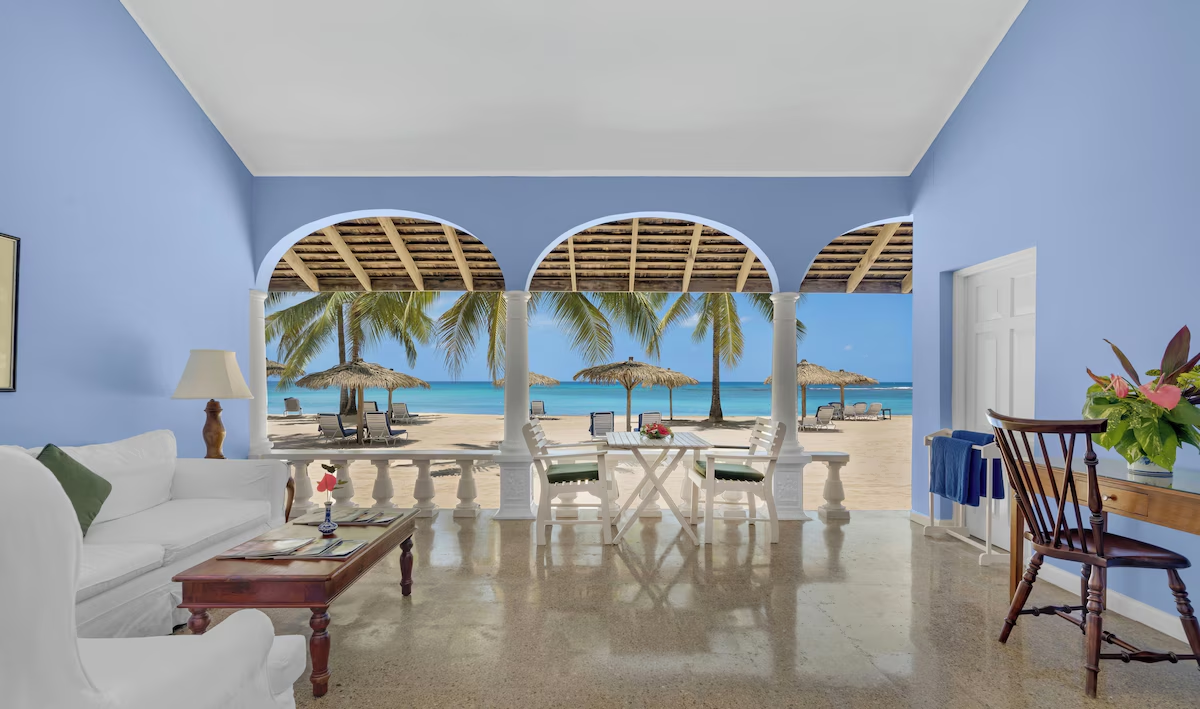
Jamaica Inn sits just east of town on an eight acre oceanfront estate, a Green Globe certified hotel that has held on to its quiet, timeless charm while the rest of Ocho Rios grew busy around it. It favours space and grace over crowds, with a crescent of soft sand and a sheltered cove of glassy blue water at its heart, and a genteel, unhurried mood where afternoon tea, croquet on the lawn and long swims still set the rhythm of the day.
Who owns Jamaica Inn?
Jamaica Inn has been family run for decades and is known for a discreet, almost private club feel that comes from that long, personal stewardship. Rather than the corporate polish of the area’s big chains, it carries the warmth of a place that has been cared for by the same family over generations, with staff who have often stayed for years and service that feels personal rather than scripted.
About the rooms in Jamaica Inn
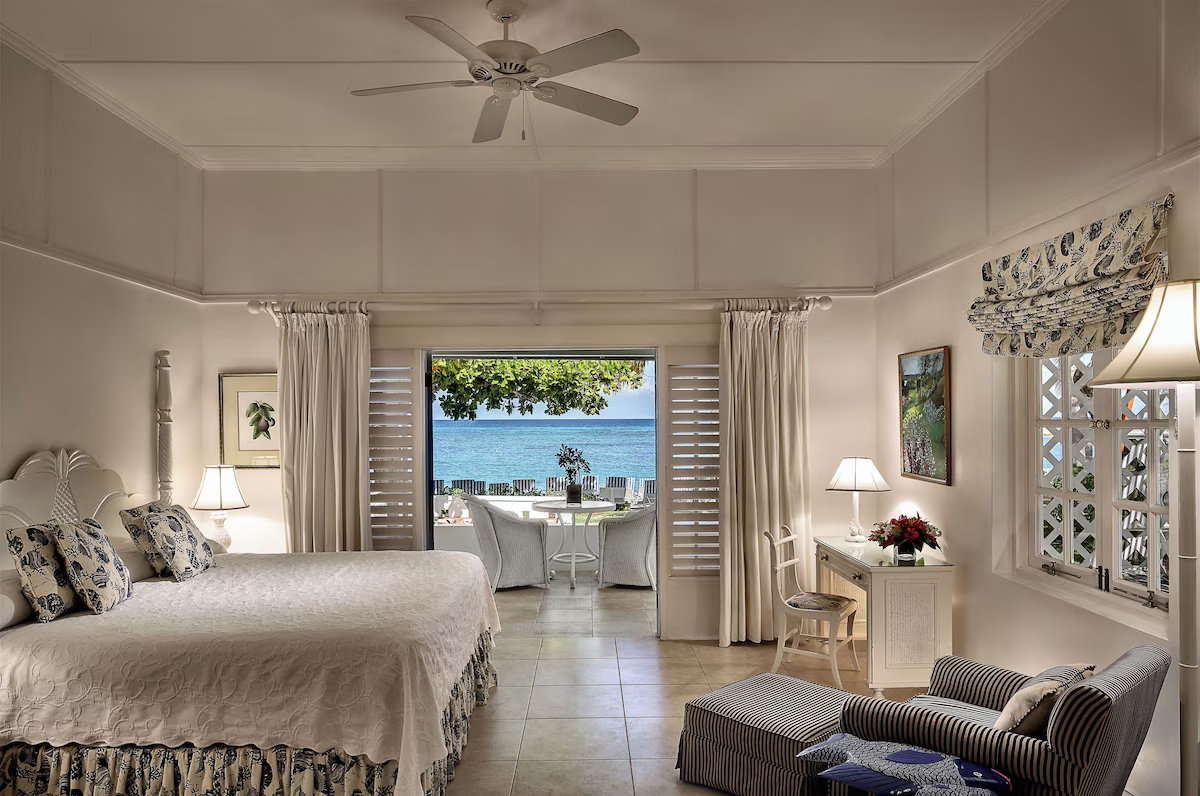
The rooms read like rooms in a gracious private home rather than a resort, most of them open fronted suites and cottages with wide verandahs that look straight out over the sea. They are dressed in cool pastels, mahogany and breezy fabrics, and deliberately free of televisions so that nothing competes with the view. The emphasis is on space, sea breeze and that sheltered cove rather than gadgets, which is exactly what draws guests who want to switch off completely.
What food is available at Jamaica Inn?
The kitchen leans on the estate’s own gardens, with menus built around fresh Jamaican produce and the day’s catch. Meals are served on the terrace or, by candlelight, right at the water’s edge, and the cooking feels generous and local without ever shouting about itself. It is the sort of dining where the setting, the produce and the quiet attention to detail matter as much as the plate itself.
Sustainability features of Jamaica Inn
Jamaica Inn runs partly on solar power, tends its own gardens and an orchid greenhouse, and backs a five year coral restoration project as part of its wider conservation work, all of which sits behind its Green Globe certification. The calm blue water out front is something it actively protects rather than simply enjoys, which makes it the grown up, sustainable answer to the area’s big all inclusive resorts.
Who is Jamaica Inn for?
Jamaica Inn is perfect for couples and discerning travellers who want true quiet, classic service and a clear conscience in equal measure. It suits those who prefer space and grace over crowds and entertainment, who like the idea of a refined oceanfront base close to Ocho Rios attractions, and who value a property that protects the sea and gardens it sits within. It is one of the most refined places to stay anywhere in Jamaica.
How to get to Jamaica Inn from the airport
The closest airport to Jamaica Inn is Ian Fleming International Airport (OCJ) at Boscobel, a small airport roughly 20 minutes drive east along the coast that handles light aircraft and private charters. Most guests, however, fly into Sangster International Airport (MBJ) in Montego Bay, the island’s main gateway, which sits about 1.5 to 2 hours west by road, a drive of around 110 kilometres along the north coast.
Private transfer or taxi to Jamaica Inn
For the last leg, a pre arranged private transfer is the easiest option, and the hotel can help organise a driver to meet you at either airport. Hire cars and metered taxis are both straightforward as well, though a private transfer takes the guesswork out of the longer Montego Bay run and lets you settle in the moment you land. Agree the fare or confirm the booking in advance so there are no surprises on arrival.
Public transport to Jamaica Inn
Public transport to the door is limited, so a car or transfer is best. The Knutsford Express coach runs comfortable, air conditioned services from Montego Bay and Kingston into Ocho Rios town, which is a sensible budget option for the long haul, and from the Ocho Rios terminal you would take a short taxi east to the hotel. Local route taxis and minibuses also link Ocho Rios with surrounding towns, but for reaching Jamaica Inn itself with luggage, a private transfer or taxi remains the most comfortable choice.
Things to do while staying at Jamaica Inn
Things to do around Jamaica Inn range from a guided climb up the famous Dunn’s River Falls, where you scale the terraced limestone cascades hand in hand with your group, to a string of nearby highlights worth a half day each. Within easy reach you have the lush botanical paths and zip lines of Mystic Mountain, the gentle inland tubing on the White River, and the bustling craft markets and dining of Ocho Rios town itself.
Further afield, the literary history of Noel Coward’s Firefly estate sits up in the hills with sweeping coastal views, while the wider parish of St Ann offers rainforest trails, birdlife and quiet coves to explore between outings. Back at the hotel, the sheltered cove invites long swims and snorkelling, and the lawns lend themselves to afternoon tea and croquet when you simply want to slow down.
Families will love the falls and the river tubing, nature lovers the rainforest trails and birdlife, and culture seekers the colonial era houses and local music. Solo travellers, meanwhile, will find the calm of the property an easy base between adventures, and couples will appreciate returning each evening to candlelit dinners at the water’s edge.
Port Antonio is best for nature lovers, couples, music fans and off the beaten track travellers
Port Antonio sits in the lush northeast of Jamaica, in the parish of Portland, where rainforest tumbles down to the sea and the crowds thin right out. It is the island’s quiet hidden gem, home to the Blue Lagoon, Rio Grande rafting and Frenchman’s Cove, a place where nature dominates and the pace slows. It suits nature lovers, couples and music fans, along with independent travellers who want the authentic, off the beaten track side of Jamaica rather than the polished resort strip.
The difference between Port Antonio and other popular Jamaican beach towns like Negril and Montego Bay is that Port Antonio has stayed genuinely low key, with no high rise all inclusive sprawl and far fewer day trippers, so the beaches, waterfalls and rafting rivers feel like discoveries rather than packaged excursions, and the landscape is greener and wilder than anywhere on the busier north and west coasts.
Where to stay in Port Antonio: Top Pick

Geejam and Great Huts is the best place to stay in Port Antonio, Jamaica
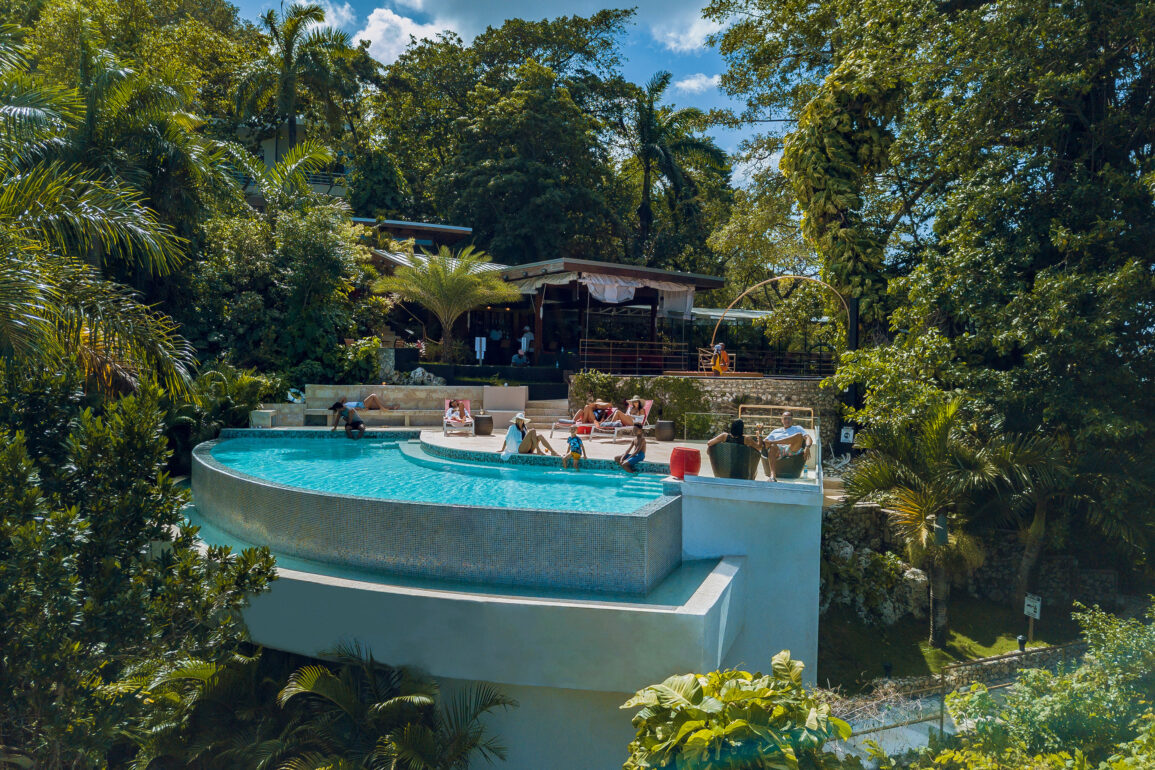
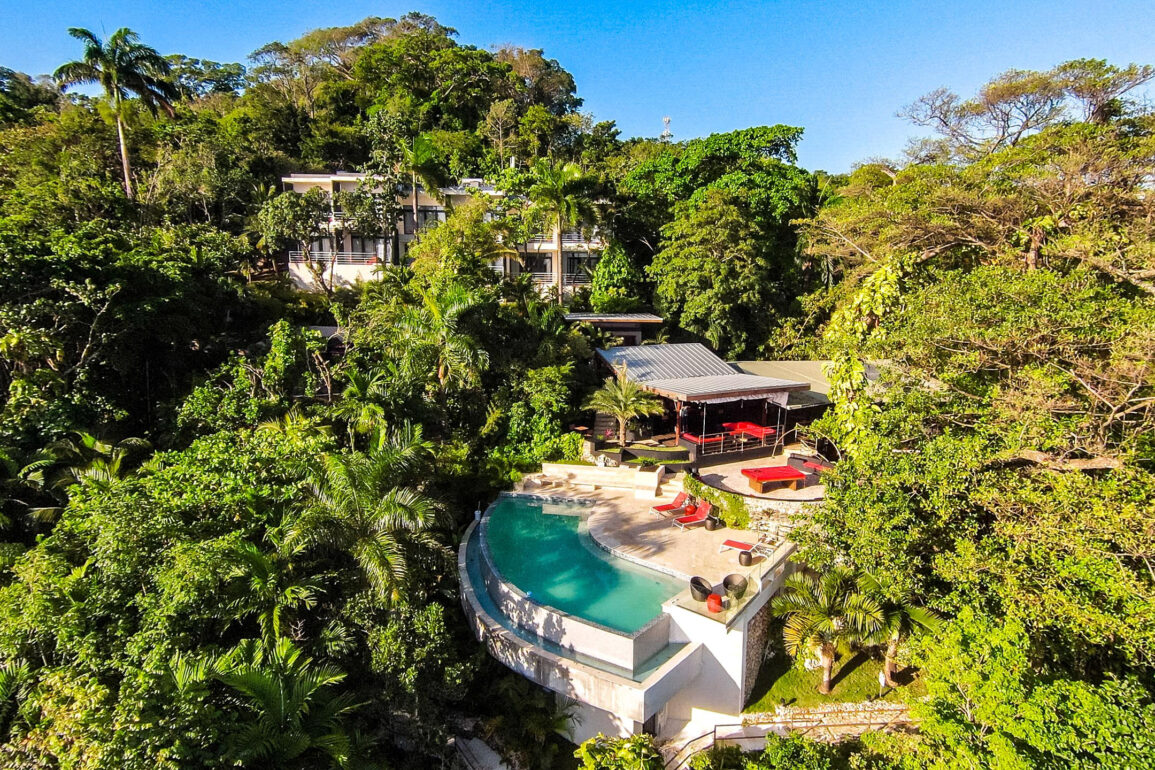
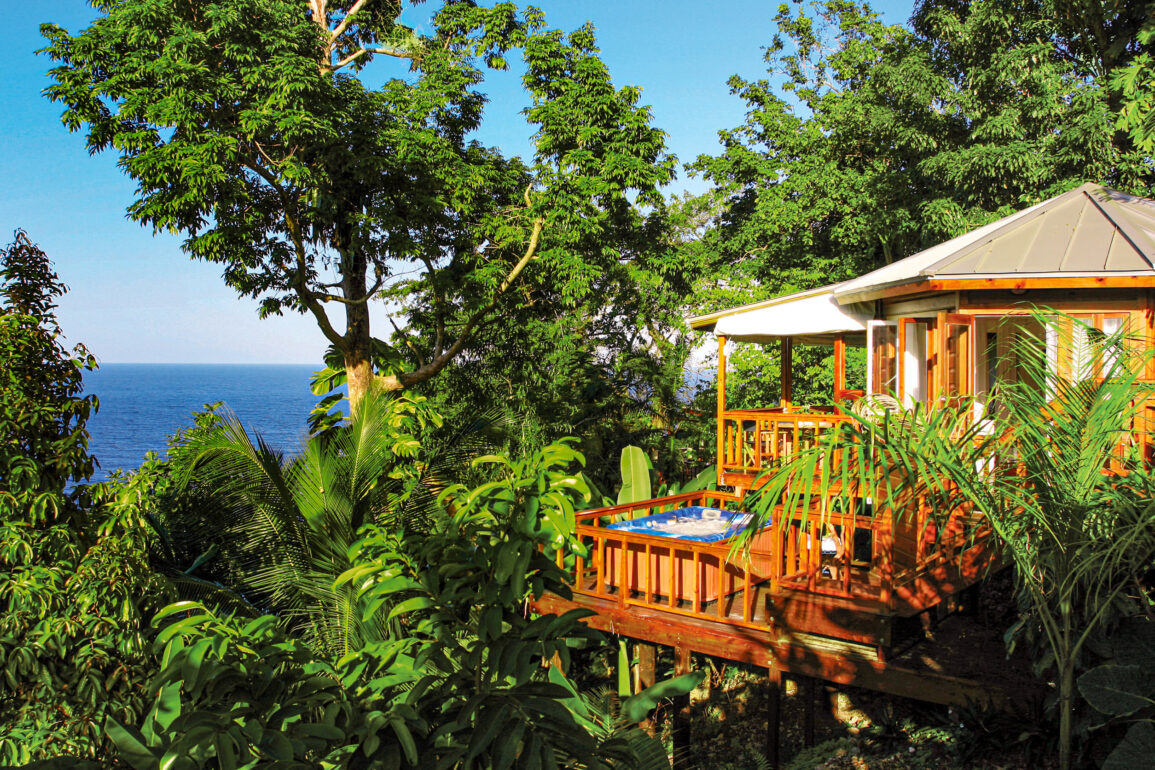
Geejam and Great Huts are two distinct properties that together capture the full range of how you might want to experience this part of Jamaica, from a polished rainforest retreat to a raw, elemental clifftop stay. Geejam sits in the rainforest at the foot of the Blue Mountains above town, an intimate boutique hotel of a handful of cabins and rooms built into the natural hillside. Great Huts is the wilder sibling, a cliffside eco lodge perched above Boston Bay with a Rasta and African inspired spirit running through everything. Both share a deep respect for the landscape and a refusal to flatten it for the sake of convenience, which is exactly what makes Port Antonio special.
Who owns Geejam and Great Huts?
These are two separate, independently run properties rather than a single owner’s portfolio. Geejam is a privately owned boutique hotel whose creative heart is its recording studio, a magnet for musicians that lends the place a low key glamour. Great Huts is the vision of its founder, a passionate eco lodge with a strong community and Rastafarian cultural ethos. We have grouped them here because together they show the two sides of staying in Port Antonio, the refined and the elemental.
About the rooms in Geejam and Great Huts
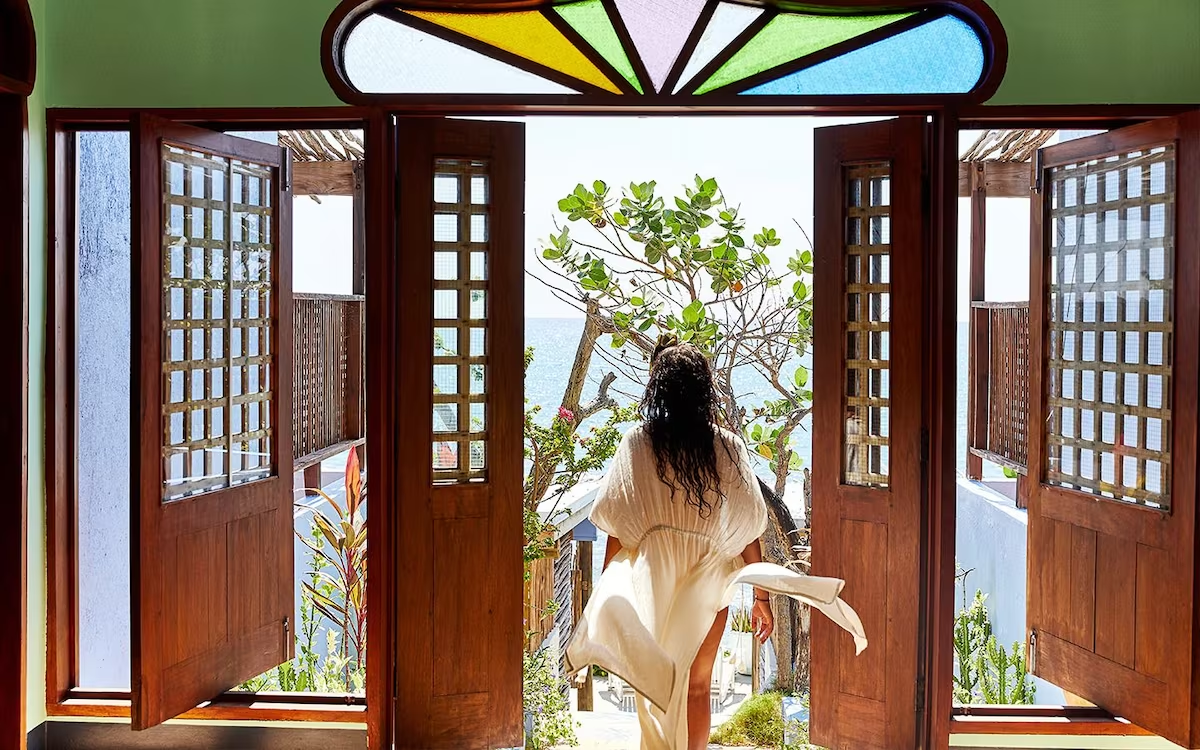
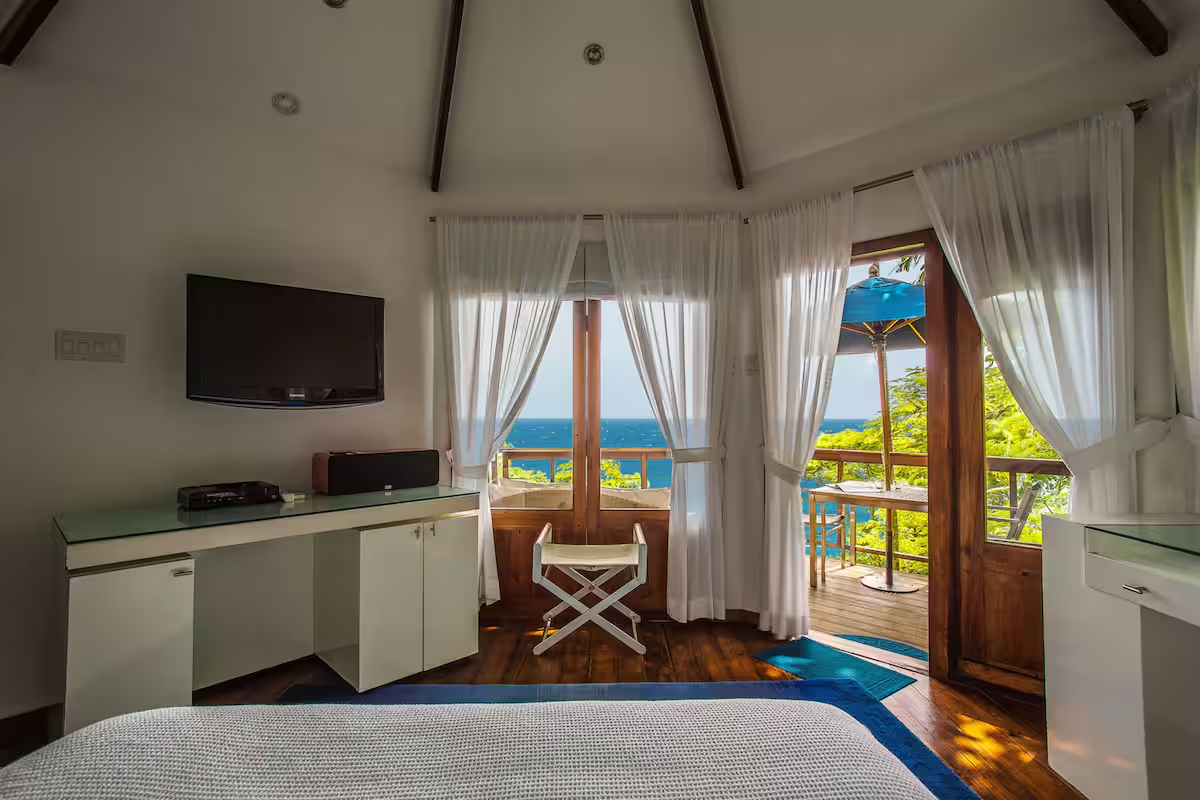
At Geejam the rooms feel like private hideaways among the trees, a small collection of cabins and rooms tucked under deep forest cover and built into the mountain topography so the hillside is left largely undisturbed. At Great Huts the accommodation is altogether wilder, with huts built gently from bamboo, hardwood and natural rock so the trees and shoreline are spared, ranging from simple, close to nature huts to more comfortable cliffside options, all designed so you fall asleep to the sound of the sea below.
What food is available at Geejam and Great Huts?
Geejam leans on fresh Jamaican produce and the seafood the island does so well, served in an intimate setting with the polish you would expect of a boutique hotel. Great Huts offers hearty, locally rooted Jamaican cooking with an emphasis on fresh, natural ingredients, eaten with the sea as your backdrop. Both put local flavour front and centre, and Boston Bay, the spiritual home of Jamaican jerk, is right on the doorstep for fiery, smoky pork and chicken cooked over pimento wood.
Sustainability features of Geejam and Great Huts
Sustainability runs through both properties in different ways. Geejam is built into the natural mountain topography so the hillside stays largely undisturbed, keeping the forest cover and the land intact. At Great Huts the eco credentials are the real thing rather than a marketing line, with composting toilets, solar heated water, rainwater catchment and structures of bamboo, hardwood and rock that tread lightly on the cliff. Both prove you can stay in real comfort while leaving a genuinely light footprint on this fragile coast.
Who is Geejam and Great Huts for?
Geejam is perfect for couples and creative travellers who want comfort with a conscience, helped along by the studio that has drawn the Rolling Stones, Amy Winehouse and Drake. Great Huts is made for nature lovers and free spirits happy to trade a little luxury for somewhere truly close to off grid and alive. Between them they suit honeymooners, music fans, and anyone who wants nature pressed right up against them rather than admired from behind glass.
How to get to Geejam and Great Huts from the airport
The closest airport to Geejam and Great Huts is Ian Fleming International Airport (OCJ) near Ocho Rios, around a two hour drive east along the north coast to Port Antonio, though many visitors fly instead into Norman Manley International Airport (KIN) in Kingston, roughly two to two and a half hours away over the Blue Mountains, or into Sangster International Airport (MBJ) in Montego Bay, closer to three and a half hours away.
Private transfer or taxi to Geejam and Great Huts
A pre booked private transfer is the easiest option for the final leg, as the coastal roads wind and signage can be patchy, and a driver who knows the route takes the stress out of arriving after a long flight. A metered taxi from any of the three airports works well too if you would rather not arrange it in advance. A hire car is worth considering if you want the freedom to explore the eastern parishes at your own pace, though be ready for narrow, twisting roads.
Public transport to Geejam and Great Huts
Public transport into Port Antonio is limited but possible. The Knutsford Express coach runs a scheduled service from Kingston to Port Antonio, a comfortable and affordable way to cover the long stretch, and from Kingston you can also pick up shared route taxis and local minibuses, known as robots, heading east. Once in Port Antonio town you will still need a local taxi for the last few miles to either property, so for most visitors a private transfer or hire car remains the simplest choice.
Things to do while staying at Geejam and Great Huts
Things to do around Geejam and Great Huts range from a lazy raft trip down the Rio Grande, poled by a captain on a long bamboo raft just as Errol Flynn once did, to swimming in the impossibly blue Blue Lagoon a short drive away, where freshwater springs mix with the sea to create that extraordinary colour.
Nearby you can hike up to Reach Falls in the rainforest, surf or eat fiery jerk at Boston Bay, the spiritual home of Jamaican jerk, wander the markets and Georgian streets of Port Antonio town, and spend a slow afternoon on Frenchman’s Cove beach where a freshwater river meets the sea. The Somerset Falls and the Blue Mountains foothills are within easy reach for anyone wanting more time in the forest.
It suits families with the gentle rafting and calm beaches, solo travellers and groups of friends drawn to the music scene at Geejam, nature lovers spoiled by the waterfalls and forest, and culture seekers chasing the food and history of this quieter eastern corner of Jamaica.
Treasure Beach is best for slow and authentic travel, repeat visitors, nature lovers and culture seekers who want real Caribbean village life
Treasure Beach sits on the south coast in the parish of St Elizabeth, around two and a half hours by car from Sangster International Airport in Montego Bay. Taxi coverage is thin, so it is much easier with your own wheels or a local driver, and there is no direct express coach to the village itself. This is the slowest, most low key base on the island, a string of sleepy fishing villages that have resisted mass tourism, with community run stays and the famous Pelican Bar out on an offshore sandbar. It suits slow travellers, repeat visitors, nature lovers and culture seekers who want real Caribbean life rather than a resort strip.
The difference between Treasure Beach and other popular Jamaican beach towns like Negril and Ocho Rios is that Treasure Beach has barely any large resorts, no strip of bars and vendors, and a quiet, dark coastline at night. Where Negril trades on its seven mile beach and party scene and Ocho Rios fills up with cruise passengers and big chain hotels, Treasure Beach stays small, locally owned and unhurried, so you swim off rocky coves shared with fishermen rather than crowded sand.
Where to stay in Treasure Beach: Top Pick

Jakes Hotel is the best place to stay in Treasure Beach, Jamaica
Jakes Hotel is a colourful, characterful boutique stay woven right into the fabric of the Treasure Beach community, and it is our pick as the most sustainable place on the whole list. The setting is relaxed and barefoot, with hand painted walls, mosaic finishes and bohemian cottages and villas that tumble down towards the sea, each one different and full of personality rather than cut from a corporate template. It is a place built for slow mornings and long evenings rather than a polished chain experience.
Who owns Jakes Hotel?
Jakes Hotel is Jamaican family owned and run, and that local ownership shows in every detail, from the artwork on the walls to the warm, personal way the place is hosted. Rather than following a corporate template, the owners have grown the property organically over the years, which is why each cottage and villa feels individual and rooted in the village around it.
About the rooms in Jakes Hotel
The rooms are a collection of bohemian cottages and villas that tumble down towards the sea, each one different and full of personality, with hand painted walls, mosaic finishes and a relaxed, barefoot feel throughout. Expect colour, character and individual touches rather than uniform resort rooms, with options that suit couples wanting a snug cottage as well as families or groups needing a larger villa.
What food is available at Jakes Hotel?
The kitchen is firmly farm to table, supplied by the local Ital Farmers Association, so the menus lean on what the surrounding land and sea actually produce. You can expect fresh fish, tropical fruit and proper Jamaican home cooking, all rooted in the local harvest rather than shipped in to suit a chain menu.
Sustainability features of Jakes Hotel
The eco credentials here are concrete rather than cosmetic. Jakes has long championed Green Globe sustainability standards, heats its water with solar panels and recycles its greywater for irrigation. It also channels real money back into the village through a foundation that funds local conservation work, so a stay here genuinely puts money straight into the community around it.
Who is Jakes Hotel for?
Jakes Hotel is perfect for the conscious traveller who wants to feel part of a community rather than sealed away from it. It suits anyone after colour, character and a true sense of place, with sustainability built in rather than bolted on, and it rewards slow travellers, nature lovers and culture seekers over those looking for a polished, all inclusive resort.
How to get to Jakes Hotel from the airport
The closest airport to Jakes Hotel is Sangster International Airport (MBJ) in Montego Bay, which sits roughly two to two and a half hours away by road, covering around 130 kilometres on the south coast run down to Treasure Beach. Some travellers coming from the Kingston side instead fly into Norman Manley International Airport (KIN), a similar drive of around two hours, so either gateway is realistic depending on your route into the island.
Private transfer or taxi to Jakes Hotel
The easiest last leg is a private transfer arranged through the hotel, as the drive winds through small villages and is far simpler with a local driver who knows the south coast roads. A hire car works well too if you want the freedom to explore the surrounding parishes, while metered taxis are scarce this far from the resort towns, so it is best to book a transfer in advance rather than hope to find one on arrival.
Public transport to Jakes Hotel
Public transport to Treasure Beach is limited and not really geared towards visitors. There is no direct express coach to the village, and reaching it by bus means connecting through Mandeville or Black River on the shared route taxis and minibuses known locally as route taxis, then changing again for the final stretch into Treasure Beach. This is slow and awkward with luggage, so a private transfer or a hire car is by far the most practical way to arrive.
Things to do while staying at Jakes Hotel
Things to do around Jakes Hotel range from a boat trip out to the Pelican Bar, a ramshackle wooden bar built on a sandbar a mile offshore where you wade in for a cold Red Stripe and fresh fish, to lazy days on the quiet coves that string along Treasure Beach itself. The slow pace is part of the appeal, so plenty of guests are happy simply swimming, reading and watching the fishing boats come in.
From here you can take a guided river safari up the Black River to spot crocodiles and wading birds, hike or swim at the spectacular YS Falls, and wander the fishing villages and farm plots that give this stretch of coast its unhurried character. The surrounding parishes of St Elizabeth reward exploring, with local markets, community run tours and quiet back roads that feel a world away from the busier north coast.
It suits nature lovers drawn to the river and falls, culture seekers who want a genuine Jamaican village rather than a resort strip, solo travellers who value the warm and walkable community, and families who appreciate the calm water and the easygoing pace.
When is the best time to visit Jamaica?
The dry season runs from December to April and is the most reliable for weather, which also makes it the priciest and busiest. May and the November to early December window give you good weather for less money. The Atlantic hurricane season runs from June to November, with the highest risk in August, September and October, so build a little flexibility into a trip in those months.
A note on Hurricane Melissa
Hurricane Melissa, a category five storm, struck Jamaica on 28 October 2025, the strongest on the island’s record, and hit the western parishes of Westmoreland, Hanover and St James hardest. By mid 2026 Jamaica is broadly open and recovering, with airports operating normally and most hotels reopened, but if you are heading to the west coast or the interior it is worth checking the current status of your specific hotel and the latest official travel advice before you book.
Is Jamaica safe, and how do you get around?
Jamaica’s crime is real but heavily concentrated in specific inner city areas that tourists do not visit, and the main resort corridors of Negril, Ocho Rios and the Montego Bay strip see far lower violent crime. The UK Foreign Office notes that tourist areas are not usually affected, while still advising sensible precautions: avoid isolated spots and deserted beaches after dark, avoid travelling at night, use licensed transport and take out comprehensive travel insurance. Be aware too that same sex activity between men remains illegal under an old colonial law and social attitudes can be hostile, so LGBTQ travellers should take extra care, particularly with dating apps.
Jamaica drives on the left, which is familiar to British drivers. You can hire a car, though rural roads are narrow and busy, or use licensed red plate route taxis and private JUTA transfers. You do not really need a car in Negril, Montego Bay or Ocho Rios, a car helps in Port Antonio, and Treasure Beach is much easier with your own wheels.
What about money and tipping?
US dollars are widely accepted in tourist areas but at a poor rate with change given in Jamaican dollars, so for food, taxis and tips the local currency gives better value, and small bills are genuinely useful. Many restaurants add a ten to fifteen percent service charge, so check the bill before adding more; housekeeping and porters appreciate a dollar or two, and drivers or guides around ten to fifteen percent.
Why we only list sustainable stays in Jamaica
Every hotel in this guide was hand picked and checked for how it actually runs, from Jakes recycling its greywater and Charela’s farm to table kitchen to Jamaica Inn’s coral restoration, and most are Jamaican rooted so your money stays in local hands rather than leaving the island with an all inclusive chain. If you want the full breakdown of each one with photos and booking links, see our guide to the best sustainable hotels in Jamaica, or zoom out to the best sustainable hotels across the Caribbean.
More Caribbean Sustainable Stays
Book Your Next Stay Consciously
Travel is a wonderful opportunity to connect with Mother Earth.
However, it is also frequently undermined by reckless development and disrespectful tourism practices.
This directory is a curated, verified list of hotels, lodges, and resorts that honour our planet and are led by visionary stewards of the environment.
From farm-to-table culinary experiences to dedicated ocean conservation efforts, such as marine protection and coral restoration, these establishments are redefining hospitality.

12% Off Sustainable Swimwear
Freedom Ecowear is offering our readers 12% off their eco-friendly swimwear, perfect for your next eco getaway. Use the link and your discount is added automatically.