Destinations › South America · The Destination Index · universal template · every figure sourced
Chile.
Southern South America, bordering the South Pacific Ocean, between Argentina and Peru. 756,102 sq km and 19,859,921 people, 6,435 km of coastline, temperate; desert in north; Mediterranean in central region; cool and damp in south.
Region · South AmericaPopulation · ~19,859,921Languages · Spanish, Mapudungun, Rapa Nui, Aymara, QuechuaEco Index · 65/100 · Passable
The Eco Index across 12 pillars · scored 0 to 5 · World Bank, OWID, WHO/UNICEF JMP, FiBL, Protected Planet, IUCN, UNESCO (2023-24)
Conservation
Wildlife
Water
Food & farming
Organic & clean
Climate & energy
Waste
Health
Heritage
Ownership
Governance
Future
The History of Chile.
Chile's national dance, the cueca, and its Andean and folk music remain widely performed, and northern festivals such as La Tirana blend Catholic and Aymara ancestral devotion. The Mapuche sustain living spiritual traditions including the ngillatun ceremony, the guidance of the machi and the game of palin.
Where the name comes from
Most often traced to a Quechua or Aymara word, chilli, read as 'where the land ends' or as the name of a valley. A derivation from a bird call is also cited. The origin is not settled. Source: national and regional toponymic records.
The land itself: low coastal mountains, a fertile central valley, and the Andes along the eastern edge. Its high point is Nevado Ojos del Salado, 6,893 m. Source: national mapping and survey records.
Where it starts
The oldest mummies in the world
A waterlogged settlement at Monte Verde in the south, around 14,500 years old, preserved wooden structures, cordage and plant remains, and broke the long-held assumption that Clovis people were the first in the Americas. On the Atacama coast, Chinchorro communities were practising artificial mummification from around 5000 BC, the oldest known anywhere in the world, removing organs and rebuilding the body with clay, reeds and ash. They were fisherfolk, not kings, and the treatment was given to everyone, including the newborn. Thousands of hillside geoglyphs later marked caravan routes across the driest desert on earth.
How it got here
Mapuche resistance to 1990
Mapuche communities held the south with their own language, law and land system. Inca expansion reached the north but was stopped further south, and Spanish colonisation from 1541 was resisted for centuries in the Mapuche south. Chile became independent in 1818. Seventeen years of military dictatorship followed a coup in 1973, with more than 3,000 killed or disappeared. The Chinchorro sites were inscribed as World Heritage in 2021.
The timeline
c. 14,550 years ago
Monte Verde.
A waterlogged settlement in the south preserved wooden structures, cordage and plant remains, and broke the assumption that Clovis was first. ↗
c. 5000 BC
The Chinchorro mummies.
Coastal communities in the Atacama practised artificial mummification, the oldest known anywhere in the world, removing organs and rebuilding the body with clay, reeds and ash. The Chinchorro who did so lived on this coast from about 5450 BCE until around 890 BCE. ↗
c. 1000 BC to AD 1500
Atacama geoglyphs.
Thousands of hillside figures mark caravan routes across the driest desert on earth. ↗
c. AD 500 onward
Mapuche.
Mapuche communities hold the south with their own language, law and land system. ↗
1463 to 1533
Inca expansion.
The Inca state reaches the north of the country but is stopped further south. ↗
1541 to 1810
Spanish rule.
Spanish colonisation is resisted for centuries in the Mapuche south. ↗
1818
Independence.
Chile proclaims independence on 12 February 1818. The year before, O'Higgins had asked citizens across the provinces to sign public registers at their cabildos and parishes, for or against, so the proclamation could rest on a recorded vote. ↗
1973 to 1990
Dictatorship.
Seventeen years of military dictatorship follow a coup, with more than 3,000 killed or disappeared. ↗
2021
World Heritage.
The Chinchorro settlement and mummification are inscribed as a World Heritage site. ↗
Protected areas cover about 21.6% of Chile's land (World Bank, 2024) through an extensive national parks and reserves system, and marine protection is exceptional at roughly 41.2% of territorial waters (World Bank, 2024), among the largest in the world thanks to giant reserves around Rapa Nui, the Juan Fernandez and Desventuradas islands and Cape Horn. Coverage on paper outstrips management capacity, and researchers have repeatedly flagged chronic underfunding and understaffing of many terrestrial parks. The 2018 Rewilding Chile donation helped create the Route of Parks of Patagonia, adding millions of hectares of new national parkland.
Is wild Chile protected? 21.6% of the land is, against a 30% target for 2030
Found only here. Monkey puzzle (Araucaria araucana), alerce (Fitzroya cupressoides), Chilean wine palm (Jubaea chilensis), Darwin's fox (Lycalopex fulvipes), pudu (Pudu puda), Juan Fernandez firecrown hummingbird.
The watchlist
ThreatenedWaved Albatross (Phoebastria irrorata)Critically Endangered on the IUCN Red List, and recorded in Chile in GBIF occurrence data (bird).
ThreatenedSpeckled Smoothhound (Mustelus mento)Critically Endangered on the IUCN Red List, and recorded in Chile in GBIF occurrence data (shark or ray).
ThreatenedLiolaemus paulinaeCritically Endangered on the IUCN Red List, and recorded in Chile in GBIF occurrence data (reptile).
ThreatenedEriosyce chilensisCritically Endangered on the IUCN Red List, and recorded in Chile in GBIF occurrence data (plant).
ThreatenedChonta palm (Juania australis)Critically Endangered on the IUCN Red List, and recorded in Chile in GBIF occurrence data (plant).
ThreatenedAraucaria angustifoliaCritically Endangered on the IUCN Red List, and recorded in Chile in GBIF occurrence data (conifer).
ThreatenedMountain Catfish (Nematogenys inermis)Critically Endangered on the IUCN Red List, and recorded in Chile in GBIF occurrence data (species).
ThreatenedJuan Fernandez Firecrown (Sephanoides fernandensis)Critically Endangered on the IUCN Red List, and recorded in Chile in GBIF occurrence data (bird).
Critically Endangered, the last IUCN category before Extinct in the Wild, and still recorded in Chile. GBIF holds 122 verified occurrence records.
Speckled Smoothhound (Mustelus mento)
Critically Endangered, the last IUCN category before Extinct in the Wild, and still recorded in Chile. GBIF holds 33 verified occurrence records.
Liolaemus paulinae
Critically Endangered, the last IUCN category before Extinct in the Wild, and still recorded in Chile. GBIF holds 12 verified occurrence records.
Eriosyce chilensis
Critically Endangered, the last IUCN category before Extinct in the Wild, and still recorded in Chile. GBIF holds 39 verified occurrence records.
Species named here are drawn from GBIF occurrence records for Chile filtered to the IUCN Red List threatened categories. Species are listed where GBIF holds occurrence records for them in this country. Record counts are not published here because the figure cannot be reproduced from a public GBIF query.
National park, mapped and named in the open record for Chile. OpenStreetMap.
Water and Ocean in Chile.
Chile's water is a study in extremes. Andean snowmelt and glaciers feed the major rivers, and the Patagonian south holds some of the planet's most abundant freshwater in its lakes and rivers, while the northern Atacama is hyper-arid and increasingly dependent on desalination and contested groundwater for mining. The densely populated central zone has endured a prolonged megadrought since around 2010, straining agriculture and urban supply.
Does Chile have enough fresh water? Yes, with headroom
97.8% of people here have safely managed drinking water at home (2024, WHO/UNICEF JMP). Tap water is safe for a visitor nearly everywhere.
Cleanest water: Aysen and Patagonian rivers and lakes such as the Baker and Futaleufu.
How much fresh water does Chile have, per person?
45,262 m³
Chile
1,000 m³
the UN “water scarce” line
Chile withdraws about 35,368 million cubic metres of fresh water a year (2022). That is 9.0% of the fresh water actually available to it, which FAO counts as no water stress. Of what is taken, farming takes 91%, homes and towns 4%, industry 5%. Source: FAO AQUASTAT.
What are the rules on Chile beaches?
·Tap water: Varies.
✓Plastic rules: Yes. Nationwide retail plastic-bag ban (2018, first in South America) and a single-use plastics law (Law 21.368, 2021)..
✕Solo travel: rated take care on the record for this destination.
✓Marine protection: 41.2% of the sea is protected. The 30x30 pledge is met.
Named on the open map: Playa Ancha, Playa Arenal, Playa Bahía Jara, Playa Camping Olga, Playa Chépica, Playa El Kaleuche, Playa El Negro, Playa El Tabito. That is 19 named beaches in the public record for Chile, each one a place you can look up before you go. OpenStreetMap.
Where does the sewage go?
95.1%
of people have safely managed sanitation
95.1% of people here use a safely managed sanitation service, meaning waste is contained, emptied and treated rather than reaching the ground or the sea untreated (2024, World Bank / WHO-UNICEF JMP, SDG 6.2.1). That is close to universal coverage.
How is the sea around Chile doing?
One cross-section, every answer measured.
Surface
What the coast carries
Atacama is nearly rainless; Patagonia is wind and four seasons in a day.
Nearshore
Protected water
41.2% of territorial waters are protected, against the 30% pledged for 2030 under the Global Biodiversity Framework.
Cleanest
Where the water is cleanest
Aysen and Patagonian rivers and lakes such as the Baker and Futaleufu..
The record
Measured
Chile's water is a study in extremes. Andean snowmelt and glaciers feed the major rivers, and the Patagonian south holds some of the planet's most abundant freshwater in its lakes and rivers, while the northern Atacama is hyper-arid and increasingly dependent on desalination and contested groundwater for mining.
Sea protected
41.2%
Against the 30% pledged for 2030 under the Global Biodiversity Framework.
Threatened species
315
Mammals, birds, fish and higher plants on the IUCN list.
Cleanest water
here
Aysen and Patagonian rivers and lakes such as the Baker and Futaleufu..
Is the tap water safe in Chile?
97.8% of people have safely managed drinking water at home (2024, WHO/UNICEF JMP). Renewable fresh water works out at about 45,262 cubic metres per person a year (World Bank).
How hard is the water supply being pushed?
Of every 10 buckets nature refills, 1 are already taken. Withdrawals run at 9% of what Chile renews internally each year (2022, World Bank / FAO AQUASTAT). That is inside the 25% mark generally treated as water stress, so the supply has headroom.
When is the best time to visit Chile? Tap your month.
Tap your month.
JanFebMarAprMayJunJulAugSepOctNovDec
.
How much fresh water does Chile actually have?
Nature renews about 45,262 cubic metres of fresh water per person per year here. That ranks Chile 197 of 208 countries measured, placing it among the 20 best-watered countries measured. The UN treats anything under 1,000 cubic metres as water scarce, and this is above that line. World Bank / FAO AQUASTAT.
Chile is one of the world's leading exporters of fresh fruit such as grapes, cherries, blueberries and apples, as well as wine and farmed salmon, and it grows abundant vegetables in its Mediterranean central valleys, so it is strongly agricultural and a net food exporter by value (ODEPA, Ministerio de Agricultura de Chile). It is, however, reliant on imports for staple grains, particularly wheat and feed maize. A reliable single share-of-food-imported figure could not be verified, so that stat is left blank.
Where does the food in Chile come from?
11.6% imported
about US$10,727m a year
On the plate: Bread (marraqueta, hallulla), potatoes, maize (choclo), beans (porotos), quinoa, avocado (palta), and abundant fresh fruit, wine.
How often each food is on the plate
Share of people eating each one regularly. These overlap, so they do not add up to 100%.
Potatoes51%
Quinoa24%
1 of 10
bites are imported
The island buys in more food energy than it eats. About US$10,727m a year leaves the country to pay for it. The green slice is roughly what still grows here.
About 11.6% of everything Chile buys in from abroad is food, roughly 1 in every 10 imported items on the dock (2025, World Bank). Farming itself is 3.5% of the economy and 14.4% of the land is agricultural, of which 1.9% is arable. The green slice is roughly what still grows here.
What is killing people in Chile? The imported diet.
Cause of death, and the diet behind it.
Non-communicable diseases, all combined73.2%
Diabetes12.2%
Adults living with overweight or obesity. 78.8%.
Can Chile feed itself?
1.9%
Arable land
14.4%
Agricultural land
626,331
Farmers
3,476,520
Arable acres
3.5%
Agriculture, share of GDP
Harvest: Southern-hemisphere seasons; grape and stone-fruit harvest (vendimia) runs February to April, with summer produce December to March.
Feeding itself
Chile is one of the world's leading exporters of fresh fruit such as grapes, cherries, blueberries and apples, as well as wine and farmed salmon, and it grows abundant vegetables in its Mediterranean central valleys, so it is strongly agricultural and a net food exporter by value (ODEPA, Ministerio de Agricultura de Chile). It is, however, reliant on imports for staple grains, particularly wheat and feed maize.
Certification
Certified organic farmland covers roughly 156,819 hectares, about 1.0% of Chile's agricultural land (FiBL, The World of Organic Agriculture 2025), which is low by international standards. Chile is nonetheless a notable organic exporter, shipping certified organic wine, berries and fruit to Europe and North America.
Water for crops
Chile's water is a study in extremes. Andean snowmelt and glaciers feed the major rivers, and the Patagonian south holds some of the planet's most abundant freshwater in its lakes and rivers, while the northern Atacama is hyper-arid and increasingly dependent on desalination and contested groundwater for mining.
Why the organic number looks like that. Certified-organic farmland is not separately reported for Chile, and that is a certification gap rather than proof nothing is grown cleanly. What the official land record does show: 14.4% of the country is agricultural land and 1.9% is arable (2023, World Bank). Certification is paid for per farm per year by a foreign body, which prices out smallholders, so the organic number reads worse than the practice.
What actually grows here
GrapesApplesWheatTomatoesPotatoesMaizeSugar beets
The food that already fits
The plant-based kitchen here is not an import. By tonnage, the largest crops grown in Chile are grapes, apples, potatoes and wheat (FAO, FAOSTAT crop production, 2024). That is what the land itself puts on a plate.
Chile has moved rapidly on clean energy, lifting renewables to about 70 per cent of electricity generation, with solar alone providing over a fifth of the grid thanks to the Atacama's exceptional resource. Per-capita emissions are moderate at roughly 4.8 tonnes of CO2 and falling as coal is retired. The 2022 National Energy Policy targets 80 per cent renewables by 2030 and net-zero by 2050, and Chile is widely regarded as a climate leader for its accelerated coal phase-out by 2040. The main caveat is that some mid-range emissions and remaining coal capacity persist.
What powers Chile?
Renewable 66.4%Fossil 33.6%
Climate pollution per person
The safe amount, what the planet can absorb
2 tonnes
One person here
3.94 tonnes
The world average, for comparison
4.7 tonnes
The worst it ever got
4.96 tonnes
The grid
Chile has moved rapidly on clean energy, lifting renewables to about 70 per cent of electricity generation, with solar alone providing over a fifth of the grid thanks to the Atacama's exceptional resource. Per-capita emissions are moderate at roughly 4.8 tonnes of CO2 and falling as coal is retired.
Pollution
Chile was the first country in South America to ban retail plastic bags nationwide (2018) and followed with a single-use plastics law (Law 21.368, 2021) restricting disposable food-service plastics. Air quality is moderate, with a national annual mean PM2.5 of about 16.6 micrograms per cubic metre (IQAir, 2024), still above the WHO guideline.
Water stress
Chile's water is a study in extremes. Andean snowmelt and glaciers feed the major rivers, and the Patagonian south holds some of the planet's most abundant freshwater in its lakes and rivers, while the northern Atacama is hyper-arid and increasingly dependent on desalination and contested groundwater for mining.
What pollutes most here
1The gridThe share of electricity still generated from fossil fuel.32%
2IndustryCopper mining (world's largest producer, heavy water use and tailings); industrial salmon farming in the southern fjords (antibiotics and escapes); pine and eucalyptus plantation forestry; coal power now being phased out..named
3AirModelled annual mean against a WHO guideline of 5 µg/m³.16.6
4On the recordChile was the first country in South America to ban retail plastic bags nationwide (2018) and followed with a single-use plastics law (Law 21.368, 2021) restricting disposable food-service plastics.
What has Chile promised on climate?
Net zero, whole economy2050
Electricity renewable today48.1% (2021)
Land protected, against a 30% target21.6% by 2025
Sea protected, against a 30% target41.2% by 2025
The net-zero target year on file with Climate Watch is 2050, status: in law; in policy document. Measured against it, 48.1% of electricity is already renewable (2021, World Bank), so 51.9% of the grid is still to be converted. The pledge on file is measured here against what has actually been delivered, not taken on its own (UNFCCC NDC Registry, CBD Kunming-Montreal Target 3).
The biggest line item
One return flight against a whole year of living.
A resident's entire year3.94 t CO2e
Safe-climate budget, per year2 t CO2e
Singapore return, economy2.96 t CO2e
Dubai return, economy2.66 t CO2e
Frankfurt return, economy2.18 t CO2e
Paris return, economy2.1 t CO2e
London return, economy2.1 t CO2e
How much CO2 does flying to Chile emit?
Tap where you would fly from. One return flight, economy.
Every prompt runs on a machine in a building on somebody’s grid. What that costs the planet depends less on the prompt than on what is burning to power it. Here is what would power one in Chile.
Data centres
49
Registered colocation and interconnection facilities, PeeringDB, 2026
Grid renewable
66.4 %
What a machine here runs on.
What powers a data centre in Chile?
A machine here runs mostly on renewables, but not entirely.
Renewable 66.4%Fossil 33.6%
Cooling water. Every one of those halls runs on the national grid, which is 48.1% renewable today (World Bank). A data centre is only as clean as the electricity behind it, so the same figure that decides this country's climate score also decides the footprint of the AI running inside it. Cooling water use is not separately published by facility, and no operator here reports it.
The rules. Chile has 49 colocation and interconnection facilities on the public PeeringDB register, concentrated in Santiago (30), Las Condes (2), Viña del Mar (2), alongside 9 internet exchanges (PIT Santiago, PIT Chile, PIT Concepcion, PIT Chile, PIT Temuco, PIT Chile, PIT entel). Named sites include Cirion Santiago de Chile, SAN1, Internexa Santiago de Chile, Bynarya, Servicios Informaticos Hostname.
Where the cables land. 19 landing points · Antofagasta, Arica, Caldera, Cartagena
79% residents to 21% visitors across a year. 5,431,000 international arrivals in 2019 against 19,859,921 people who live here (2025, World Bank / UN Tourism).
Where a visitor dollar goes in Chile
5,431k
Visitors a year
0.3
Visitors per resident
How deep in debt is Chile?· for every $100 Chile earns in a year, it owes…
Pay to the order of: the creditorsmemo · today
$ 42What is owed now, for every $100 of national income (2026).
IMF World Economic Outlook, 2026signed, the creditors
Pay to the order of: the creditorsmemo · projected 2031
$ 49The IMF's own forecast has this rising to $49 by 2031.
IMF World Economic Outlook projection, 2031signed, the forecast
For every $100 Chile earns in a year, it owes $42 (2026, IMF World Economic Outlook). The interest on that is paid before schools, clinics or coastline get their turn.
Where does a tourist dollar actually go in Chile?
Play one tourist dollar around the board. Every square is a measured fact from this page.
START!
1
GO: a visitor lands
$100 goes on the table. 5,431,000 international arrivals in 2019 against 19,859,921 residents, one visitor a year for every 4 residents (World Bank / UN Tourism).
$100 in play
2
The bed
Who owns the largest places to stay in Chile is not published in the records we can check, so this square is left open rather than guessed. Where a listing names its owner, it is shown in the ownership table below.
not published
3
The plate
Food is only 11.6% of everything Chile imports (2025, World Bank), so most of a meal is bought from producers inside the country. Eating what the land here actually grows, grapes, apples, wheat, tomatoes, potatoes, maize, sugar beets, keeps that money with the grower.
mostly home-grown
4
The power
48.1% of the electricity is renewable (2021, World Bank), so the energy on the bill is mostly generated inside the country rather than shipped in.
made at home
5
What actually stays
Of the two parts of a visitor's bill that can be measured here, the plate and the power stay inside Chile. This is not an economy where a visitor's money drains away, and the board is shorter for it.
most of it
6
Pay the bank first
Chile owes $42 for every $100 it earns (IMF World Economic Outlook, 2026 projection). The interest is paid before anything else on this board.
$42 per $100
7
No plan B
29.8% of everything Chile sells abroad is ores, slag and ash (2023, UN Comtrade). One market moving takes the whole board with it.
29.8% one export
8
Community chest
Tourism earns 1.3% of everything Chile makes from exports (2020, World Bank / UN Tourism). That is how much of the economy depends on the game continuing.
1.3% of exports
9
The flight
Getting here is usually the biggest single line on the bill. From Singapore a return economy seat is 2.96 t CO2, on the UK Government's published conversion factors. It is the one part of the trip this board cannot reduce.
2.96 t CO2
10
Back to GO
The economy turns over about US$408 billion a year (IMF World Economic Outlook, 2026 projection). Every lap of this board is a choice about how much of it stays.
US$408bn
GDPUS$357.4bn
Agriculture, share of GDP3.5%
Visitors a year5,431,000
Visitors per resident0.3
Residents~19,859,921
Agriculture
Farming is 3.5% of the economy. Chile is one of the world's leading exporters of fresh fruit such as grapes, cherries, blueberries and apples, as well as wine and farmed salmon, and it grows abundant vegetables in its Mediterranean central valleys, so it is strongly agricultural and a net food exporter by value (ODEPA, Ministerio de Agricultura de Chile).
Natural materials
Chile has genuine living natural-materials traditions. Mapuche weavers still make wool textiles coloured with natural dyes, the island of Chiloe keeps its own sheep-wool knitting and weaving culture, and the village of Rari sustains a horsehair (crin) weaving craft found almost nowhere else.
Energy
Chile has moved rapidly on clean energy, lifting renewables to about 70 per cent of electricity generation, with solar alone providing over a fifth of the grid thanks to the Atacama's exceptional resource. Per-capita emissions are moderate at roughly 4.8 tonnes of CO2 and falling as coal is retired.
Who owns the biggest hotels in Chile?
By rooms · company records and press.
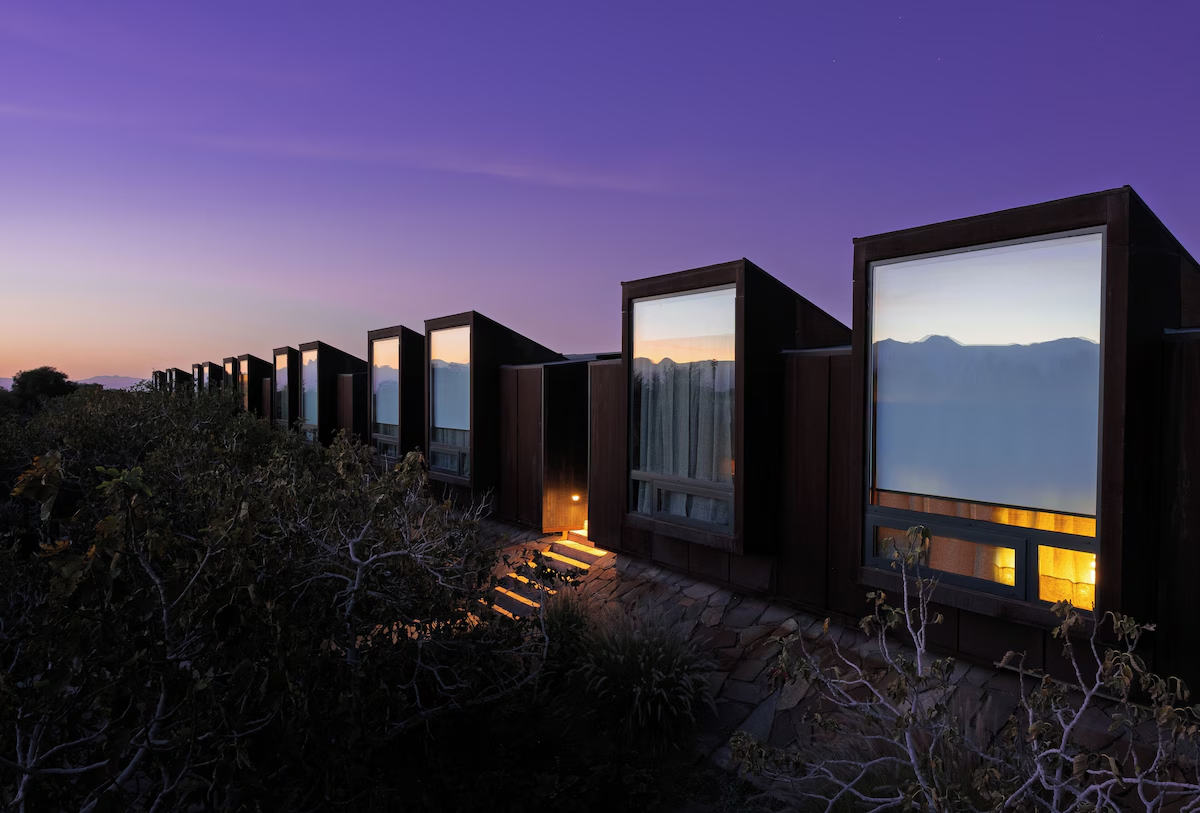
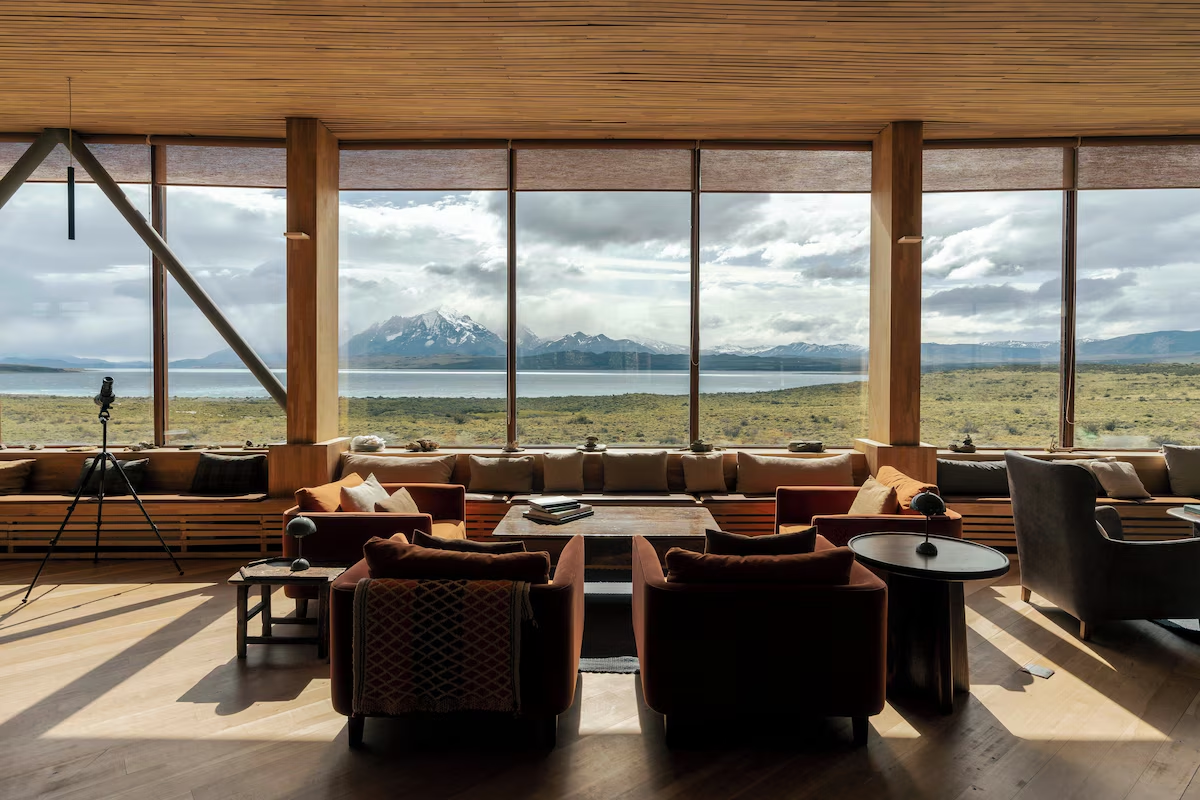
Tierra Atacama · ~32 roomsIndependentnot published
Tierra Patagonia · ~40 roomsIndependentnot published
Mallin Colorado Ecolodge · ~10 roomsIndependentnot published
Visitors, over time
20144,601k
20155,487k
20166,712k
20177,621k
20186,603k
20195,431k
International tourism receipts run at about US$1.03 billion in 2020 (World Bank / UN Tourism). That is 1.3% of everything the country earns from exports.
How much of your money actually stays here?
Tap the holiday you are planning.
All-inclusive resortForeign-owned hotel and tourist restaurantsLocally owned stay and local restaurantsGuesthouse, markets and public transport
Resort guest, villa renter, family, nomad or backpacker. The honest playbook for each, from the same sourced numbers.
Already booked a resort? · the rescue list
Five swaps that move your money back on-island
1. Eat where the country eats Choose kitchens cooking what the land here grows, grapes, apples, wheat, tomatoes, potatoes, maize and sugar beets, over an imported menu. The checked list →
2. Book with a local operator Never the lobby desk. The margin on a tour is the part that stays. Eco tours →
3. Stay somewhere locally owned Ownership decides where the room rate books. Eco stays →
4. Use the transport residents use A 4,300 km-long country: domestic flights (LATAM, Sky, JetSmart) link the extremes, long-distance buses are cheap and comfortable, Santiago has a modern metro, and Patagonia relies on the Carretera Austral and ferries.
5. Buy the craft, not the souvenir Natural-materials work made here pays the maker directly; imported gifts pay a shipping line.
swipe →
First time here
A 4,300 km ribbon of desert, vineyard, temperate rainforest and Patagonian ice, Chile pairs world-leading marine protection and ambitious rewilding with real central-zone water stress and very low recycling.
Best time: Spring to autumn.
Getting around
A 4,300 km-long country: domestic flights (LATAM, Sky, JetSmart) link the extremes, long-distance buses are cheap and comfortable, Santiago has a modern metro, and Patagonia relies on the Carretera Austral and ferries.
Transport is where the fare either stays or leaves.
Eating here
The everyday plate that actually grows here is grapes, apples, wheat, tomatoes, potatoes, maize and sugar beets. Ordering those keeps the money with the grower and cuts the imported share of the meal.
Eating what the country grows is the cheapest way to cut the import bill.
Good to know
Cards widely accepted; CLP. Big distances, plan travel time.
Rate my hotel. Tap yours for the honest verdict.
Ownership from company records and press.
Tierra AtacamaTierra PatagoniaMallin Colorado Ecolodge
.
Who owns the big hotels
Tierra AtacamaIndependent · 32 rooms
Tierra PatagoniaIndependent · 40 rooms
Mallin Colorado EcolodgeIndependent · 10 rooms
None of the 3 properties listed here publishes who ultimately owns it, so no claim is made either way. Ownership is what decides how much of a room rate stays in the country, which is why we show it when a listing states it.
Society and Governance in Chile.
How well is Chile actually run?
Governance, measured · World Bank WGI
Four measured answers, none of them opinion. Averaged across corruption control, delivery and accountability, Chile scores 72 out of 100 (2024, World Bank Worldwide Governance Indicators). That is a state that generally does what it says it will do, which is what makes a climate pledge worth reading.
How well is Chile run? · each scored out of 100, higher is better
Clean government, scored 70 of 100
Control of corruption scores 70.2 out of 100 (2024, World Bank Worldwide Governance Indicators). That is above the halfway mark of governments measured.
70
Freedom and rights, scored 74 of 100
Voice and accountability, which measures free expression, free media and the ability to choose a government, scores 74.3 out of 100 (2024, World Bank WGI). Citizens here can question their government openly.
74
Government effectiveness, scored 70 of 100
Government effectiveness, which measures the quality of public services and how well policy is actually delivered, scores 70.1 out of 100 (2024, World Bank WGI). Delivery is rated above average.
70
Income equality, scored 43 of 100
The Gini index of income inequality reads 43 (2024, World Bank). Zero is perfect equality and 100 is one person holding everything. Above 40 is the level usually treated as socially strained, and Chile sits above it.
43
LGBTQ+ status: HighSolo female travel: Take care96.4% adult literacyIndustry to avoid: Copper mining (world's largest producer, heavy water use and tailings); industrial salmon farming in the southern fjords (antibiotics and escapes); pine and eucalyptus plantation forestry; coal power now being phased out.
Getting around, breathing, throwing away, learning. The honest checklist.
TransportAirWaterWastePower
✓How you get around A 4,300 km-long country: domestic flights (LATAM, Sky, JetSmart) link the extremes, long-distance buses are cheap and comfortable, Santiago has a modern metro, and Patagonia relies on the Carretera Austral and ferries.
✓Air quality, measured Modelled annual mean 16.6. The WHO guideline is 5 µg/m³.
✓Where the air is cleanest Patagonia and the Aysen region, and the high Atacama plateau prized by international observatories.
✓Tap water Varies
✓What to drink Santiago tap water is drinkable; bottle it in remote Atacama and Patagonia.
✓Plastic rules Yes. Nationwide retail plastic-bag ban (2018, first in South America) and a single-use plastics law (Law 21.368, 2021).
✓Sockets and voltage Type A/B/C, 220V (Brazil 127/220V)
96.4%
literacy. Public spending on education runs at 4.9% of GDP and 18.4% of all government spending, and secondary enrolment stands at 105.6% gross (UNESCO Institute for Statistics, 2022 to 2024).
Made in Chile.
Chile has genuine living natural-materials traditions. Mapuche weavers still make wool textiles coloured with natural dyes, the island of Chiloe keeps its own sheep-wool knitting and weaving culture, and the village of Rari sustains a horsehair (crin) weaving craft found almost nowhere else. Every step of processing done at home is value that stops leaving the country.
What Chile actually sells the world
The single biggest thing Chile sells the world is ores, slag and ash, 29.8% of all exports in 2023 (about US$27.72 billion, UN Comtrade). The next four are copper at 21.2%, inorganic chemicals at 8.5%, fruit and nuts at 8.1%, fish and seafood at 7.8%.
Sells now · 29.8% of exports
Ores, slag and ash
Ores, slag and ash is 29.8% of everything Chile sold abroad in 2023, worth about US$27.72 billion. UN Comtrade.
Sells now · 21.2% of exports
Copper
Copper is 21.2% of everything Chile sold abroad in 2023, worth about US$19.68 billion. UN Comtrade.
Sells now · 8.5% of exports
Inorganic chemicals
Inorganic chemicals is 8.5% of everything Chile sold abroad in 2023, worth about US$7.93 billion. UN Comtrade.
Sells now · 8.1% of exports
Fruit and nuts
Fruit and nuts is 8.1% of everything Chile sold abroad in 2023, worth about US$7.50 billion. UN Comtrade.
Sells now · 7.8% of exports
Fish and seafood
Fish and seafood is 7.8% of everything Chile sold abroad in 2023, worth about US$7.29 billion. UN Comtrade.
Buys in · 20.8% of imports
Mineral fuels and oils
Chile imported US$17.68 billion of mineral fuels and oils in 2023, 20.8% of everything it bought abroad, and sells none of it back. Every point of that is a business that could be built at home rather than shipped in. UN Comtrade.
Buys in · 12.2% of imports
Machinery and mechanical appliances
Chile imported US$10.40 billion of machinery and mechanical appliances in 2023, 12.2% of everything it bought abroad, and sells none of it back. Every point of that is a business that could be built at home rather than shipped in. UN Comtrade.
Buys in · 10.0% of imports
Electrical machinery and electronics
Chile imported US$8.52 billion of electrical machinery and electronics in 2023, 10.0% of everything it bought abroad, and sells none of it back. Every point of that is a business that could be built at home rather than shipped in. UN Comtrade.
Buys in · 9.5% of imports
Vehicles
Chile imported US$8.08 billion of vehicles in 2023, 9.5% of everything it bought abroad, and sells none of it back. Every point of that is a business that could be built at home rather than shipped in. UN Comtrade.
The maths for an entrepreneur. Chile produces about US$357 billion a year, which is roughly US$17,995 per person (2025, World Bank). Farming is 3.5% of that, while food is 11.6% of everything the country imports. The country buys in more food than its own farms contribute to the economy, and every point of that gap is a business someone could build here rather than ship in.
A living tradition of Chile, still practised rather than archived.
Andean Aymara
A living tradition of Chile, still practised rather than archived.
Quechua music
A living tradition of Chile, still practised rather than archived.
La Tirana festival
A living tradition of Chile, still practised rather than archived.
Mapuche ngillatun ceremonyA living tradition of Chile, still practised rather than archived.
Machi ancestral spiritualityA living tradition of Chile, still practised rather than archived.
Does Chile protect its heritage by law?
Partly, and the gaps say as much as the protections.
What is kept alive. Chile's national dance, the cueca, and its Andean and folk music remain widely performed, and northern festivals such as La Tirana blend Catholic and Aymara ancestral devotion. The Mapuche sustain living spiritual traditions including the ngillatun ceremony, the guidance of the machi and the game of palin. On Rapa Nui, Polynesian dance, song and carving continue as a distinct living culture.
Who it belongs to. Chile has living Indigenous cultures, above all the Mapuche, the country's largest Indigenous people, alongside the Aymara and Quechua of the north, the Atacameno (Lickan Antay), the Rapa Nui of Easter Island and the Kawesqar and Yagan of the far south. Community-based tourism is real and growing, with Rapa Nui National Park co-managed by the Ma'u Henua Indigenous community and Mapuche and Atacameno communities running their own rural tourism and guiding. Mainstream tourism around Torres del Paine, the wine country and the Atacama is largely operator-led rather than community-owned, and Indigenous communities continue to face land conflicts and marginalisation.
Only here. The Atacama desierto florido, when the world's driest non-polar desert bursts into carpets of flowers after rare rains..
Three futures for Chile, every one run forward from measured data.
Where the making actually happens
Named cultural and craft sites on the open map: Botanical Garden Tau Kiani (Easter Island), National Botanical Garden of Viña del Mar (Viña del Mar). OpenStreetMap. Named craft workshops on the open map: Arte Color, ArteSana, Artesania Tradicional Losa De Greda, Artesania de Pomaire, Artesanias, Artesanias Tierra de luz.
Every measured trend on one line
Run forward at the pace already recorded.
+20%
Forest cover
1995: 20.9 % → 2023: 25 %
-34%
Renewable electricity
1995: 72.4 % → 2021: 48.1 %
+37%
CO2 per person
1995: 2.88 t → 2024: 3.94 t
+46%
Tourist arrivals
2008: 3713 k → 2019: 5431 k
+18%
Protected land
2013: 18.3 % → 2025: 21.6 %
-56%
Farm workforce
1995: 13.7 % → 2025: 6.1 %
+836%
Protected sea
2013: 4.4 % → 2025: 41.2 %
-30%
Agricultural land
1995: 20.6 % → 2023: 14.4 %
+6%
Urban population
1995: 84.4 % → 2025: 89.2 %
-11%
Air pollution
1995: 25.9 µg/m³ → 2023: 23.1 µg/m³
-26%
Fresh water per person
1995: 60919.4 m³ → 2022: 45261.5 m³
+52%
Adult overweight
1995: 51.8 % → 2022: 78.8 %
+3%
Electricity access
1995: 95.8 % → 2024: 99 %
+254%
GDP per person
1995: 5081 → 2025: 17995
+37%
Population
1995: 14527 k → 2025: 19860 k
-29%
Renewable energy use
1995: 34.2 % → 2021: 24.2 %
+61%
Energy per person
1995: 1263 kg → 2024: 2029 kg
+457%
Protected area, total
2013: 6.8 % → 2025: 37.9 %
+8%
Life expectancy
1995: 75.3 yrs → 2024: 81.4 yrs
+48%
Cereal yield
1995: 4472 ha → 2024: 6606 ha
+31%
Fertiliser use
1995: 191 ha → 2023: 249.5 ha
-31%
Rural population
1995: 15.6 % → 2025: 10.8 %
+78%
Water productivity
1995: 4.45 $/m3 → 2022: 7.89 $/m3
+50%
Health spending
2000: 7 % → 2024: 10.5 %
+20%
Forest area
1995: 155316 km2 → 2023: 185794 km2
+153%
Electric power use
1995: 1728 kWh → 2024: 4373 kWh
-7%
Emissions: Agriculture
1990: 10.6 e → 2023: 9.9 e
+102%
Emissions: Building
1990: 3.77 e → 2023: 7.6 e
+111%
Emissions: Electricity/Heat
1990: 10.7 e → 2023: 22.5 e
+142%
Emissions: Energy
1990: 31.5 e → 2023: 76.2 e
+368%
Emissions: Industrial Processes
1990: 1.09 e → 2023: 5.1 e
+136%
Emissions: Manufacturing/Construction
1990: 6.5 e → 2023: 15.2 e
World Bank open data, recorded series
How much forest is left?
Forest cover moved from 20.9% to 25.0% across 28 recorded years.
World Bank AG.LND.FRST.ZS
How clean is the grid?
Renewable electricity moved from 72.4% to 48.1% across 26 recorded years.
World Bank EG.ELC.RNEW.ZS
How much climate pollution per person?
CO2 per person moved from 2.9 t to 3.9 t across 29 recorded years.
World Bank EN.GHG.CO2.PC.CE.AR5
How many people visit?
Tourist arrivals moved from 3713k to 5431k across 11 recorded years.
World Bank ST.INT.ARVL
How much land is protected?
Protected land moved from 18.3% to 21.6% across 12 recorded years.
World Bank ER.LND.PTLD.ZS
How many people still farm?
Farm workforce moved from 13.7% to 6.1% across 30 recorded years.
World Bank SL.AGR.EMPL.ZS
How much sea is protected?
Protected sea moved from 4.4% to 41.2% across 12 recorded years.
World Bank ER.MRN.PTMR.ZS
How much land is farmed?
Agricultural land moved from 20.6% to 14.4% across 28 recorded years.
World Bank AG.LND.AGRI.ZS
How fast is it urbanising?
Urban population moved from 84.4% to 89.2% across 30 recorded years.
World Bank SP.URB.TOTL.IN.ZS
Is the air getting cleaner?
Air pollution moved from 25.9 µg/m³ to 23.1 µg/m³ across 28 recorded years.
World Bank EN.ATM.PM25.MC.M3
Is water getting scarcer?
Fresh water per person moved from 60919.4 m³ to 45261.5 m³ across 27 recorded years.
World Bank ER.H2O.INTR.PC
Is diet-related disease rising?
Adult overweight moved from 51.8% to 78.8% across 27 recorded years.
World Bank SH.STA.OWAD.ZS
Who has power?
Electricity access moved from 95.8% to 99.0% across 29 recorded years.
World Bank EG.ELC.ACCS.ZS
Is income rising?
GDP per person moved from 5081 to 17995 across 30 recorded years.
World Bank NY.GDP.PCAP.CD
How fast is it growing?
Population moved from 14527k to 19860k across 30 recorded years.
World Bank SP.POP.TOTL
What share of all energy is renewable?
Renewable energy use moved from 34.2% to 24.2% across 26 recorded years.
World Bank EG.FEC.RNEW.ZS
How much energy does one person use?
Energy per person moved from 1263 kg to 2029 kg across 29 recorded years.
World Bank EG.USE.PCAP.KG.OE
How much land and sea is protected together?
Protected area, total moved from 6.8% to 37.9% across 12 recorded years.
World Bank ER.PTD.TOTL.ZS
How long do people live?
Life expectancy moved from 75.3 yrs to 81.36 yrs across 29 recorded years.
World Bank SP.DYN.LE00.IN
How much does a hectare of cereal produce?
Cereal yield moved from 4472 kg/ha to 6606 kg/ha across 29 recorded years.
World Bank AG.YLD.CREL.KG
How much fertiliser goes on the land?
Fertiliser use moved from 191.04 kg/ha to 249.52 kg/ha across 28 recorded years.
World Bank AG.CON.FERT.ZS
How many people still live rurally?
Rural population moved from 15.58% to 10.82% across 30 recorded years.
World Bank SP.RUR.TOTL.ZS
How much value per cubic metre of water?
Water productivity moved from 4.45 $/m3 to 7.89 $/m3 across 27 recorded years.
World Bank ER.GDP.FWTL.M3.KD
How much goes on health?
Health spending moved from 7.0% to 10.53% across 24 recorded years.
World Bank SH.XPD.CHEX.GD.ZS
How much forest is there in total?
Forest area moved from 155316 km2 to 185794 km2 across 28 recorded years.
World Bank AG.LND.FRST.K2
How much electricity per person?
Electric power use moved from 1728 kWh to 4373 kWh across 29 recorded years.
World Bank EG.USE.ELEC.KH.PC
How have agriculture emissions moved?
Agriculture emissions moved from 10.63 to 9.86 MtCO2e across 33 recorded years.
Climate Watch (WRI), historical emissions
How have building emissions moved?
Building emissions moved from 3.77 to 7.6 MtCO2e across 33 recorded years.
Climate Watch (WRI), historical emissions
How have electricity/heat emissions moved?
Electricity/Heat emissions moved from 10.66 to 22.47 MtCO2e across 33 recorded years.
Climate Watch (WRI), historical emissions
How have energy emissions moved?
Energy emissions moved from 31.51 to 76.23 MtCO2e across 33 recorded years.
Climate Watch (WRI), historical emissions
How have industrial processes emissions moved?
Industrial Processes emissions moved from 1.09 to 5.1 MtCO2e across 33 recorded years.
Climate Watch (WRI), historical emissions
How have manufacturing/construction emissions moved?
Manufacturing/Construction emissions moved from 6.46 to 15.23 MtCO2e across 33 recorded years.
Climate Watch (WRI), historical emissions
Worst caseCurrent pathBest case
Worst case
Every measured decline continues at the pace already recorded. The weakest pillar, recycling at 1/5, is the one that gives way first.
Computed from: recorded series extended with no policy change
Current path
Every line above is a recorded World Bank series for this country. The current path is simply those series continuing at the pace already measured.
Computed from: recorded series, no policy change assumed
Best case
The pledges are met on their own stated timetables and the weakest pillars are lifted to match the strongest. Chile already shows it can do this: pollution scores 4/5.
Computed from: each published target delivered on its own date
What the best case actually asks for
Lift recycling
It scores 1 out of 5 today, among the weakest parts of Chile's record. Chile recovers only a small fraction of its municipal waste, in the low single digits by most estimates, with the great majority of household rubbish still landfilled. The 2016 Extended Producer Responsibility law (Ley REP, Law 20.920) makes producers responsible for financing the collection and recycling of priority products such as packaging, tyres and batteries, but its mandatory recycling targets are only now being phased in. Kerbside separate collection remains limited and patchy. Lifting it toward the 4/5 the strongest pillars already reach is what the best case turns on.
measured each year
Costs: spending and enforcement, not new technology
Lift organic farming
It scores 2 out of 5 today, among the weakest parts of Chile's record. Certified organic farmland covers roughly 156,819 hectares, about 1.0% of Chile's agricultural land (FiBL, The World of Organic Agriculture 2025), which is low by international standards. Chile is nonetheless a notable organic exporter, shipping certified organic wine, berries and fruit to Europe and North America. Uptake is concentrated in export horticulture rather than in the domestic market. Lifting it toward the 4/5 the strongest pillars already reach is what the best case turns on.
measured each year
Costs: spending and enforcement, not new technology
Lift natural fibres
It scores 3 out of 5 today, among the weakest parts of Chile's record. Chile has genuine living natural-materials traditions. Mapuche weavers still make wool textiles coloured with natural dyes, the island of Chiloe keeps its own sheep-wool knitting and weaving culture, and the village of Rari sustains a horsehair (crin) weaving craft found almost nowhere else. Willow and vegetable-fibre basketry and the woven straw chupalla hat remain in everyday use. These crafts survive within an otherwise modern, industrialised consumer economy. Lifting it toward the 4/5 the strongest pillars already reach is what the best case turns on.
measured each year
Costs: spending and enforcement, not new technology
Government and Goals in Chile.
Who is in charge of Chile now · Office-holders from the UN Protocol and Liaison Service public list of Heads of State and Heads of Government, 8 September 2026. Legislature and election dates from IFES ElectionGuide. Constitution dates from the Constitute Project. Governance scores from the World Bank Worldwide Governance Indicators 2024.
José Antonio Kast
President
José Antonio Kast is the head of government of Chile, in office since 11 March 2026. Every climate, protection and energy pledge on this page is delivered, or not, under this administration.
Public opinion, measured
Voice and accountability, the freedom to question government: 74.3 / 100. Above the halfway mark of governments measured. World Bank WGI 2024
Control of corruption: 70.2 / 100. Above the halfway mark of governments measured. World Bank WGI 2024
Political stability and absence of violence: 68 / 100. Above the halfway mark of governments measured. World Bank WGI 2024
Rule of law: 68.9 / 100. Above the halfway mark of governments measured. World Bank WGI 2024
Regulatory quality: 67.2 / 100. Above the halfway mark of governments measured. World Bank WGI 2024
José Antonio KastPresident
National Congress (Congreso Nacional)Legislature, bicameral
Last election16 November 2025
Constitution1980, as revised to 2021
Government typepresidential republic
Chile national goals: climate commitments on record · as recorded by Climate Watch, World Resources Institute
2050
Net zero
In Law<br>In Policy Document
Net-zero target as recorded by Climate Watch. Status: In Law (9/8/2022) In Policy Document (11/3/2021, 4/8/2020) ↗
The questions people actually type, answered in full sentences from the sourced data above.
swipe →
Is Chile sustainable?
Chile scores 65 out of 100 on the Throne Eco Index, across twelve equally weighted pillars. A 4,300 km ribbon of desert, vineyard, temperate rainforest and Patagonian ice, Chile pairs world-leading marine protection and ambitious rewilding with real central-zone water stress and very low recycling.
Is the water in Chile safe and plentiful?
Chile's water is a study in extremes. Andean snowmelt and glaciers feed the major rivers, and the Patagonian south holds some of the planet's most abundant freshwater in its lakes and rivers, while the northern Atacama is hyper-arid and increasingly dependent on desalination and contested groundwater for mining. The densely populated central zone has endured a prolonged megadrought since around 2010, straining agriculture and urban supply.
Can Chile feed itself?
Chile is one of the world's leading exporters of fresh fruit such as grapes, cherries, blueberries and apples, as well as wine and farmed salmon, and it grows abundant vegetables in its Mediterranean central valleys, so it is strongly agricultural and a net food exporter by value (ODEPA, Ministerio de Agricultura de Chile). It is, however, reliant on imports for staple grains, particularly wheat and feed maize. A reliable single share-of-food-imported figure could not be verified, so that stat is left blank.
Is it easy to eat plant-based in Chile?
Traditional Chilean cooking is meat-forward, built around the asado, empanadas and the completo, but the country grows and eats a wealth of fresh produce, from avocados (palta) and beans (porotos) to maize, quinoa and an enormous variety of fruit. Santiago and other cities have a fast-growing vegetarian and vegan scene, and legumes and fresh vegetables are cheap and widely available. Eating unprocessed, plant-based food is straightforward without being the cultural default.
How much of Chile is actually protected?
Protected areas cover about 21.6% of Chile's land (World Bank, 2024) through an extensive national parks and reserves system, and marine protection is exceptional at roughly 41.2% of territorial waters (World Bank, 2024), among the largest in the world thanks to giant reserves around Rapa Nui, the Juan Fernandez and Desventuradas islands and Cape Horn. Coverage on paper outstrips management capacity, and researchers have repeatedly flagged chronic underfunding and understaffing of many terrestrial parks. The 2018 Rewilding Chile donation helped create the Route of Parks of Patagonia, adding millions of hectares of new national parkland.
What wildlife is left in Chile?
Chile's geographic isolation between the Andes, the Atacama and the Pacific has produced high endemism, including the monkey puzzle (Araucaria araucana), the ancient alerce (Fitzroya cupressoides, among the oldest living trees on Earth), the Chilean wine palm, Darwin's fox and the pudu, the world's smallest deer. Patagonia holds iconic megafauna such as the puma, guanaco, Andean condor and the endangered huemul that appears on the national coat of arms. Chile is also home to one of the planet's most ambitious rewilding programmes, the Tompkins and Rewilding Chile initiative, which created and handed national parks to the state and is reintroducing native species.
Is Chile on clean energy?
Chile has moved rapidly on clean energy, lifting renewables to about 70 per cent of electricity generation, with solar alone providing over a fifth of the grid thanks to the Atacama's exceptional resource. Per-capita emissions are moderate at roughly 4.8 tonnes of CO2 and falling as coal is retired. The 2022 National Energy Policy targets 80 per cent renewables by 2030 and net-zero by 2050, and Chile is widely regarded as a climate leader for its accelerated coal phase-out by 2040.
How polluted is Chile?
Chile was the first country in South America to ban retail plastic bags nationwide (2018) and followed with a single-use plastics law (Law 21.368, 2021) restricting disposable food-service plastics. Air quality is moderate, with a national annual mean PM2.5 of about 16.6 micrograms per cubic metre (IQAir, 2024), still above the WHO guideline. The picture is very uneven, as several central-southern cities such as Coyhaique, Temuco and Osorno suffer severe winter particulate pollution from wood-burning heating, among the worst in the Americas.
Does recycling work in Chile?
Chile recovers only a small fraction of its municipal waste, in the low single digits by most estimates, with the great majority of household rubbish still landfilled. The 2016 Extended Producer Responsibility law (Ley REP, Law 20.920) makes producers responsible for financing the collection and recycling of priority products such as packaging, tyres and batteries, but its mandatory recycling targets are only now being phased in. Kerbside separate collection remains limited and patchy.
Is the farming in Chile organic?
Certified organic farmland covers roughly 156,819 hectares, about 1.0% of Chile's agricultural land (FiBL, The World of Organic Agriculture 2025), which is low by international standards. Chile is nonetheless a notable organic exporter, shipping certified organic wine, berries and fruit to Europe and North America. Uptake is concentrated in export horticulture rather than in the domestic market.
Are there natural materials and craft in Chile?
Chile has genuine living natural-materials traditions. Mapuche weavers still make wool textiles coloured with natural dyes, the island of Chiloe keeps its own sheep-wool knitting and weaving culture, and the village of Rari sustains a horsehair (crin) weaving craft found almost nowhere else. Willow and vegetable-fibre basketry and the woven straw chupalla hat remain in everyday use.
Is there living culture in Chile?
Chile has living Indigenous cultures, above all the Mapuche, the country's largest Indigenous people, alongside the Aymara and Quechua of the north, the Atacameno (Lickan Antay), the Rapa Nui of Easter Island and the Kawesqar and Yagan of the far south. Community-based tourism is real and growing, with Rapa Nui National Park co-managed by the Ma'u Henua Indigenous community and Mapuche and Atacameno communities running their own rural tourism and guiding. Mainstream tourism around Torres del Paine, the wine country and the Atacama is largely operator-led rather than community-owned, and Indigenous communities continue to face land conflicts and marginalisation.
What heritage does Chile keep alive?
Chile's national dance, the cueca, and its Andean and folk music remain widely performed, and northern festivals such as La Tirana blend Catholic and Aymara ancestral devotion. The Mapuche sustain living spiritual traditions including the ngillatun ceremony, the guidance of the machi and the game of palin. On Rapa Nui, Polynesian dance, song and carving continue as a distinct living culture.
So is Chile actually green? The measured answer
What is working: sea protected at 41.2%.
What is not: renewable electricity at 48.1% against a 100% mark.
Chile sits 52 of 77 at 65/100. Every name links to its own destination page, built exactly like this one. The full ranking →
What is Chile particularly good at?
✓Conservation, scored 4/5. Protected areas cover about 21.6% of Chile's land (World Bank, 2024) through an extensive national parks and reserves system, and marine protection is exceptional at roughly 41.2% of territorial waters (World Bank, 2024), among the largest in the world thanks to giant reserves around Rapa Nui, the Juan Fernandez and Desventuradas islands and Cape Horn. Coverage on paper outstrips management capacity, and researchers have repeatedly flagged chronic underfunding and understaffing of many terrestrial parks. The 2018 Rewilding Chile donation helped create the Route of Parks of Patagonia, adding millions of hectares of new national parkland.
✓Culture, scored 4/5. Chile has living Indigenous cultures, above all the Mapuche, the country's largest Indigenous people, alongside the Aymara and Quechua of the north, the Atacameno (Lickan Antay), the Rapa Nui of Easter Island and the Kawesqar and Yagan of the far south. Community-based tourism is real and growing, with Rapa Nui National Park co-managed by the Ma'u Henua Indigenous community and Mapuche and Atacameno communities running their own rural tourism and guiding. Mainstream tourism around Torres del Paine, the wine country and the Atacama is largely operator-led rather than community-owned, and Indigenous communities continue to face land conflicts and marginalisation.
✓Energy, scored 4/5. Chile has moved rapidly on clean energy, lifting renewables to about 70 per cent of electricity generation, with solar alone providing over a fifth of the grid thanks to the Atacama's exceptional resource. Per-capita emissions are moderate at roughly 4.8 tonnes of CO2 and falling as coal is retired. The 2022 National Energy Policy targets 80 per cent renewables by 2030 and net-zero by 2050, and Chile is widely regarded as a climate leader for its accelerated coal phase-out by 2040. The main caveat is that some mid-range emissions and remaining coal capacity persist.
Where does Chile score worst?
✕Wildlife, scored 3/5. Chile's geographic isolation between the Andes, the Atacama and the Pacific has produced high endemism, including the monkey puzzle (Araucaria araucana), the ancient alerce (Fitzroya cupressoides, among the oldest living trees on Earth), the Chilean wine palm, Darwin's fox and the pudu, the world's smallest deer. Patagonia holds iconic megafauna such as the puma, guanaco, Andean condor and the endangered huemul that appears on the national coat of arms. Chile is also home to one of the planet's most ambitious rewilding programmes, the Tompkins and Rewilding Chile initiative, which created and handed national parks to the state and is reintroducing native species. The Juan Fernandez Islands form a distinct endemism hotspot with their own firecrown hummingbird.
✕Organic farming, scored 2/5. Certified organic farmland covers roughly 156,819 hectares, about 1.0% of Chile's agricultural land (FiBL, The World of Organic Agriculture 2025), which is low by international standards. Chile is nonetheless a notable organic exporter, shipping certified organic wine, berries and fruit to Europe and North America. Uptake is concentrated in export horticulture rather than in the domestic market.
✕Recycling, scored 1/5. Chile recovers only a small fraction of its municipal waste, in the low single digits by most estimates, with the great majority of household rubbish still landfilled. The 2016 Extended Producer Responsibility law (Ley REP, Law 20.920) makes producers responsible for financing the collection and recycling of priority products such as packaging, tyres and batteries, but its mandatory recycling targets are only now being phased in. Kerbside separate collection remains limited and patchy.
Similar countries doing it better and worse
PeruScored on the same twelve pillars as Chile.78
BrazilScored on the same twelve pillars as Chile.73
EcuadorScored on the same twelve pillars as Chile.73
ColombiaScored on the same twelve pillars as Chile.72
A note from the lens of mother natureswipe →
Energy, 4/5
Chile has moved rapidly on clean energy, lifting renewables to about 70 per cent of electricity generation, with solar alone providing over a fifth of the grid thanks to the Atacama's exceptional resource. Per-capita emissions are moderate at roughly 4.8 tonnes of CO2 and falling as coal is retired.
Food and farming, 4/5
Chile is one of the world's leading exporters of fresh fruit such as grapes, cherries, blueberries and apples, as well as wine and farmed salmon, and it grows abundant vegetables in its Mediterranean central valleys, so it is strongly agricultural and a net food exporter by value (ODEPA, Ministerio de Agricultura de Chile). It is, however, reliant on imports for staple grains, particularly wheat and feed maize.
Heritage, 4/5
Chile's national dance, the cueca, and its Andean and folk music remain widely performed, and northern festivals such as La Tirana blend Catholic and Aymara ancestral devotion. The Mapuche sustain living spiritual traditions including the ngillatun ceremony, the guidance of the machi and the game of palin.
The Chile Directory.
Everything on Hold The Throne that sits in Chile, checked and listed.
World Bank Worldwide Governance Indicators, 2024. Percentile among all governments measured.
Government effectiveness
70.1 / 100
World Bank Worldwide Governance Indicators, 2024. Percentile among all governments measured.
Rule of law
68.9 / 100
World Bank Worldwide Governance Indicators, 2024. Percentile among all governments measured.
Political stability
68 / 100
World Bank Worldwide Governance Indicators, 2024. Percentile among all governments measured.
Voice and accountability
74.3 / 100
World Bank Worldwide Governance Indicators, 2024. Percentile among all governments measured.
Environmental Performance Index
49.6 / 100 · 64 of 180
Yale Environmental Performance Index 2024, ranked 64 of 180 countries assessed.
Ecosystem vitality
57.4 / 100 · 56 of 180
Yale Environmental Performance Index 2024, ranked 56 of 180 countries assessed.
Biodiversity and habitat
42.5 / 100 · 115 of 180
Yale Environmental Performance Index 2024, ranked 115 of 180 countries assessed.
Air pollution
80.9 / 100 · 61 of 180
Yale Environmental Performance Index 2024, ranked 61 of 180 countries assessed.
Terrestrial biomes protected
54.9 / 100 · 87 of 180
Yale Environmental Performance Index 2024, ranked 87 of 180 countries assessed.
Marine protected areas
87.7 / 100 · 51 of 131
Yale Environmental Performance Index 2024, ranked 51 of 131 countries assessed.
How Chile Is Scored. The Throne Standard.
Every destination on the index is scored the same way, so a 4 in Barbados means exactly what a 4 means in Iceland. No self-declared data and no brochure claims are accepted. Every figure on this page carries its named source and year, and the history on each page names what empire took as plainly as it scores the present.
The 12 pillars every destination is scored on, equally weighted
01
Conservation
Land and sea actually protected, not pledged
02
Wildlife
What survives, what is endemic, what is lost
03
Water
Fresh water per person, and the ocean’s health
04
Food & farming
Whether the place can feed itself
05
Organic & clean
Certified land and pesticide reality
06
Climate & energy
Emissions per person, how the grid is powered
07
Waste
Where the rubbish goes, what comes back
08
Health
What people eat and die of
09
Heritage
Living culture, and what the law keeps standing
10
Ownership
Who owns the economy, how much of a dollar stays
11
Governance
Freedom, honesty, promises kept
12
Future
Measured trends run forward, pledges against pace
What each 0 to 5 pillar score means, in plain words
The institutions above are the ones cited on this page, ranked by how many of its figures they carry. This same sectioned page renders for all 77 scored destinations, each with its own researched history, comparison charts and three-way future. Read the full methodology
Every figure on this page, and where it came from: 106 sources across 43 institutions
World Bank15 FIGURES
Terrestrial protected areas (% of total land area), Chile, 2024 (21.6%) check
Marine protected areas (% of territorial waters), Chile, 2024 (41.2%) check
CO2 emissions per capita EN.GHG.CO2.PC.CE.AR5, 2024 check
Renewable electricity output (% of total) EG.ELC.RNEW.ZS, 2021 check
occurrence search, Chile, IUCN category Critically Endangered, class Elasmobranchii, Critically Endangered on the IUCN Red List, and recorded in Chile in GBIF occurrence data (shark or ray). check
occurrence search, Chile, IUCN category Critically Endangered, class Reptilia, Critically Endangered on the IUCN Red List, and recorded in Chile in GBIF occurrence data (reptile). check
occurrence search, Chile, IUCN category Critically Endangered, kingdom Plantae, Critically Endangered on the IUCN Red List, and recorded in Chile in GBIF occurrence data (plant). check
occurrence search, Chile, IUCN category Critically Endangered, class Pinopsida, Critically Endangered on the IUCN Red List, and recorded in Chile in GBIF occurrence data (conifer). check
Chile country profile (Secretariat of the CBD), Chile's geographic isolation between the Andes, the Atacama and the Pacific has produced high endemism, includ check
Chile country profile (Secretariat of the CBD) corroboration check
Chile country profile (Secretariat of the CBD) corroboration check
Chile country profile (Secretariat of the CBD) corroboration check
Chile country profile (Secretariat of the CBD) corroboration check
ODEPA (Oficina de Estudios y Politicas Agrarias)5 FIGURES
Ministerio de Agricultura de Chile, Frutas frescas y procesadas, Chile is one of the world's leading exporters of fresh fruit such as grapes, cherries, blueberries and apples check
Ministerio de Agricultura de Chile, Frutas frescas y procesadas corroboration check
Ministerio de Agricultura de Chile, Frutas frescas y procesadas corroboration check
Ministerio de Agricultura de Chile, Frutas frescas y procesadas corroboration check
Ministerio de Agricultura de Chile, Frutas frescas y procesadas corroboration check
Subdireccion Nacional de Patrimonio Cultural Inmaterial5 FIGURES
Servicio Nacional del Patrimonio Cultural de Chile, Mapuche weavers still make wool textiles coloured with natural dyes, the island of Chiloe keeps its own sheep- check
Servicio Nacional del Patrimonio Cultural de Chile corroboration check
Servicio Nacional del Patrimonio Cultural de Chile corroboration check
Servicio Nacional del Patrimonio Cultural de Chile corroboration check
Servicio Nacional del Patrimonio Cultural de Chile corroboration check
Museo de Historia Natural de Valparaiso4 FIGURES
Servicio Nacional del Patrimonio Cultural de Chile, On the Atacama coast, Chinchorro communities were practising artificial mummification from around 5000 BC, the check
Servicio Nacional del Patrimonio Cultural de Chile corroboration check
Servicio Nacional del Patrimonio Cultural de Chile corroboration check
Servicio Nacional del Patrimonio Cultural de Chile corroboration check
BirdLife International, IUCN and UNEP-WCMC3 FIGURES
UN SDG Global Database, terrestrial Key Biodiversity Areas covered by protected areas (%) ER_PTD_TERR, Chile, 2025 (33.3%), country-reported check
UN SDG Global Database, marine Key Biodiversity Areas covered by protected areas (%) ER_MRN_MPA, Chile, 2025 (28.1%), country-reported check
UN SDG Global Database, freshwater Key Biodiversity Areas covered by protected areas (%) ER_PTD_FRHWTR, Chile, 2025 (46.8%), country-reported check
CONAF (Corporacion Nacional Forestal)3 FIGURES
Parque Nacional Torres del Paine, Patagonia holds iconic megafauna such as the puma, guanaco, Andean condor and the endangered huemul that appea check
Parque Nacional Torres del Paine corroboration check
Parque Nacional Torres del Paine corroboration check
FAO, Global Forest Resources Assessment3 FIGURES
UN SDG Global Database, forest area (% of land area) AG_LND_FRST, Chile, 2025 (24.4%), country-reported check
UN SDG Global Database, forest area under a long-term management plan (%) AG_LND_FRSTMGT, Chile, 2025 (0.12%), country-reported check
UN SDG Global Database, forest area inside legally established protected areas (%) AG_LND_FRSTPRCT, Chile, 2025 (23.9%), country-reported check
GBIF (Global Biodiversity Information Facility)3 FIGURES
occurrence search, Chile, IUCN category Critically Endangered, class Aves, Critically Endangered on the IUCN Red List, and recorded in Chile in GBIF occurrence data (bird). check
Instituto Nacional de Estadisticas de Chile (INE)2 FIGURES
Los pueblos originarios en Chile segun el Censo 2017, Chile has living Indigenous cultures, above all the Mapuche, the country's largest Indigenous people, alongsid check
Los pueblos originarios en Chile segun el Censo 2017 corroboration check
IUCN (International Union for Conservation of Nature)2 FIGURES
The IUCN Red List of Threatened Species, Critically Endangered, the last IUCN category before Extinct in the Wild, and still recorded in Chile. check
The IUCN Red List of Threatened Species corroboration check
UNESCO2 FIGURES
Intangible Cultural Heritage of Chile (Baile Chino) check

 PeruScored on the same twelve pillars as Chile.78
 BrazilScored on the same twelve pillars as Chile.73
 EcuadorScored on the same twelve pillars as Chile.73
 ColombiaScored on the same twelve pillars as Chile.72